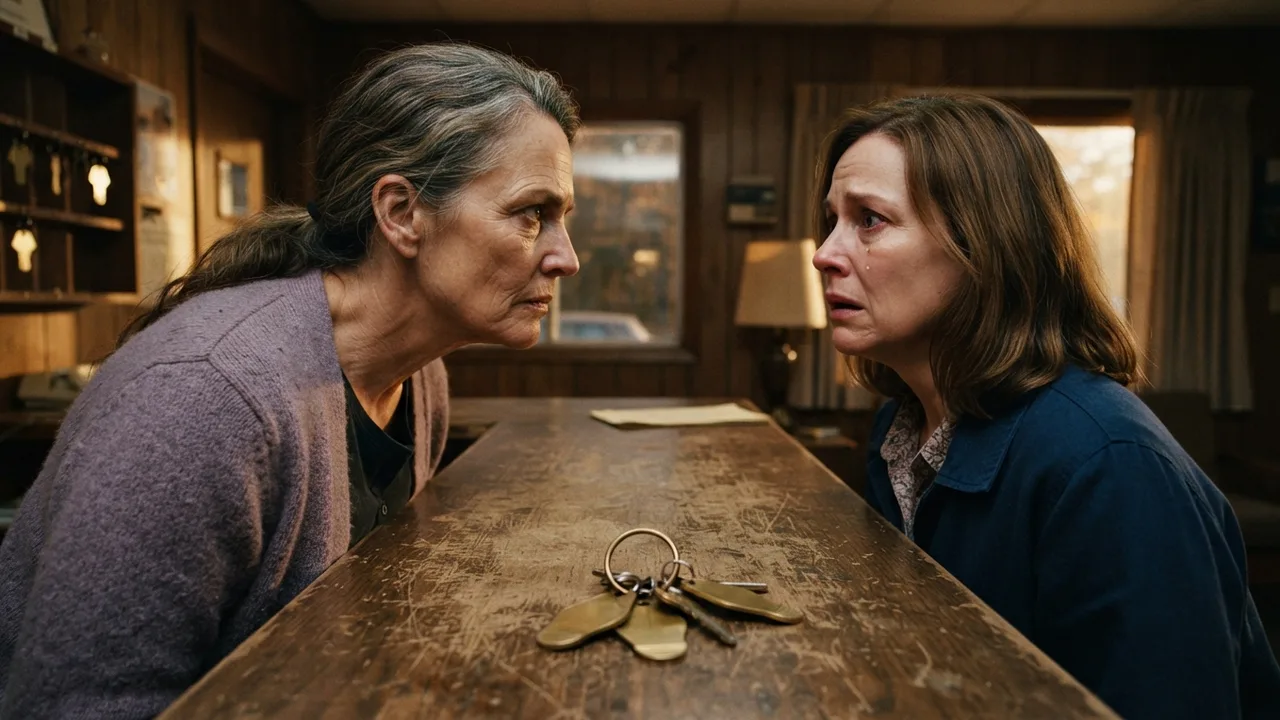
"He left the front gate unlocked all night, Jeanette," my sister said over the phone, her voice a careful blend of pity and panic. "Rick found it standing open at six this morning. We need to talk about selling the Cactus Wren before something worse happens."
I was in the break room at Verde Valley Medical Center at the end of a night shift, holding a coffee gone cold. Behind Monica I could hear the motel's ice machine rattling in the courtyard, a sound I had known since I was a girl.
"Dad has locked that gate at ten o'clock every night of my life," I said.
"Then he forgot. That's what forgetting is, Jeanette. Nobody's calling him a bad man."
"Nobody was calling him forgetful either, until you."
Advertisements
"I'm telling you what we saw." Her phone buzzed against something hard. She always had it in her hand. "We have to be proactive here. A listing agent can tell us what the place is worth, and then we can strategize about a good assisted living place in Prescott."
Dad was seventy-seven, lean as fence wire, and the week before he had corrected the county inspector about the date on a fire extinguisher tag. He was right, and the inspector checked.
"Let me talk to him," I said.
"He's embarrassed, so he won't say much. Rick is sitting with him right now. Being very gentle."
I put the cup down. A tremor had started in my thumb, and I held it with my other hand until it stopped.
A week later she called again, and this time she skipped the pity.
"Did you know about the Memorial Day block?" she said. "A whole block of rooms, booked online by a church group out of Mesa. Cancelled. Refunded automatically. The coordinator called Dad yesterday, and Dad had no idea."
"Cancelled by whom?"
"By Dad, Jeanette. His login. It happened the weekend we were there, and he never noticed. That's thousands of dollars on the biggest weekend of the season. A man who can't keep his own reservations can't run a business."
"Let me look at it."
"Look at what? It's irrefutable. I'm sending you the agent's number."
She hung up. I stayed at my kitchen table with the phone in my hand until it rang again, and this time it was my father.
Advertisements
It was ten to two in the morning, and he said four words. "Mija, I'm so sorry."
I drove the five minutes to the Cactus Wren with my scrubs still on under a cardigan. The neon sign over the gate buzzed pink against a black sky. The gate was locked, and I let myself in with my own key.
Dad was at the office desk with the lamp on and the laptop open. He had buttoned his pearl-snap shirt one snap off, so the collar rode crooked. He hadn't shaved. His hands lay on the desk like tools he had set down.
"Sit, Dad," I said. "Let me see your eyes."
"My eyes are fine." But he let me look. His pupils matched and he tracked my finger. He was tired and frightened, and neither of those is dementia.
"What day is it?" I asked, because he would want me to ask.
"Tuesday, now Wednesday. President's name is on the quarter in the till drawer, and I'm not senile." He rubbed his face. "But I cancelled those rooms, didn't I? The log says so."
"Show me the log."
He turned the laptop. The activity page listed every change to the reservations, each with a time stamp. I read down it slowly. The cancellations all sat in a row on Saturday night at 11:30. Two minutes later came another line: *Password changed.*
"Did you change your password that night?" I asked.
"I couldn't get in on Sunday. I thought I'd mistyped it. I reset it through my email." He swallowed. "I must have done it in my sleep. Or I'm worse than you all think."
"You were asleep at eleven-thirty?"
"I'm always asleep by ten."
"Then you didn't do it, and you didn't sleepwalk either. You haven't walked in your sleep since you were a boy."
He looked at me for a long moment. "Then who?"
I didn't have an answer. I had a question I didn't want to ask, and I put it away while I helped him find the cancellation emails and write to the church coordinator. We offered the group a free night each. Dad's hand shook on the keyboard, and I steadied the other side of the laptop without saying so.
Before I left, I opened Monica's old emails on my phone. Over six months she had sent me a running tally of each incident she called proof, and I had filed each one under *Monica being Monica*. There was the ice machine on Thanksgiving weekend. There was the credit card reader that kept glitching the weekend after Christmas, with guests lined up at the desk. Then came the vacancy sign dark all night, and then the gate left open, and the cancellations.
I checked the dates against her Facebook posts. She posted from every visit, always the same angle of the motel sign, always captioned *Daddy time.*
Every incident fell on a Saturday or Sunday. Every one fell on a weekend she and Rick were in town.
I sat in my car in the motel lot with the engine off. My stomach rolled, and I opened the door and breathed the dry night air until it settled. I was fifty-two years old, and I was checking my sister's vacation photos like a detective in a bad movie.
I wanted to be wrong. A nurse is trained to rule out the worst thing last, not first, and I had put it first.
The next evening I bought a spiral steno pad at Walgreens, the kind I used to carry on the floor, and I started a log. I wrote the dates in the left column and the problems in the right. My handwriting was small and neat, as if neatness could make the thing less ugly.
Monica's email came the following Monday.
*Hi Jeanette! Rick and I are driving in for Dad's 78th. I've also looped in Delia Fontaine, a commercial real estate agent out of Phoenix. She'll be at the motel Friday for a preliminary valuation. Please make sure Dad is available and cooperative. Let's be efficient about this! XO*
I called her at once, which I never do.
"You hired an agent without asking him?" I said.
"I'm asking you, Jeanette. You're the one who's there."
"I'm not letting a stranger measure his rooms the day before his birthday."
"What's the endgame, then? You keep him there until something actually happens to him?"
"The endgame is that he's fine."
"He's not fine! He cancelled his own holiday weekend!"
"He did not!" It came out of me loud enough that a cat on my fence bolted. My ears rang. I hadn't raised my voice at my sister since she was twelve and borrowed my car keys.
There was a silence, and then Monica said, in her coldest corporate voice, "I think you need to look at why you're so invested in this staying the same. I'll see you Saturday."
She hung up. I stood there with the phone against my chest, the way you hold something that's burned you. She had given me a deadline without meaning to, because Saturday was the party.
I let Delia Fontaine in on Friday. She was brisk and pleasant, with a tablet and a lanyard, and she measured the units while Dad stood in the doorway of Room 6 with his arms folded. He said nothing. When she asked about the roof, he told her the year of the last replacement, down to the contractor's name, and she wrote it down.
That night I opened the router. I had installed it a month earlier, after the vacancy sign went dark, because the old modem was a decade past its life and a tech at the Verizon store had said so. I hadn't thought of it as a trap. It logged every device that joined the office network, with names and times.
I scrolled to the Saturday of the cancellations. Dad's phone and desktop were listed as off after nine. At 11:28 PM, a device named *Rick's iPhone 17* connected to the office network, and it stayed on for fifteen minutes.
I printed the page and slid it into the back of the steno pad. Then I stayed in the kitchen with the lights off and wished, for the first time in my life, that I were somebody else's sister.
Saturday was clear and already hot, the first real heat of the year. The breakfast room at the Cactus Wren holds five small tables, a coffee urn, and one window that catches the morning on the east side. I tied six balloons to the chair backs, and Dad pretended not to notice them.
Monica arrived in white linen with her phone in her hand. Rick came behind her in a pale blue polo and a watch that caught the window light. He hugged my father with one arm and clapped him on the shoulder.
"Happy birthday, Hector. Seventy-eight, and still on his feet. Good for you."
"Still on my feet," Dad said.
We ate the cake, a half sheet from Fry's with HAPPY BIRTHDAY HECTOR in blue gel. Dad cut the corner piece for himself the way he always does, and Rick took the second one. Monica barely touched hers. She was watching Dad's hands.
When the plates were stacked, she reached into her tote and set a folder on the table beside the balloon ribbon. It was thick and cream-colored, with Delia Fontaine's name embossed in the corner.
"Daddy," she said, and her voice went soft in a way I had not heard in years. "We love you so much. You know that. You built this place with Mama, and none of us wants to take that from you."
Dad looked at the folder and didn't touch it.
"But we're scared," she said. "The gate. The reservations. We can't be here every weekend, and Jeanette can't be here every hour. If anything happened to you in one of these rooms, we'd never forgive ourselves. Selling now means you choose your future instead of someone choosing it for you."
Rick nodded gravely. "It's a tough conversation, but we have to have it."
Dad's shoulders had come down, and his chin with them. He stared at the little pile of crumbs on his plate as though he were already somewhere else. I had seen that look on patients in the minutes before they signed a form they didn't understand.
I waited until Monica finished. Then I took the steno pad from my bag and opened it to a page I had copied clean that morning. I laid it next to the realtor's folder, and I didn't say anything until she looked at it.
"What is this?" she said.
"Your last four visits are on the left. Thanksgiving weekend, the weekend after Christmas, Presidents' Day weekend, and the one three weeks ago." I tapped the first line and kept my hand off the rest. "On the right is what went wrong each time. The ice machine, the card reader, the vacancy sign, the unlocked gate, the cancelled rooms."
Rick picked up the page, read it, and laughed, an easy, pleasant sound.
"Wow, Jeannie. That's some coincidence."
"How dare you," Monica said. Her face had gone red under her makeup. "We come all this way to help, and you hand us a list like we're suspects? You're in denial, and now you're inventing conspiracies so you don't have to face facts. This is sick."
"Monica." It was Dad, barely above a whisper, and she didn't hear him.
I didn't look at her. I looked at Rick, who was still smiling, though the smile had started to hold on with effort.
"It's not a coincidence," I said. "The Memorial Day rooms were cancelled at 11:30 on Saturday night. Dad was asleep. The booking log shows the cancellations came through the motel's office network."
Rick set the page down. "Anyone could get into that network."
"I put a new router in last month." I turned to my father. "Dad, it keeps a list of every device that connects. Your phone and your computer were off that night. A new device named *Rick's iPhone 17* joined the office network at 11:28 and stayed on for fifteen minutes."
The balloons knocked softly against one another in the draft from the door.
"The booking system password was changed two minutes after the cancellations," I said. "Dad thought he'd done it in his sleep. He's been apologizing to everyone for a week."
Rick's smile was gone. His color went with it, from the neck up, like a glass draining.
"That's my phone's name," he said. "Anyone can name a phone."
"Then show me your phone, Rick."
He didn't move. Monica looked at me, then at him, and her mouth opened and closed.
My father stood up. He took his time about it, one hand on the table, the way he does now when his knees remind him. He looked at Rick for a long moment, and there was no anger in it, only a kind of tired grief, like a man looking at a fence post he'd trusted and found hollow.
"My password is my wife's name," he said. His voice was thick. "Lucia. You knew that. I told you at the kitchen table when you asked me how I kept it all straight."
Rick said nothing.
Dad turned to Monica. "He did this."
It wasn't a question, and Monica seemed to know it. She stared at her husband's face. I watched her work back through the weekends in her head, the sign, the card reader, the open gate, and I watched each one land. She didn't make a sound. Tears ran down her face, and she didn't wipe them.
Dad lifted a hand and pointed at the door. It was steady, and it was the hand of a man who had poured a foundation with it.
"Get out of my house, Rick. Now."
Rick picked up his keys from the table. His watch caught the window light once more, and then he walked out into the heat without looking at anyone.
Dad's eyes went to my sister. "You too, mija. For today, you need to go."
"Daddy—"
"Today."
Monica stood. She picked up her tote and her phone and, after a moment, left the folder where it lay. At the door she turned and looked at me, and I held her gaze. She was my little sister, and I had never seen her look like that, as if I were someone she'd never met.
Neither of us spoke. The door shut, and then I heard the gate rattle in the parking lot and an engine start.
Dad crossed the room and picked up Delia Fontaine's cream-colored folder. He weighed it in his hand and carried it behind the counter. Then he dropped it into the wastebasket under the coffee station, where it landed on a pile of used napkins.
"Let's clean up," he said.
We took down the balloons one by one. I untied the ribbons and he popped two of them, the first with his thumb and the second with a fork, and neither of us laughed. I carried the half cake to the refrigerator in the office and wrapped it with foil.
Monica had called me every Sunday for years. Her name wouldn't come up on my phone tomorrow, and I knew it the way I know a rhythm on a monitor. I had been right, and I would have traded it all to be wrong.
That evening I sat in the office with Dad while he went through the day's receipts. He did them by hand, the way he always had, with a pencil behind his ear. I ran the tape on the old adding machine and stacked the slips for him.
"You should call her," he said, without looking up. "Not tonight."
"I know."
"She isn't a bad girl."
"I know that too, Dad."
He nodded and licked his thumb and turned a page. The window beside the desk had gone the soft blue of the high desert at dusk, and the first moths were working at the glass. I put the adding machine tape down and looked out.
Across the lot, the old neon sign over the front gate was buzzing softly. Its pink light had come on by itself, as it does every evening. It held steady over the locked gate, and under it the dust settled on the empty road.

Comments