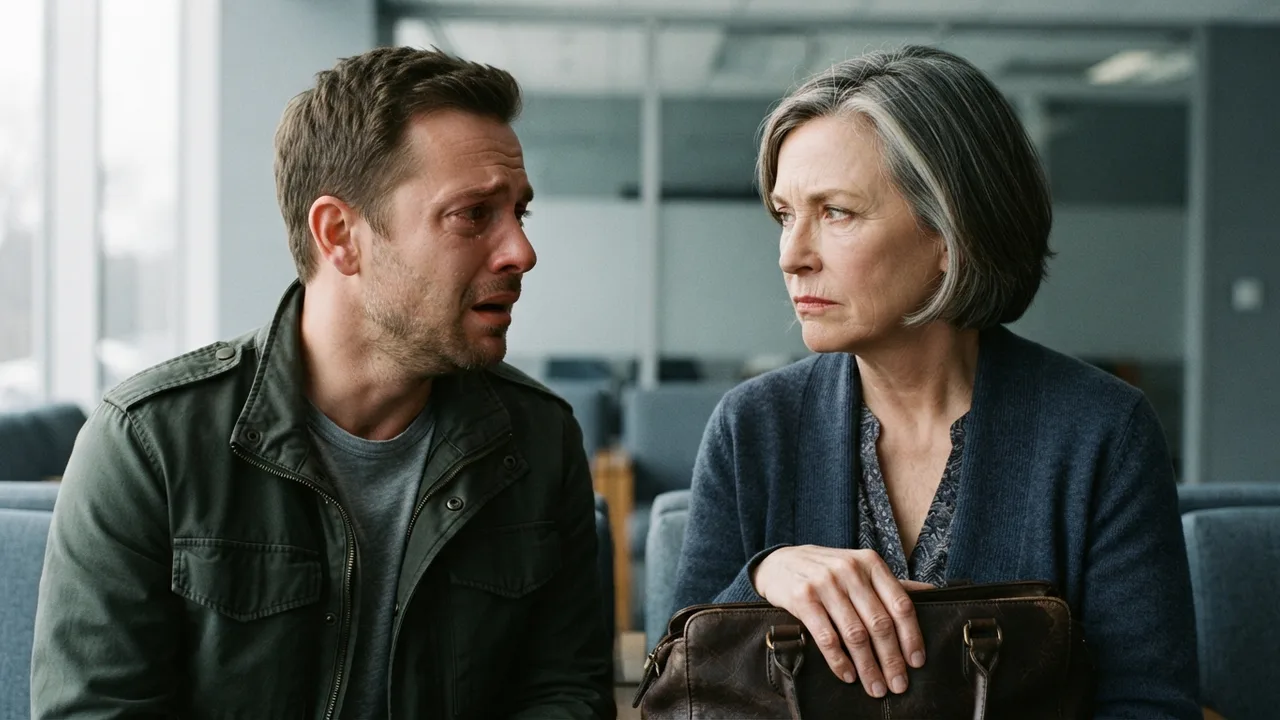
My husband kept a shoebox of letters from his college roommate, or so I thought, until I found the carbon copies of cash withdrawal slips tucked between them, dating back twenty-five years. Three months after Richard's funeral, my sons wanted me to sign over control of my money, and I had just found where most of it went.
I found the slips on a Thursday. By Saturday morning I had them sorted by year and rubber-banded, and the adding machine from my carrier days was plugged in on the kitchen table.
Jonah's SUV pulled in first, then Andrew's little hatchback. I watched from the window as they stood in the driveway and talked before they came up the steps. They did not look like men visiting their mother. They looked like men who had agreed on a plan.
Advertisements
"Mom." Andrew hugged me. He carried a key lime pie from Publix, still in its plastic dome. "You look tired."
"I look sixty-seven," I said. "Come in. It's already hot."
Jonah kept his phone in his hand all the way to the table. He wore a pressed shirt and loafers in Osprey Landing in May, and the sweat was already coming through at his collar.
"We want to talk about the accounts," he said. "Gently, Mom. We know it's been hard."
"Good, because I want to talk about them too."
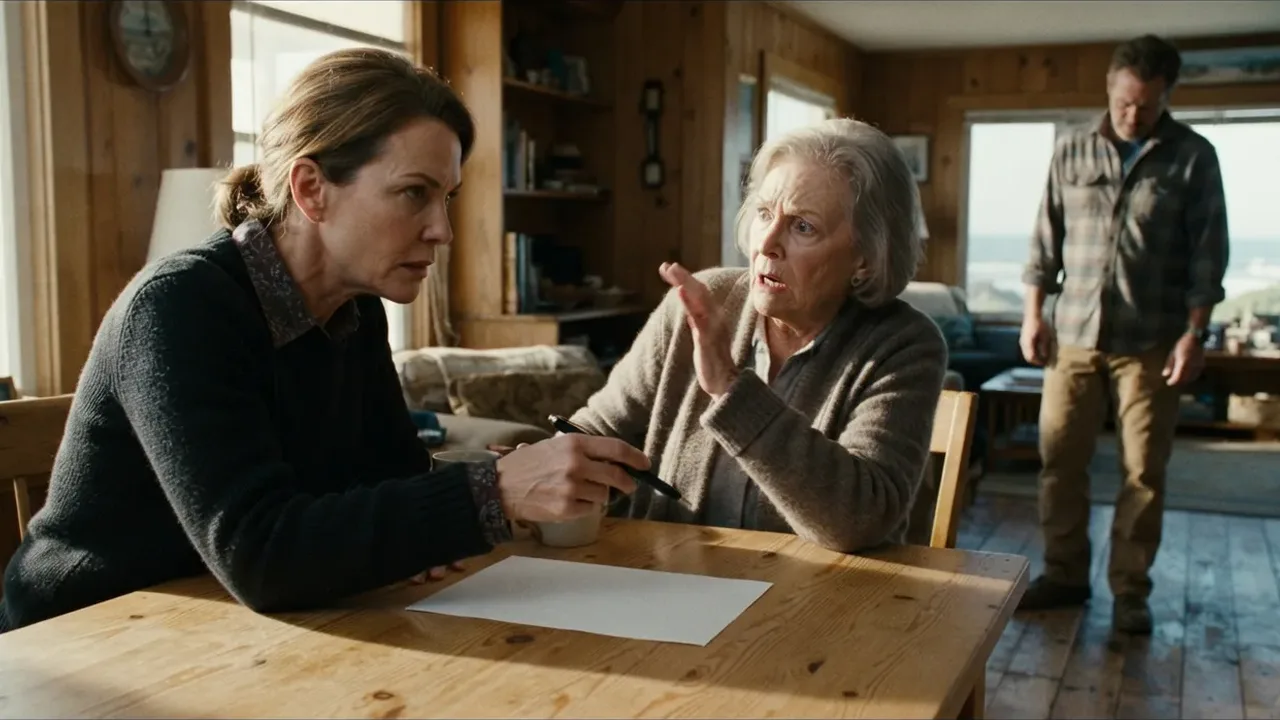
I pushed the adding machine tape across the table. It was a long curl of paper, and I had circled the total in pencil.
"Your father took cash out of the credit union every few weeks for twenty-five years," I said. "Two hundred here, three hundred there. I put them in order. It comes to over three hundred thousand dollars."
Jonah looked at the tape. He did not pick it up.
"That's the retirement money," I said. "Your father told us the market ate it. The market doesn't hand a man cash across a counter."
"Mom." He used the patient voice, the one he used on clients. "Dad had a cash habit. Fishing gear, the boat motor he never finished, whatever he did on Tuesdays. A lot of men his age keep a private budget."
"For twenty-five years? On a mail carrier's pension and a county clerk's salary?"
Advertisements
He straightened his cuff before he answered.
"The portfolio was concentrated and illiquid. I saw the statements. Cash withdrawals don't change that."
Andrew cut a slice of pie and set it in front of me like a peace offering. "Mom, maybe it's both. Some losses, some spending. Does it matter now?"
"It matters to me."
Jonah exhaled through his nose and glanced at his brother. It was a quick look, the kind passed between two people who already had a word for me.
"This is what we're worried about," he said. "You're up at night with a calculator. Nobody did anything to you. Dad made bad decisions and he was ashamed. Let it rest."
I picked up the tape and folded it along its creases. My hands were steady. My face was not, and I let them see that, which I regretted.
After they left for the motel on Highway 21, I sat in the dark kitchen and listened to the refrigerator. They would not stay with me. They had booked rooms before they ever called.
That night I heard Jonah on the porch with Andrew, talking low. I caught "evaluation," and I caught "before it gets worse." They had stopped hiding it from me and started hiding it from each other's faces.
Monday I went back to the old checks.
Richard had written them in the first years of our marriage's second half, and I had kept the register boxes in the hall closet. Most of the early ones were ordinary. A few had the same word on the memo line in his square engineering hand. *Hobbs.* Sometimes *Hobbs, parts*. Once only *H.* The oldest check had a clipping folded behind it from the Island Packet, and I put it aside as one of the things Richard saved.
I knew that name from the route. I had carried mail to that house for nearly all my thirty years: gravel drive, a mailbox with a pelican painted on it, a man who left the flag up for me on rainy days and never said a word.
Nate Hobbs ran a repair shop out past the tidal creek. I drove there with the windows down because the car's air conditioning had quit in April and I hadn't had it fixed.
The shop was a tin-roofed shed beside a house with a tarp on one corner. Nate came out of the bay wiping his hands on a rag. He was gray and wiry now, but I knew the walk.
"Mrs. Keating," he said. He did not say sorry for your loss.
"Mr. Hobbs. I'm going through Richard's papers. Your name is on some old checks."
"I fixed his truck now and then." He folded the rag into a square and set it on a fender.
"The memo says parts, but there are no receipts."
I waited. He picked a bolt off the fender and turned it over.
"Some of the checks were only for round numbers."
"I don't recall." He looked past me at my car. "Lots of people owe me. Lots of people paid me."
"Did Richard owe you?"
A truck went by on the blacktop, and he waited for it to pass.
"Ma'am, I knew your husband to wave at. That's all I knew him." He stepped back into the bay. "I got a job on the lift."
"Nate."
"Go home, Mrs. Keating."
The door of the shed rolled down. I stood in the gravel and heard the latch drop, and my knees were not right for a minute. I drove home gripping the wheel and checking the mirror at every turn, although nobody followed me.
I had picked the one person on my old route who had never once been rude to me, and he had shut me out like a salesman. A man who only waved at Richard did not need that much time to decide to lie.
By Wednesday my neighbor Bernice Odom was on the phone to Jonah. She told him she'd seen me drive out to Hobbs's place and come back gray in the face. She'd heard, from her cousin who lived near there, that I was "pestering" the man.
Jonah called me at six that evening.
"Mom, I've scheduled an appointment with Mr. Fenwick. Friday morning at ten. Andrew's driving down tonight."
"Fenwick drew up your father's will."
"Right. That's why he's the one to do this. A power of attorney, so we can take care of the accounts and you don't have to carry it."
"I've carried it a long time."
The kettle had started to tick on the stove, and I moved it off the burner.
"You went to that man's shop alone. What if he'd been dangerous? What if you'd hurt yourself, or somebody else?" He stopped, and I heard him breathe. "We have to act, Mom. We have to do it before something happens."
"You're not asking me."
"I'm telling you because I love you."
I hung up before I said what I thought. I stood at the counter with the receiver still in my hand, and then I put it back in its cradle.
Then I went and got the register boxes again, because I wanted to see the last one.
I had been over the slips so many times my fingertips knew the paper. But I had never laid out the last year, month by month, the way I used to lay out a route sheet. The slips came steady, every few weeks, never missing. They did not stop gradually. They stopped in the month Richard died.
No withdrawal after the funeral. No withdrawal in the weeks his heart was failing, either, because he'd been in the hospital in Beaufort then and I had been the one carrying the checkbook. I sat down on the hall floor.
Somebody had been waiting on those envelopes. Somebody had been counting on them like a pension. And somebody, three months back, had stopped getting them, and had spent every day since wondering when I would come asking.
That was why Nate had shut the door so fast. He wasn't hiding from me. He was frightened.
I went out to his place again on Thursday afternoon. This time I took my checkbook and no questions.
He was in the yard with a carburetor in a coffee can of solvent. He saw me and did not go for the door.
"I told you I got nothing to say."
"I'm not here to ask you anything," I said. "Listen, Nate. My sons are about to take over everything. Tomorrow morning at ten, a lawyer in town is drawing up the papers. After that, somebody will audit every account Richard had, back to the first year. They'll find where the cash went. They'll find your name on the checks. And they won't be gentle, because they'll have no idea what they're looking at."
He wiped his hands for a long time. "I never asked him for nothing he didn't give."
"I'm not interested in that. I want one thing from you, and I'll pay for it."
"What thing?"
He lifted the carburetor out of the can and set it on a stump to drip.
"Come to the lawyer's office tomorrow and say it out loud in front of my sons. Whatever it is. All of it. In return I'll write you a check for five thousand dollars, and nothing more will come out of it from me."
He eyed the checkbook as if it might bite. "Five thousand."
"That's the last payment you'll get from this family."
"And if I say no?"
"Then it comes out the other way. The slow way, with strangers and paperwork. You're sixty-nine, Nate. You won't like it."
He spat to one side of the gravel. "Ten o'clock?"
"Come at a quarter till. Wait in the lobby until I call for you."
I did not sleep that night. The five thousand came out of the eighty that was left, and the eighty was what stood between me and a life of asking my sons for grocery money. I lay in the dark and listened to the tree frogs and told myself I had trusted worse men than Nate Hobbs, because I had.
The lobby of Hollis Fenwick's building smelled of carpet cleaner, and the conference room on the second floor was cold enough that I was glad of my cardigan. A long table, a pitcher of water sweating onto a coaster, a pad of yellow paper at every seat. Through the window I could see the Beaufort County courthouse flag hanging dead in the heat.
Nate sat downstairs on a vinyl chair with his cap in his hands. He wore a clean white shirt buttoned to the neck, and I could see where he'd cut himself shaving.
Upstairs, Jonah took the seat across from mine. Andrew took the one at the end and kept looking at the table.
"Thank you for coming, Lenora," Mr. Fenwick said. He had known me since Richard bought the house. "I know this isn't easy."
"No, it isn't."
Jonah squared a folder in front of him. He did not need notes. He had been rehearsing in the mirror of his motel room.
"What we're asking for is simple," he said. "Since Dad passed, Mom's been fixated on the idea that the retirement money was taken. She's done her own tally, driven out to a man's shop twice, and she's made accusations. Our neighbor says Mom was upset when she came home."
"Bernice Odom is not your neighbor," I said. "You live in Atlanta."
Jonah ignored it. "I'm not saying Mom is a danger. I'm saying she's grieving, and the grief has her seeing a story that isn't there. If she signs, she gets to rest. We handle the bills and the taxes. She keeps her home."
Mr. Fenwick nodded slowly, with the sympathy of a man who has seen it all before. He slid the papers across the polished wood toward me, and the pen sat on top of them like a paperweight.
"Just here, Lenora. And here."
I put my hand up, palm out, the way I used to stop traffic at a rural crossing.
"Before I sign anything, I'm going to tell you where the money went."
"Mom, we've been through this," Jonah said.
"Not the whole of it."
I took the clipping out of my purse. It had gone soft and yellow along the folds, and I smoothed it on the table between the water pitcher and the pen.
"October of 2001," I said. "A girl named Wendy Teague, nineteen, walking home from her shift at the Piggly Wiggly. Struck at Hemlock and River Road. The driver left her there and was never found."
Jonah looked at it and did not touch it. Mr. Fenwick leaned over to read it upside down.
"I found this folded behind the first check your father wrote to Nate Hobbs," I said. "That check is dated the Monday after. So is the first cash slip. There's nothing like either one in the register before it."
Jonah sat back. "A news story and two dates. Dad drove a Buick, Mom, and so did half of Beaufort County. You've been up nights with a calculator, and now you're building a crime out of a clipping."
"Andrew," I said. "What did your father tell you was wrong with the front of that Buick?"
Andrew's head came up. "A deer. He wouldn't let me go look at it."
"Nate Hobbs fixed it that Monday," I said. "I think he was at that corner on Friday night, and I think he watched Richard drive away. Richard paid him every few weeks after that, and the payments stopped the month he died."
Jonah's chair creaked as he leaned in.
"You paid that man," he said. "He'll say whatever you want. This is exactly what we were afraid of."
"I offered him five thousand dollars to tell the truth in this room. I'm telling you so you don't have to find it out. I haven't told him what to say. I'll ask, and you can listen."
I nodded to the secretary, and she opened the door. Nate came in with his cap crushed in his fist and stopped at the end of the table. He looked at the carpet.
"Nate. Did Richard bring you his Buick that Monday, with the front end pushed in?"
"Yes, ma'am. Said he hit a deer."
He turned the cap a full circle in his hands.
"Were you at Hemlock and River Road the Friday night before?"
"I was. Coming off a tow."
Nate wet his lips. Jonah stared at him, and I waited.
"Did you see Richard hit that girl and drive away?"
"I did." He looked at the clipping, not at any of us. "Every few weeks after, he paid me. Cash, mostly. Till he died."
Andrew put his head down on his folded arms. His shoulders shook, and the only other sound in that cold room was the air handler ticking in the ceiling.
Jonah's face had gone gray. "Dad's dead, Mom," he said. "What does anybody get out of this now?"
"Wendy Teague gets something. She was nineteen and walking home, and your father stood over her and left. I don't know where she is. I'm going to find out, and what we owe her comes out of what's left. Out of the house too, if it comes to that."
"That's our inheritance."
"Your father already spent it. He just did it a few hundred dollars at a time."
He had no answer for that. I turned to Mr. Fenwick, picked up the unsigned papers, squared them and handed them across the table.
"We won't be needing these today, Hollis."
"No," he said. "I don't suppose we will."
I looked at my sons. "I'll be managing my own affairs. All of them. Jonah, you told a lawyer I was confused before you asked me one question. I want you to remember that."
He nodded. His mouth worked, and no words came.
I stood and took my purse. "Nate. Downstairs, please. I'll bring your check."
In the lobby, under the fluorescent lights, I wrote it out on my knee: five thousand dollars, in my own hand, with my own pen. Nate took it and folded it once and put it in his shirt pocket without looking at the number.
"He wasn't a bad man," he said. "Mostly."
"Don't," I said.
He put his cap on and went out into the heat.
Jonah and Andrew drove behind me as far as the Piggly Wiggly and then turned off toward the motel. Neither one called that evening. I did not call them, either.
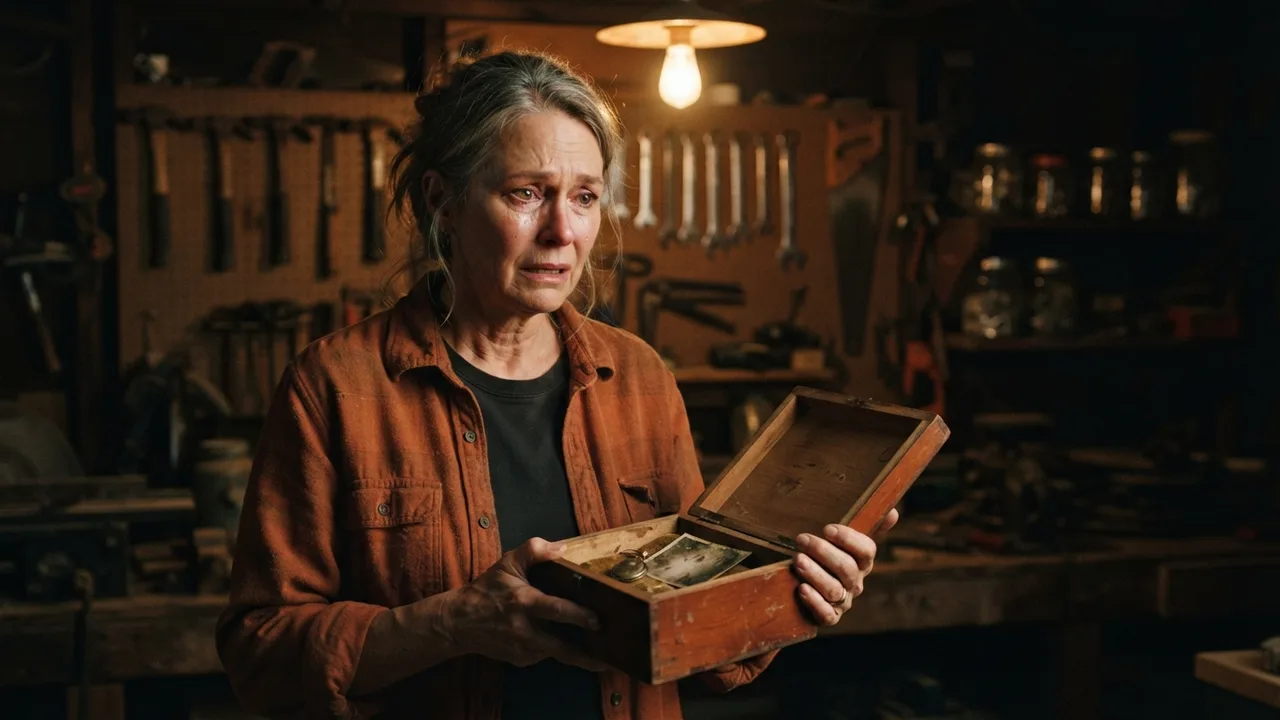
At home I stood in the kitchen with the lights off for a while. I propped the clipping against the sugar bowl, where I would see it in the morning. Then I took the shoebox down from the top shelf of the hall closet, with Richard's roommate's letters and the rubber-banded slips, and carried it out the back door in my bare feet.
The grass was still warm. Tomorrow was pickup. I lifted the lid of the green bin at the curb and set the shoebox down on top of the kitchen bags and let the lid fall shut.

Comments