The day my lilies wilted hours after delivery, my new boyfriend's son told his father I was getting careless in my old age. He said it kindly, over August's good coffee, while I sat right there with a mug in my hands. Three hundred dollars of lilies had gone limp on a client's dining table, and the Frye wedding, eight thousand dollars and the best booking of my season, needed a florist people trusted.
"I just worry about her, Dad," Elijah said. "She's got the shop, the market orders, the Frye wedding. Getting careless at her age is how people end up in real trouble."
He wore his pruners in a leather holster on his belt, even at his father's kitchen table.
"Ros isn't careless," August said. He looked at me over his reading glasses a beat longer than the sentence needed.
Advertisements
"The lilies were my doing," I said. "I loaded them at noon, ran the van with the vents shut, and took the long way up the hill. They cooked. I've already replaced them."
"That's honest," Elijah said. "That's all I'm saying. A person has to ask when she's stretched too thin." He smiled at me, and I smiled back, the way I smile at a bride's mother who wants peonies in October.
I had run Dogwood & Fern for twenty-five years and been a widow for five. For six months I had been seeing August Bellows, a retired history professor who once compared my Saturday rush to the Oklahoma Land Run and then carried my buckets anyway. He was the one who sent Melinda Frye through my door.
At Easter dinner Elijah had tapped his glass and announced he'd planted six hellebores along his father's porch steps, a curated shade palette, his gift. August patted his arm. I thought only that they were the wrong kind for that much sun, and I passed the rolls.
That night I lay awake going through the loading of that van, stem by stem. The three hundred dollars stung less than the look in August's eyes.
On Friday, April 17, Elijah came into the shop for a fern his father wanted. I was at the counter with Dottie Oyler, who needed two dozen carnations for a church luncheon and had opinions about every one.
Advertisements
"Mind if I wait in back?" Elijah called. "Dad says you keep the good ferns by the workroom window."
"Help yourself," I said, and went back to Dottie's carnations.
He was in there about ten minutes. When I finally carried the fern out to him, he was standing at the workbench with his hands in his jacket pockets, looking at nothing.
"Great setup," he said. "Really organized. Tell Dad I said hi."
After he left, I went to the buckets for that morning's garden roses. Five hundred dollars' worth, soft and fat and the color of peach flesh. Every head had a brown crescent pressed into the outer petals, as if someone had pinched each one to test it.
I stood there with a rose in my hand and my mind went through the cooler thermostat, the delivery driver, my own two hands. I could not find the mistake, and that frightened me more than the loss.
August called that evening.
"I heard about the roses," he said. "Dottie Oyler called after. She said you seemed rattled."
"I wasn't rattled until I saw them."
"Ros." His voice went gentle, the voice he used on freshman essays. "You've taken on a great deal. I only wonder if the Frye wedding is more than one shop should carry alone."
"I'm not slipping, August."
"I never said slipping." He let that sit. "I only said tired."
I hung up and held the phone in my lap. For the first time in twenty-five years I wondered whether the person in the mirror still knew her trade.
On Saturday I drove the three sample centerpieces to Fayetteville, an hour west. I had packed them Thursday night, taped the boxes myself, and set them in the cooler. I never thought to open them again.
Melinda met me in her kitchen with the fat white binder already out. She lifted the first lid and stopped.
The hellebores lay slumped over the rim of the vase, brown at the edges, heads down like they'd been dry for a week. She opened the second box. The third.
"I just need to know," Melinda said. "Is this what May looks like?"
"No. These were fine when I packed them."
"Rosalind, I like you. Everyone says you're the best. But the next mistake ends the contract." She closed the lid very gently, as if the flowers could still feel it. "I'm sorry."
I drove home on Highway 62 with three dead centerpieces on the back seat and the air conditioner roaring. From a gas station lot I called my grower, who had a truck coming through Eureka Springs that evening. The new stems cost me three hundred dollars with the rush fee, and I didn't argue with a cent of it.
August phoned while I was rebuilding the samples.
"Eli thinks you should step back from the Frye wedding," he said. "He's brought it up twice today. I told him it's your decision."
"Do you think I should?"
"I think you need a night's sleep," he said, which was not an answer.
I never got the sleep. Near midnight I carried the old samples to the workbench to strip them for the compost, and I picked up one stem to snap it and then didn't.
It was a single. I had ordered doubles, green-white, full as a ruffled collar. This one was speckled maroon, five petals and a center crowded with yellow stamens, and the pollen on them was still fresh.
Fresh pollen meant young. A hellebore cut that early has not hardened, and it will collapse inside a day however you treat it. My grower cuts them mature and sears the base, and ships them in clean water.
I turned the stem under the work lamp. One side of the base was mashed flat. A knife slices; pruners with an anvil blade crush.
In the angle where a leaf met the stem sat a few grains of potting grit and a blue bead the size of a pinhead. I found a second bead in another stem. Slow-release fertilizer, the kind that comes already mixed into a nursery pot.
Wholesale cut flowers never touch a pot. Somebody had pulled my eighteen stems out of those boxes and put these in, and I knew who had stood at his father's porch steps in front of the whole family and told us what he'd planted.
I put the eighteen stems in a mason jar and sat on my stool until the window turned gray.
On Sunday morning August was at early service. I had his gate key, the one he'd pressed into my palm in March, grinning like a boy. I drove to his house and let myself in the side gate.
The porch bed ran along the steps. Six plants, speckled maroon, set in a row. Plastic tags still stuck in the soil, and one read $14.98. Blue beads lay scattered on top of the dirt like confetti.
Every flowering stem was gone. I counted the stubs with a finger, careful not to touch. Eighteen, cut clean on a slant, and callused over a few days.
I knelt there with my knees in the mulch, and I hated myself a little. I had used his trust to go through his yard behind his back, and I was going to have to say so out loud.
August had invited Melinda to Sunday dinner at his house that afternoon, so she could hear in person that her wedding was in good hands. He'd set the table by the front windows. Through the glass I could see the porch steps and the bed.
Melinda sat with her binder beside her plate. August had made Helen's chess pie from the recipe card, and the room smelled of butter and coffee. Elijah took the chair across from me, pruners in their holster.
"Melinda, I say this with respect," Elijah said over pie. "A wedding that size, Fayetteville has shops with a full staff. Rosalind's a sweet woman, but things keep going wrong. Why not hand it off before something else does?"
Melinda looked down at her binder and didn't say anything.
I let him finish. Then I reached under my chair and set the mason jar on the white tablecloth.
"I can't prove what happened to my roses," I said, "so I won't talk about the roses. I'll only talk about these."
Elijah's fork stopped.
"These are the eighteen stems from Melinda's samples," I said. "I ordered green-white doubles from my grower at nine dollars a stem. These are single, speckled maroon. They were cut before they were ready, which is why they collapsed. And they were crushed by pruners. A florist uses a knife."
I tipped a stem toward the light.
"See the grit in the leaf joint? And the blue bead? Cut stems from a wholesale farm never touch a pot. These came off potted plants. Would you all step out to the porch with me?"
Nobody moved for a moment. Then August stood, and the rest followed. He carried his napkin out without noticing.
Elijah laughed on the porch steps. "Half the county grows these. You could have bought them anywhere."
I crouched and nudged one plastic tag upright with a fingertip. "Those are your tags in the soil," I said. "Your beads on top."
"Deer got the blooms, then." He shoved his hands into his pockets. "Or Dad cut some for the table."
"Deer tear a stem and leave it ragged." I knelt at the bed and pointed. "These were cut clean with a blade."
"Dad." Elijah turned his shoulders to his father. "She must have gone into your yard while you were at church. She's digging through your garden to blame me for her own mess. Doesn't that scare you?"
I didn't flinch. "I used the key this morning," I said. "I'm not proud of it. But I'd do the same to find out who put my name in the dirt."
Then I turned to August. "Have you ever cut flowers from this garden?"
"No." He shook his head slowly. "That was always Helen's job."
I held one dead stem against a stub in the bed. The cut ends matched like the halves of a torn bill.
"You told us at Easter you bought these six plants and put them in for your father," I said. "There were eighteen stems on them. There are eighteen in that jar, with your potting mix still in the leaves. My grower doesn't sell this flower. Nobody else at this table buys plants at a store and puts them in the ground, and nobody else was alone with my boxes on Friday."
I faced Melinda. "I can show you the invoice for the doubles I actually ordered. It's on my phone."
Melinda looked from the jar to the bed to Elijah. August folded his napkin once and set it on the porch rail.
Elijah's mouth opened and nothing useful came out of it. He had no account left that fit his own tags, his own words, his own soil.
"She'd be living here by Christmas," he said at last, quieter. "You'd stop helping me, Dad. You know you would."
"Inside," August said.
We sat back down at the cooling pie. August took off his reading glasses and rubbed the bridge of his nose.
"The two thousand dollars a month ends today," he said. He didn't raise his voice. "You'll pay Rosalind back tonight for those hellebores. Three hundred."
Elijah stared at him. Then he pulled a checkbook from his jacket, wrote the check on the tablecloth, and slid it across to me. His hand shook on the pen.
"I'll cover the lilies and the roses too," August said, reaching for his wallet. "Another eight hundred. That's only right, Ros."
"No," I said. "The lilies were my own mistake with the heat. And I won't take money for roses I can't prove."
Melinda closed her binder with a snap.
"The contract stands for May sixteenth," she said. "And I'll pay the balance to Rosalind directly, from now on." She looked at me, and her nerves were gone. "I just needed to know."
Elijah stood. He left his jacket on the back of the chair and went out through the front door without it. The screen door slapped shut behind him.
August walked me to the porch. The afternoon had gone warm and still, the way Ozark Aprils do, and the dogwoods along his drive were in full white.
"He's still my son, Ros," he said.
"I know that."
He looked down the drive at the dogwoods, not at me. "I know you do."
"I won't come to Sunday dinners for a while," I said. "I think that's fair to both of you."
He nodded. His hands hung at his sides.
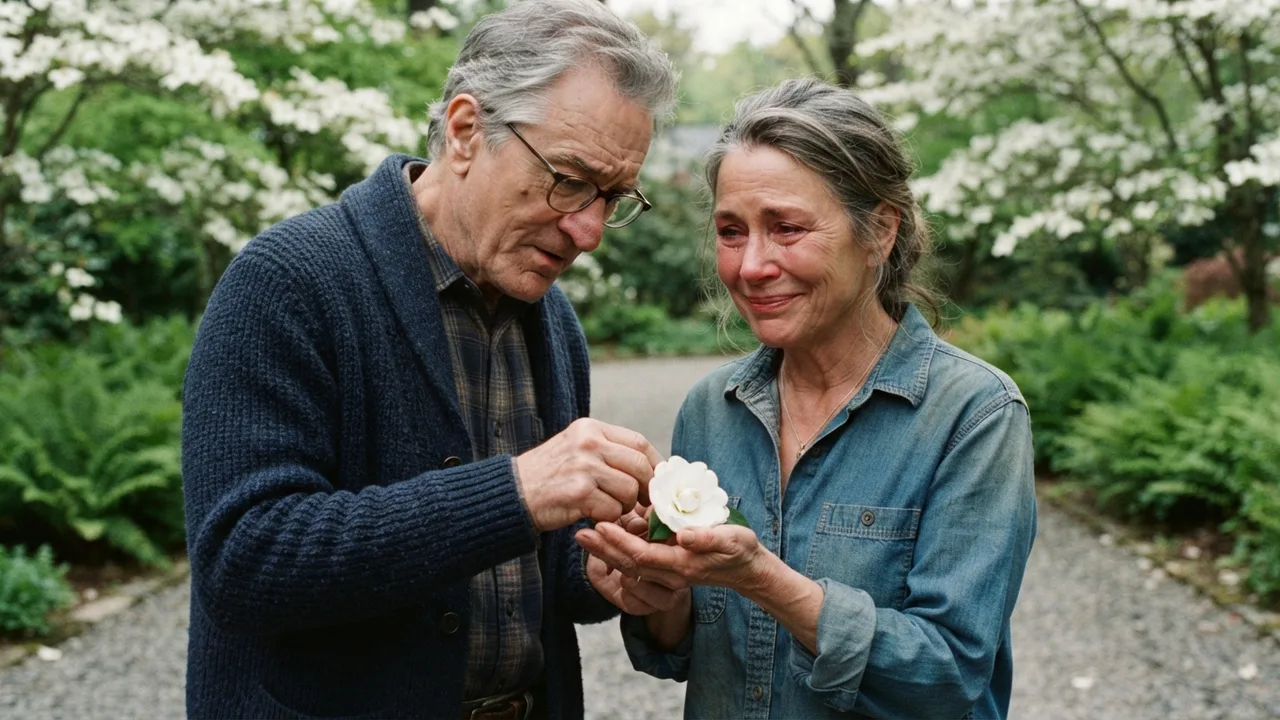
At my car I fished for my keys, and August walked to the camellia bush by the driveway. He took out a pocketknife, found a perfect white bloom, and cut it clean on a slant. He laid it in my hand without a word.
In all the months I'd known him, it was the first flower he had ever cut from his own garden.
I held it on the drive home with the window down. All I could think about was the lilies in the back of the van that day, going soft in the heat while I wasn't looking.


Comments