"It's just... another three thousand dollars for 'groceries' this month, Vivian," his daughter said, her voice laced with a sweet sort of poison.
Amelia slid Harvey's bank statement across his kitchen island until it stopped against the dish of roasted squash I had carried in from my car. Harvey studied his coffee. In a town this size, a caterer whispered about as the reason a good man's savings are running low does not get called again.
"I haven't billed Harvey anywhere near that," I said.
"Oh, I'm not saying you did." Amelia lifted the foil from my squash, sniffed, and set it back with the care of someone handling evidence. "I'm saying somebody in this house is eating very well."
Her yellow handbag sat on the next stool, and when she shifted it a cream card slid out of the flap. She pushed it back with one finger, but I had already read the gold lettering: Evermore Floral Design, and a date written beneath it in pen.
Advertisements
That was the first Friday of the autumn, and it was not the worst of what she did.
I was widowed five years ago, and for most of that time my kitchen was the only room I could stand to be in. Then Harvey Allerton hired me to cook for a retirement party, tasted my brown butter sage squash, and asked me, quite seriously, whether he could have the recipe or the cook.
We had been together eight months by then. He was a retired architect with kind eyes, a closet of well-made sweaters, and a modern house of glass and slate that sat a ten-minute drive from my cottage on its side road off Route 7A. I liked how he listened. I liked how he said thank you to the person who cleared his plate.
His daughter, who drove out from Boston most weekends, did not say thank you to anyone.
Amelia was thirty-five, polished from her part to her boots, and she carried a handbag the pale yellow of fresh butter. Her compliments always had a hook in the middle. "How brave, serving fish to a man with a delicate stomach." "That's so *rustic*."
Her questions were accusations in good shoes.
The olive oil came a few weeks before the statement. I had set out a bottle of the grassy, peppery oil I buy from a small grower and use for finishing, the kind where you taste the tree. Amelia picked it up by the neck and held the label to the light.
Advertisements
"Wow," she said. "This must have cost a fortune."
"Twenty-six dollars," I said. "It lasts a long while."
"Twenty-six. For oil." She laughed lightly and looked at her father. "Dad, did you know that?"
"It's wonderful oil, sweetheart," Harvey said, and went back to his newspaper.
That was all it took. The next week I stood in the Hannaford on Depot Street with the grower's bottle in my hand and put it back. I bought the store brand, a pale, flat oil with no pepper in it, and I felt Amelia's eyes on my back though she was in Boston.
My vinaigrette went dull. My lamb sauce lost its backbone. I cooked for a living and I was cooking apologetically in a kitchen I knew better than my own hands.
Then Amelia offered to help. She said she could find better deals, that I was too busy to compare prices, and Harvey handed her a credit card tied to his main account for what he called household errands. She began doing the shopping herself, in Boston, online, on errand days I knew nothing about.
The totals should have dropped. They climbed.
Harvey brought the statements to my cottage one evening in a manila folder. We sat at my worktable, where I do my invoices, and he laid the pages out like blueprints. His finger rested beside the word *groceries*, then *supplies*, then *household goods*.
"I don't understand it, Viv," he said gently. "Amelia says the specialty items are what's driving it. The lamb. The cheeses."
"My lamb comes from a farm in Dorset, Harvey, and I bill you for it by the pound, to the penny."
"I know you do." He rubbed the bridge of his nose. "Could you try to be a little more frugal? For me. Just until we get a handle on it."
I looked at his hands, which had drawn staircases that seemed to float, and at the folder, and I understood that he had already decided what the numbers meant, because the other answer was too painful to hold.
"All right," I said. "May I keep copies of these?"
"Of course. Whatever helps."
It helped more than he knew. I made the copies at the Staples on Main Street the next morning and brought them home to the same worktable where I'd printed every invoice I had ever sent him, each one itemized, each one dated to the day of the delivery.
I laid them side by side and found something. One line held my eye longest, a charge to Evermore Floral Design, a name I had last seen in gold on a card going back into a yellow handbag. I did not say a word about it to anyone.
Then Harvey's birthday came near. He would be sixty-two, and I planned a small dinner for him with two other couples, the people he laughed hardest with. I wrote the menu on a Sunday and it was the first happy thing I had made in weeks.
Four days later Sarah called me. She is Harvey's oldest friend's wife, a retired schoolteacher with a laugh like a screen door.
"Vivian, I just got off the phone with Amelia," she said. "She says you're not feeling up to it, and Harvey needs to cut back on expenses."
I sat down on my stool. "I'm perfectly well."
"I thought so. You sound like you could stack firewood." A pause. "Two of the other guests already begged off. Is he really in trouble?"
"Ask him," I said. "I would like to hear what he says."
I did ask him myself, that same night, on the telephone. Harvey was quiet for a long breath.
"She called a few people," he said. "She meant well, Viv. I didn't want a fight over a dinner."
"Over *your* dinner."
"Please don't make me choose a side."
He had not chosen one. That was the answer, and it was more honest than anything else anyone told me that month. Amelia was not suspicious of me. She was working at it, with a phone and a patient smile, and Harvey was going to let her.
So I changed the plan. I told him that I would cook his birthday dinner at his house for the five of us, whatever Amelia said, and I told Sarah and David to come at six. Harvey agreed, because it was easier than refusing.
I prepared everything as a gift. There would be no invoice for that meal.
The first flurries were coming across the ridge when I carried the last dish in through the garage door. Frost had stiffened the grass, and the house smelled of woodsmoke and rosemary. I had roasted a Dorset lamb shoulder with garlic and a crust of herbs, set out a washed-rind cheese from a dairy in Pawlet, and baked a walnut tart with maple syrup from a farm I trust.
David raised his glass to Harvey. Sarah squeezed my hand under the table when no one was looking. Amelia, at her father's left, ate everything on her plate and said the lamb was "rich," as if it were a diagnosis.
After the main course there was a lull, with the dishes scraped and the candles half down. Amelia reached into her yellow handbag and drew out a folded statement.
"Dad," she said, in the concerned voice she saved for hospital waiting rooms. "I hate to do this tonight. But we simply have to talk about the finances."
"Amelia," Harvey said. "It's my birthday."
"I know. That's why it can't wait." She smoothed the page on the white tablecloth. "Look at the food and household goods. It's unsustainable. Someone has to say it." Her eyes came to rest on me. "I'm sorry, Vivian. I truly am."
David studied his napkin. Sarah's jaw tightened. Harvey looked at his plate like a man at a graveside.
I had known this moment was coming since the evening at my worktable. I rose, went to my tote by the sideboard, and came back with a slim linen binder the color of cream. I set it in the middle of the table, between the candles and the salt.
"I'd like to show you something, Harvey," I said. "May I?"
He nodded once.
I opened to the first tab. "These are my invoices to you for the last three months. Every meal, every ingredient, every delivery date. They come to $4,820."
"That's what you billed," Amelia said. "Fine."
"And these," I said, turning to the second tab, "are the copies of your bank statements you gave me. Under groceries, supplies, and household goods, the total is over $22,000."
Harvey leaned forward. David leaned too.
"Here is what I did, and it was not complicated," I said. "I took my invoices and lined up the dates. On the Tuesday I drove to Dorset for the lamb, a salon in Boston charged your card in the morning. On the Thursday I picked up the cheese, there was a purchase from a designer boutique's website. On the Saturday I was cooking for the Rotary lunch, an airline charged you for a ticket." I tapped each line gently. "Those were the days Amelia had the card to run errands."
The candle flame bent in the quiet.
Amelia went white at the mouth. For a second I saw her calculating, the way you see a cook decide whether a broken sauce can still be saved. Then she did.
"You faked those invoices!" she snapped. "You typed them up after the fact to cover your tracks. Dad, she's been using your card numbers online for her own shopping. It's so obvious."
"I printed my invoices on the day I sent them," I said. "Harvey has the emails."
"Anyone can change a date."
She reached for her wineglass and found it empty.
"They can," I said. "So don't take my dates. Take yours." I turned to the most recent statement and put my finger beside one line. I did not raise my voice. "This charge for $2,800 is to Evermore Floral Design in Boston."
"Flowers," Amelia said. "For Dad's birthday. It was meant to be a surprise."
I looked down the length of the table. Two candles, the salt, a walnut tart with one slice gone.
"There isn't a flower in this house," I said.
"They're coming tomorrow."
I closed the binder over my finger to keep the place, though I did not need to look.
"Evermore does weddings, Amelia. I saw their card in your handbag the Friday you counted my squash. It slid out onto the counter, gold lettering, a date in the spring written under it. Harvey and I are not planning a wedding."
Her chin came up. "You went through my bag. Dad, she was snooping in my things. That is exactly the kind of woman..."
"It fell out in front of both of us, and you pushed it back with one finger," I said. "Nobody went through anything."
Amelia's thumb worked at the clasp of the yellow bag.
"Fine. It's a friend's wedding. I was helping with the flowers, and my own card was full, and I meant to pay you back, Dad. Every cent. It's not what she's making it sound like."
"Then show us the card," I said. "Whose wedding it is."
"No."
Sarah's hand found my arm and stayed there. It was warm and a little dry, a schoolteacher's hand, and it steadied me more than I would have thought.
"Amelia," Harvey said.
"Dad, she's twisting..."
"The card."
She held the yellow bag against her ribs for the length of three breaths. Then her fingers went to the clasp, shaking, and she drew out the cream card and laid it on the tablecloth, face down, as if that would keep it from being read.
Harvey turned it over. I watched his face change by degrees, as a house changes when the lights come on one room at a time. On the back, in her own looping hand, were a Saturday in spring and two names, hers and a man's that Harvey had never heard.
"Amelia," he said. "You are engaged."
"I was going to tell you."
"With my card? To a florist?" His voice was low, and firmer than I had ever heard it. "Is that what the salon was for? The airline?"
She did not answer. That was an answer, and David looked at the ceiling.
Harvey took a pen from the sideboard and pushed the bank statement across to her, turned to its blank back. "Write what you owe me. The total Vivian read out. Then sign it."
"You can't be serious. After everything I do for you..."
"Write it."
She started to cry, in earnest this time, with her mascara going. "Mom would never have let this woman..."
"Your mother would have asked what you did with the money," Harvey said. "Write it, Amelia."
She wrote. The pen scratched in the silence, and when she finished she signed with a hard, ugly stroke and flung the pen down. Harvey folded the page in thirds and put it in his shirt pocket. Then she took a thin black card from the yellow handbag and laid it beside the salt, and Harvey picked up the kitchen scissors from the sideboard and cut it in half, once, with a small dry crack.
David stood and put his napkin on his chair. "Harvey, I think we'll say good night."
"Yes," Harvey said. "Thank you for coming."
At the door Sarah held my face in both her hands for a moment. David shook my hand twice. "You're a better friend than he deserved to have this month," he said, and then they were out in the cold, their taillights going down the hill.
Amelia went upstairs with her handbag against her chest. Somewhere over our heads a guest room door closed, quietly, which was worse than a slam.
Harvey sat at the head of the table with the cut card in front of him. The framed photograph of his wife and a small, gap-toothed Amelia stood on the piano across the room, and he kept looking at it, then at his hands.
"I'm sorry," he said. "Vivian, I am so sorry. I let her say those things to you for months. I told myself it was easier."
"It was easier," I said. "For you."
"Yes." He nodded slowly. "I'll never be able to say how sorry I am."
"You just did."
I had won, and I knew what I had won was a table with a hole in it. My own hands were shaking as I closed the binder, and I had spent the evening being called a thief in front of the only friends I had left in his house. The daughter he adored would not stand at our holidays, and the wound I had opened in him would not close in my lifetime. The peace I had come into his house wanting was gone, and what stood in its place was a sadder, truer arrangement of furniture.
He reached across the cloth and took my hand. His thumb moved once across my knuckles.
"Will you stay?" he said. "Not tonight. I mean after. Through whatever this turns into."
"I'm not going anywhere," I said. "But we do this together, Harvey. All of it. No more folders I find out about later."
"Together," he said.
I stood, gathered the lamb-smeared plates and the good china, and carried them into his big gleaming kitchen. I scraped them and stacked them in the sink. Then I took my tote from the counter and lifted out what I had brought for myself, because I had been cooking since dawn and had never eaten.
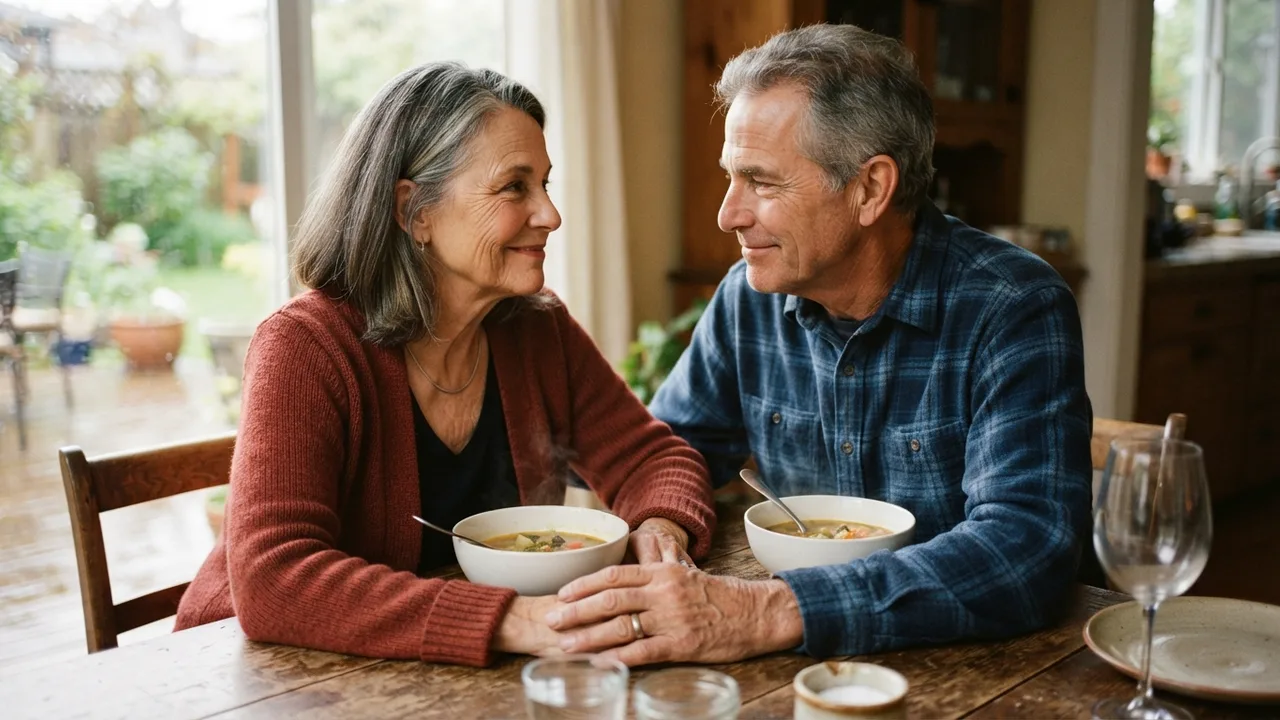
I came back with two plain white bowls, a loaf of bread I'd baked that morning with its crust still crackling, and the small pot of leek and potato soup I had made for my own lunch, from leeks and potatoes I'd paid for at the Hannaford with my own money.
I ladled the soup and set Harvey's bowl down where the bank statement had been.


Comments