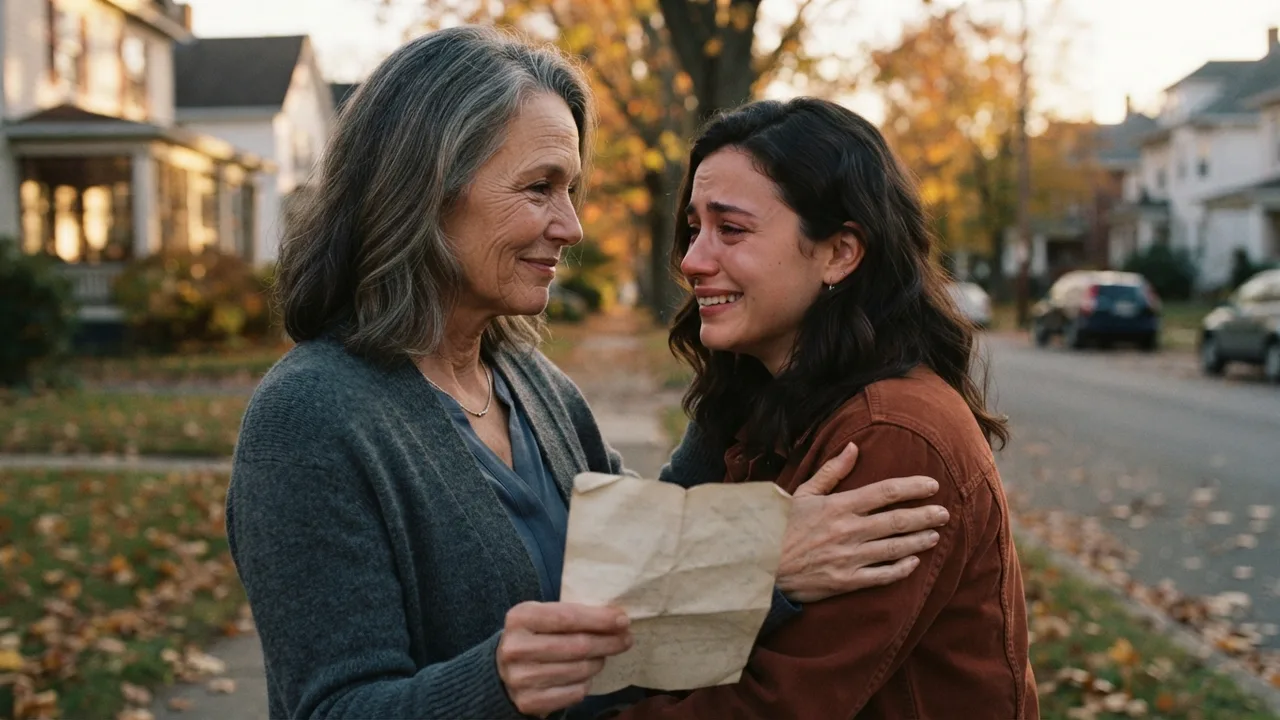
My brother slid the letter across the lawyer's polished table and said, "Mom wanted me to have the first forty thousand."
The forty thousand would come out of our mother's savings account before a dollar was divided. That account was nearly everything she had left besides the house, and I had been counting on my half to keep a retired grant writer in groceries and property taxes.
Mr. Figueroa picked the page up by its edges, the way he handled everything, and read it with his glasses pushed up on his forehead. The page was white and flat, with no fold in it anywhere. His office above the Cabot Creek hardware store held more books than shelves, and the radiator ticked under the window like a slow clock.
Advertisements
"A letter of intent isn't binding," he said. "But if the heirs agree to honor it, I can draw the distribution accordingly. Lynn?"
"I'd like to see it first," I said.
Leland leaned back in his chair. He wore the charcoal suit I'd seen at three funerals, expensive once and now shiny at the elbows. "It's Mom's handwriting. I found it in her Bible. Let's not make this a production."
"I'd like a photograph of it."
"Be my guest." He flicked two fingers at the page, then changed his mind and used his whole hand.
I held my phone over the letter and took three pictures. Mr. Figueroa set the final signing for the Thursday after next and told us both to think it over.
Leland walked me to the parking lot. "I know you're still raw about Mom," he said. "Don't get sentimental on me. We're adults."
I drove home with the radio off. Cabot Creek was in its last week of good foliage, the maples along Route 16 as red as the brake lights ahead of me, and I could not enjoy a single one.
That night I sat at my kitchen table with a cup of decaf going cold and enlarged the photo until the paper grain showed. My mother's large-print Bible sat at my elbow, where it had been since I carried it out of Maple Court in her canvas bag. I noted that, as I noted everything that week, without knowing what to do with it. The handwriting was my mother's. I knew the loop of her capital D and the way she crossed her t's high, like a woman flagging down a bus.
Advertisements
But the words were wrong.
*I wish Leland to receive the first forty thousand dollars of my savings—in recognition of the counsel he gave your father over many years, for which he never accepted payment.* My mother had never once written "I wish to receive" in her life. She wrote "I'd like" and "Be good to each other" and "Don't forget to turn off the stove."
I called him at nine. He answered from what sounded like his car.
"Lynn, I'm between things."
"The letter sounds formal for Mom," I said. "Doesn't it sound formal to you?"
"She was putting her affairs in order. People get formal."
A turn signal clicked on his end, steady as a metronome. I waited for it to stop.
"She called the savings account 'the rainy day money' for forty years. In this letter it's 'my savings.'"
"Listen to yourself." His voice took on the tone he used on subcontractors. "I'm going to say this as someone who loves you. Don't make things difficult. You've had a rough stretch, and grief makes everything look suspicious. Let's not turn Mom's last wish into a forensic exercise."
"I'm only asking a question."
"And I'm only telling you it's been asked and answered. We'll circle back Thursday."
He hung up. I stood at the sink and rinsed a cup that was already clean, then straightened the calendar on the wall, then straightened it again.
I did not sleep. Around two I admitted that I had wanted my mother's last months to be the plain, good thing I remembered, and that my brother had just handed me a different version of them. By four I had begun to doubt my own ear. I had spent thirty years choosing words for a living, and it was possible I had simply chosen the wrong ones to grieve with.
In the morning I called Audrey. She was my one hope for company in this. She was Leland's daughter, but she had spent a whole summer in my spare room at nineteen, learning to drive a stick shift in my Subaru.
"Aunt Lynn, hi, I'm walking to a standup, can I call you back? Oh, no, I have like four minutes. What's up?"
I told her about the letter and the odd formality. She was quiet for a moment, and I heard the Boston traffic behind her.
"Okay, so, I get why that's weird," she said. "But Dad's told me about this. He did a ton of business advice for Grandpa back when the hardware side of the family business was struggling. Like, for free, for years. Grandpa always said he'd make it right."
"Did you ever hear Grandpa say that?"
"Not directly. But Dad's not a liar, you know? He's just a lot." She laughed, and it did not land. "He's had some market trouble this year too, so maybe he's been stressed and bossy about it. Honestly, Aunt Lynn, I think you might be, like, looking for a reason to be mad. Because you miss her. I miss her too."
"I'm not mad, Audrey."
"I know. I just don't want this to turn into a thing. Can we all just do Thursday and then get lunch? There's that place in Concord with the lobster rolls."
"That sounds nice," I said, and meant almost none of it.
When she hung up, the kitchen was very quiet. I had come away with a lobster roll invitation and a new phrase, *market trouble*, which I wrote on the back of an envelope for no reason I could have named.
That Saturday I locked myself in the room I call my office, which is really the second bedroom with a desk my husband built. I brought in the shoebox of my mother's cards, the ones I had kept since the year I left for college, along with a printout of every email Leland had sent me that I'd saved. My inkjet ran low on black halfway through and I drove to the Staples in Plymouth for a cartridge that cost thirty-one dollars and ninety-nine cents.
I laid everything out in rows on the carpet. Birthday cards, Christmas cards, a get-well card with a cartoon hedgehog, a sympathy card after Tom died. Fifty years of the same blue ballpoint, the same careful slant.
By Saturday evening I knew the letter's handwriting could be defended. The D's matched, and so did the high t's. If anything, the letter looked steadier than her cards from the last two winters, when her hand had begun to shake.
By Sunday afternoon I was reading the same cards aloud to myself in the voice of a woman who had lost the thread. I stood up, sat down, and ate a sleeve of saltines standing at the window. I thought about calling Mr. Figueroa to say I would sign, and about whether pride was worth the strain on my eyes.
Then I picked up the letter's photograph one last time, and instead of reading the words, I looked at the marks between them.
There was a dash after "savings." A single long dash, with no space on either side, joined to the word before and the word after like a rail between two posts.
I knew that mark. Every editor I had ever worked with knew it, and so did every machine. Typed two hyphens in a word processor, and the software would fuse them into one clean em dash without being told.
I pulled the cards toward me. In forty years of notes my mother had never made that mark. She wrote two hyphens, one beside the other, with a tiny gap between them where the pen lifted. *Happy birthday, dear -- I hope the cake is chocolate.* She had done it in every card, to the end.
Then I took Leland's emails and went through them one at a time. *Lynn—quick update on the roof.* *Lynn—let's circle back.* Every message, the same long dash, no spaces, as regular as a pulse.
I sat on the floor with my back against the bed for a long time. I felt like a person who has spent a weekend digging in a field and has finally struck something with the shovel. It was small and hard, and it was mine.
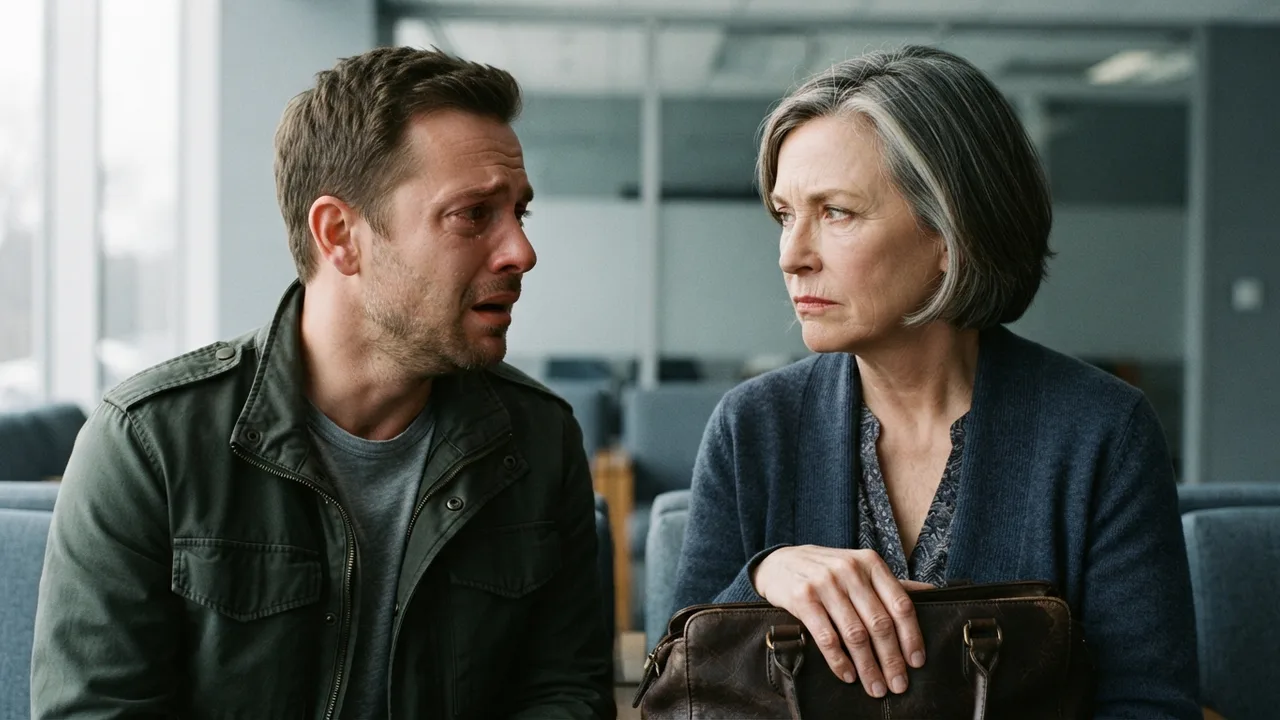
On Thursday the radiator in Mr. Figueroa's office was ticking again. Leland arrived early in a fresh shirt, and Audrey came in from the Boston train with her phone in her hand and her coat still on. She kissed my cheek and whispered, "Please be nice."
Mr. Figueroa placed the distribution documents in front of me. The forty thousand was typed on the second page, a neat line above my signature.
I pushed them back across the table.
"I can't sign this," I said. "The letter is a forgery."
Leland laughed, a short bark. "Here we go."
"Lynn," said Mr. Figueroa, taking his glasses off. "That is a serious statement."
"I know it is. May I show you?"
I opened my folder. I laid one of Leland's printed emails beside the birthday card my mother had sent me the spring before she died, and I set the photograph of the letter above both of them.
"This is the letter," I said. "It's Mom's handwriting. I'm not disputing that. But look at the dash after 'savings.'"
Mr. Figueroa leaned in. Audrey leaned in with him, and I noticed her phone had gone dark in her hand.
"It's a single long dash with no spaces. A word processor makes that automatically when you type two hyphens in a row. Mom wrote two hyphens, by hand, in every note for forty years. Here, here, and here." I touched each one with the end of my pen. "And here is Leland's email, and every email he has ever sent me, with that mark in the same spot."
"It's a dash, Lynn," Leland said. "You're building a case out of a dash. Maybe Mom had one of the aides at Maple Court type up a draft, and she copied it out. Old women do that."
"Then she copied it in the steadiest line she made in her last two winters. Look at it beside the hedgehog card." I let him look. "But the dash isn't all I brought."
I reached into my bag and set my mother's Bible on the table, the cracked brown cover with her name stamped in gold at the corner.
"You told us you found the letter in her Bible. When?"
"The week after the funeral. At the house."
"I carried this out of Maple Court in her canvas bag the day she died. It has been on my nightstand ever since. It was never at the house, and you have not been inside my house since Tom's service."
Leland's eyes went to the Bible and came back. "Then I meant Dad's. The one on the piano. Same thing."
"You said 'her Bible,' in this room." I turned. "Mr. Figueroa?"
The lawyer glanced at his legal pad. "I wrote it down as you said it. 'Her Bible.'"
"And the page has no fold in it," I said. "Everything Mom ever tucked in a book came out creased. That page came out of a printer tray."
"You could have put anything in that Bible!" He was standing now. "You had it all this time. Maybe you're the one who planted it, to make me look like a thief."
"Then why would I forge a letter that costs me forty thousand dollars?"
He opened his mouth and shut it. The radiator ticked. His collar had gone dark red.
"All right," he said, lower. "Say I typed it up. She asked me to. She was tired, she told me what she wanted, and I put it in good words and she copied it out. What's the harm?"
"She'd have said 'I'd like,'" I said. "And she'd have told me. She told me when she changed the brand of her tea."
"You're greedy." He swung toward his daughter. "I told you she'd be like this. I put years into Dad's business and never saw a penny. He promised he'd make it right."
Audrey did not answer him. She looked at the email, then the card, then the unfolded page and the Bible, and last at her father, with her lips pressed tight and her eyes going back to the email as though the sum might come out different the second time.
"Audrey," I said gently, because she deserved that much. "Ask your father why he needs forty thousand dollars in cash this month."
"Dad?" Her thumb moved on the edge of her phone. "You told me the market thing was handled."
My brother stared at the little white stack of paper. His hands, which had always been so busy with pens and keys and cuffs, hung at his sides.
"I'd have put it back," he said to the table. "Before anyone knew. I only needed it to carry me through the spring." He waved a hand at the lawyer without looking up. "Forget the letter. Draw it up fifty-fifty."
Mr. Figueroa put his glasses back on. "Mr. Haskell, you are withdrawing the letter."
"I said forget it."
"Then I'll need a few minutes."
He took the documents through a door behind his desk. I heard a printer grind and spit, and in the silence I listened to my brother's breathing. Audrey had gone to the window. She stood with her arms crossed over her coat, watching the hardware store's delivery truck back up in the lot.
When the lawyer returned, he laid the new pages down without comment. The house was divided evenly. The savings account was divided evenly. There was no line above my signature.
I read every page. My brother signed his name where the yellow tabs said, fast and slanted. I signed mine under it, slower, in the blue pen my mother would have approved of.
"The transfer will be authorized today," Mr. Figueroa said. "You'll each receive confirmation." He squared the pages against the table. "Thank you both."
I put the Bible back in my bag and stood. Leland was staring at his hands. I thought of the tall boy who had taught me to ride a bicycle on Pleasant Street, and I looked for him and did not find him.
"Goodbye, Leland," I said.
He said nothing. I went down the narrow stairs and out the door past the hardware store's display of snow shovels, priced at nineteen ninety-nine, lined up for the first storm.
The air was cold and smelled of woodsmoke. I had made it halfway to the corner when I heard quick footsteps behind me.
"Aunt Lynn."
Audrey caught up, her coat unbuttoned, phone finally out of sight. Her eyes were red.
"I'm so sorry," she said quietly. "I should have listened to you. I told you that you were just sad."
"You told me what you believed," I said. "That's different."
"I don't know what I believe about him now."
"You don't have to know today." I took her arm, and she let me. "You can have lunch with me, though. I hear there's a lobster roll in Concord."
She laughed, wetly, and wiped her face with the back of her wrist. We started down Main Street together, past the library and the Dunkin' where the same two men were always arguing about the Patriots.
Something had gone out of me in that room, something I'd carried since childhood, the idea of my brother as the capable one. It was gone, and I would not get it back. But in its place was a plain, quiet steadiness. I had trusted my own ear when no one else would, and it had been right.
In my bag, my fingers found the corner of the old birthday card, its blue ink slightly shaky, my mother's two hyphens still there between the words.
Comments