In a jaw‑dropping escalation of the 2026 Iran war, Tehran’s Revolutionary Guard navy apparently challenged American naval power — even testing U.S. defenses with drones near carrier strike groups and harassing a U.S.‑flagged tanker in the Strait of Hormuz — but within 48 hours of that provocation, U.S. forces unleashed devastating strikes that sank almost Iran’s entire surface fleet, including multiple warships and corvettes that were once the backbone of Tehran’s naval presence in the Gulf and Indian Ocean, a stunning blow that has dramatically reshaped the naval picture in the conflict.
The Sudden Fall of Iran’s Naval Power: A Dramatic Showdown with the U.S.Navy
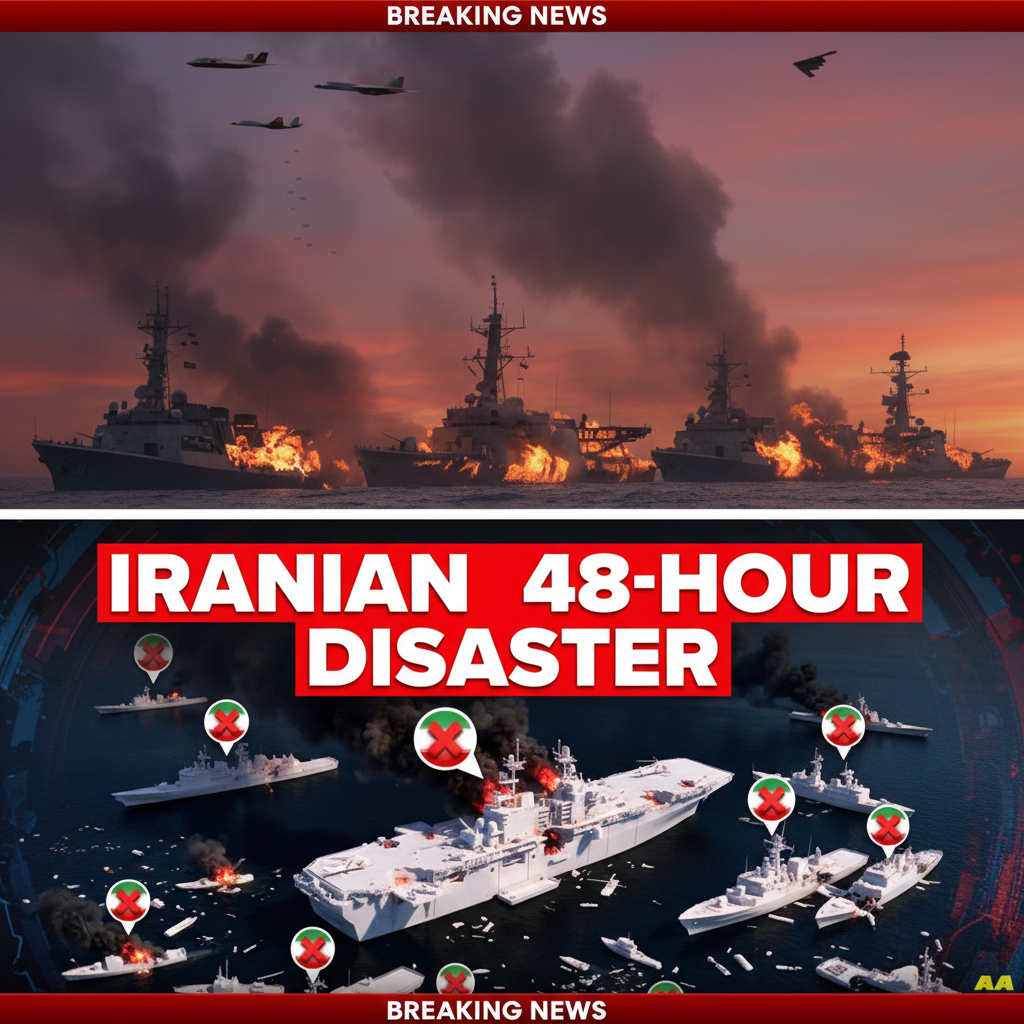
In a stunning turn of events, Iran’s naval strategy was obliterated in a matter of hours.
The backdrop of this dramatic confrontation was set when Iran, emboldened by a series of provocative actions, challenged the might of the U.S.Navy.
What unfolded next was a spectacle of military prowess that would echo through history.
Iran’s fleet, once a symbol of maritime strength, was caught in a web of its own making.
Tensions had been escalating for months, with Iranian leaders believing their naval capabilities could withstand any American retaliation.
However, this confidence was about to be shattered.
In the early hours of the conflict, reports flooded in from U.S.intelligence sources indicating that Iranian warships were mobilizing.
The U.S.military, with its vast resources and cutting-edge technology, was not about to let this challenge go unanswered.
Within 48 hours, a coordinated strike was launched, showcasing the sheer power of the U.S.armed forces.
Cruise missiles streaked across the sky, targeting key installations and vessels within the Gulf of Oman.
The precision of these strikes was nothing short of breathtaking.
Iran’s naval doctrine, developed over decades, crumbled under the weight of overwhelming force.
Key warships were destroyed in a matter of moments, leaving behind a trail of wreckage and disbelief.
Witnesses described the scene as apocalyptic, with explosions lighting up the night sky.
Iranian sailors, once proud defenders of their homeland, found themselves facing an enemy they could not see.
The tactics employed by the U.S.Navy were reminiscent of a Hollywood blockbuster, where the hero emerges victorious against all odds.
As the dust settled, the scale of the devastation became apparent.
Iran’s naval capabilities had been decimated, and the implications of this loss would resonate far beyond the immediate battlefield.
Analysts began to question how a nation that had invested so heavily in its naval forces could collapse so quickly.
The answer lay in a combination of overconfidence and underestimation of U.S.military might.
In the aftermath, Iranian officials scrambled to explain the catastrophic failure.
Denials poured forth, but the evidence was irrefutable.
Satellite images revealed the extent of the destruction, and the world watched as Iran’s leaders faced a crisis of legitimacy.
The psychological impact on the Iranian populace was profound.
Citizens, once proud of their naval prowess, were left grappling with the reality of their nation’s vulnerability.
The narrative of invincibility was shattered, and with it, the morale of a nation.
As discussions unfolded on international platforms, the U.S.Navy’s decisive action was hailed as a testament to its superiority.
Military analysts praised the strategic planning that led to such a swift victory.
Yet, beneath the surface, questions lingered about the future of Iran’s military strategy.
Would this defeat lead to a reevaluation of their approach, or would it further entrench their resolve? The stakes were high, and the world watched closely.
In the days that followed, Iran’s government attempted to rally its citizens, framing the situation as a rallying cry for national unity.
However, the cracks in their narrative were evident.
The loss of their naval fleet was not just a military defeat; it was a profound psychological blow that would take years to mend.
As the dust settled, the geopolitical landscape shifted.
U.S.allies in the region felt emboldened, while adversaries like Russia and China recalibrated their strategies in light of this new reality.
The balance of power had tilted, and the ramifications would be felt for generations.
In conclusion, the rapid dismantling of Iran’s naval power serves as a stark reminder of the unpredictability of modern warfare.
The clash between the U.S.Navy and Iran was not just a battle of ships; it was a dramatic confrontation that exposed vulnerabilities and reshaped alliances.
As the world reflects on this event, one question remains: What will be the long-term consequences of this naval showdown? The answer is still unfolding, but one thing is certain—this was a moment that would define the future of naval warfare and international relations for years to come.