When Donald Trump dismissed Canadian-built cars as unwanted and warned tariffs would punish foreign production, many assumed Windsor, Ontario—one of North America’s most important auto hubs—was headed for decline. Instead, Windsor did something unexpected. In late 2025, it rolled out a gas-powered Dodge Charger six-pack, built under tariff pressure and political uncertainty. What followed stunned the industry: major U.S. auto awards, a complete sellout of its 2026 production run, and a clear message that manufacturing reality doesn’t always obey political rhetoric. This wasn’t defiance for show—it was confidence backed by performance.
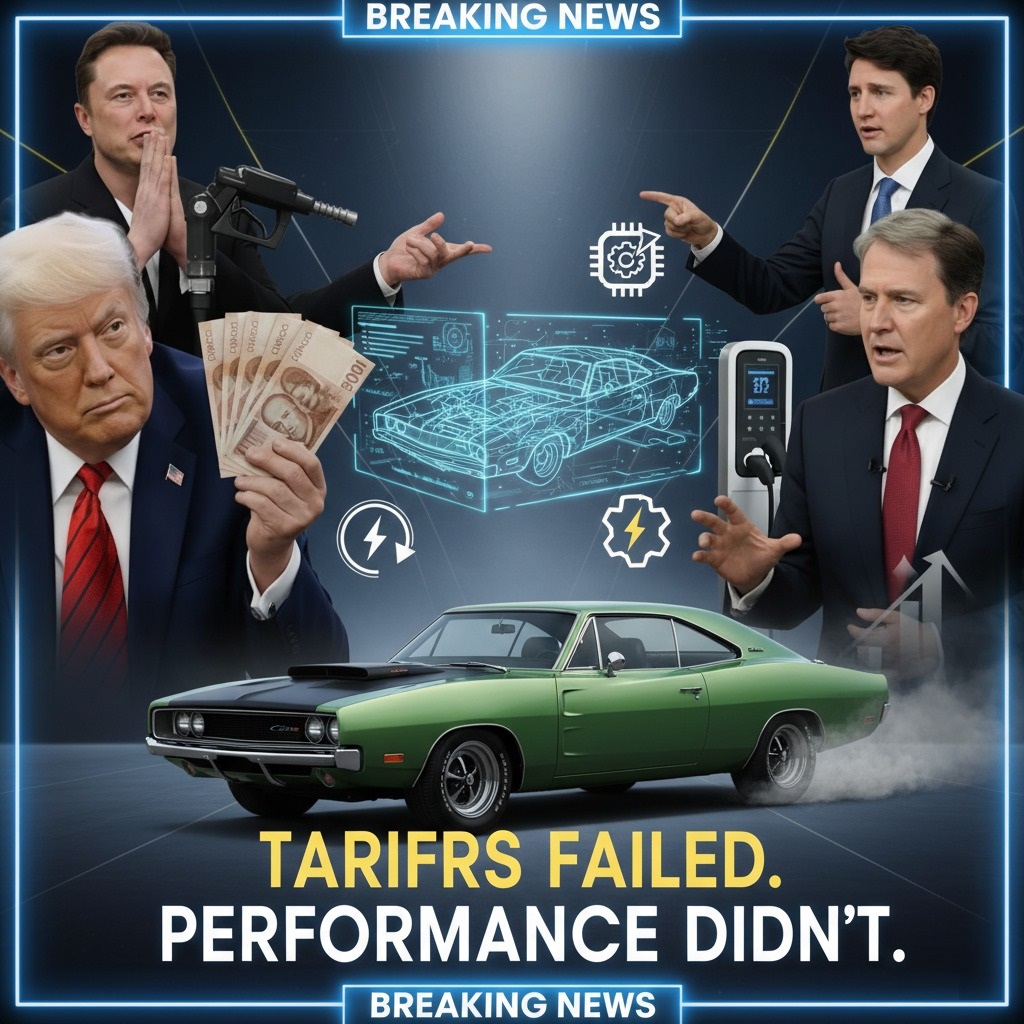
For years, Windsor has lived in the shadow of American politics.
As a cornerstone of North American auto manufacturing, the city has often been treated as vulnerable to decisions made in Washington—especially when trade rhetoric heats up. So when Donald Trump bluntly declared that America did not want Canadian cars, the assumption across much of the industry was predictable: production would move south, jobs would be at risk, and Windsor would pay the price.
That’s not what happened.
Instead of pulling back, Windsor pushed forward. In early December 2025, as tariff threats lingered and analysts warned of shrinking margins, the Dodge Charger six-pack rolled off the line—built in Canada, sold to North America, and unapologetically gasoline-powered in an era obsessed with electrification.
The Charger six-pack wasn’t designed as a nostalgic throwback or a political statement. It was engineered as a response to a market reality many policymakers underestimated: consumers still wanted performance, practicality, and value—without inflated prices or experimental compromises. With a 550-horsepower twin-turbo inline-six engine, usable cargo space, and everyday drivability, the Charger struck a balance that many competitors had abandoned.
Critics noticed immediately.
Within weeks of its debut, the Windsor-built Charger six-pack earned top honors from Top Gear and the Detroit News—institutions not known for handing out sympathy awards. Reviewers praised not only its power, but its execution: tight assembly, thoughtful engineering, and a product that felt complete rather than rushed.
Then came the market’s verdict.
Despite being built under tariffs that were supposed to scare off buyers, the entire 2026 production allocation sold out in less than 24 hours. That single data point shattered months of assumptions about trade pressure and consumer behavior. Buyers weren’t avoiding Canadian-built vehicles—they were lining up for them.
For Windsor, the success was not accidental. The city’s auto workforce carries decades of institutional knowledge, shaped by cycles of boom, bust, and reinvention. The decision to keep Charger production in Windsor wasn’t sentimental; it was strategic. Stellantis trusted the plant’s ability to deliver consistency under pressure—and the bet paid off.
This is where the story moves beyond cars.
Windsor’s Charger moment exposes a widening gap between political narratives and industrial reality. Trade threats assume fear drives outcomes. Tariffs are supposed to force relocation. Rhetoric is meant to bend supply chains to political will. But markets, as Windsor demonstrated, respond to something far simpler: product quality and value.
The Charger six-pack didn’t succeed because it was Canadian. It succeeded because it was good.
That distinction matters. In recent years, North American manufacturing has often been framed as fragile—easily disrupted by policy swings and election cycles. Windsor’s experience challenges that framing. It suggests that when factories are competitive, workers are skilled, and products meet real demand, political noise loses its power.
Even more striking is where the validation came from. Detroit—long seen as the symbolic heart of American auto manufacturing—embraced a car built just across the border. That acknowledgment carried weight. It underscored how intertwined North American industry truly is, regardless of rhetoric about winners and losers.
For Windsor, the Charger six-pack is more than a commercial win. It’s a reminder that manufacturing strength can’t be legislated away by speeches or slogans. It has to be earned on the line, measured in tolerances, performance, and customer trust.
As political cycles continue to inject uncertainty into trade and industry, Windsor’s lesson is clear: intimidation doesn’t create value—execution does.
The Dodge Charger six-pack didn’t just survive tariffs and threats. It thrived under them. And in doing so, it forced the industry to confront an uncomfortable truth: sometimes, the factories politicians expect to fail are the ones that prove them wrong.
In a year dominated by noise, Windsor delivered something quieter—and far more powerful. Results.