THE ARCHITECTS OF ACCOUNTABILITY: HOW THE SUPREME COURT ACCIDENTALLY BUILT AN IMPEACHMENT TRAP
DATELINE: CAPITOL HILL, WASHINGTON D.C. CORRESPONDENT: BUREAU DISPATCH
The ground beneath Pennsylvania Avenue is no longer steady. What began as a series of isolated legal skirmishes in the marble halls of the Supreme Court has coalesced into a seismic event that many are now calling an “Impeachment Earthquake.”
House Judiciary Committee Chairman Jerry Nadler, standing at the epicenter of this shifting landscape, has moved beyond mere rhetoric. The committee is now engaged in what senior aides describe as a “full-blown, high-velocity investigation” to determine whether to recommend formal articles of impeachment against the President of the United States.
But while the headlines focus on the political firestorm, a far more sophisticated constitutional story is unfolding. It is a story not of political theater, but of judicial architecture.
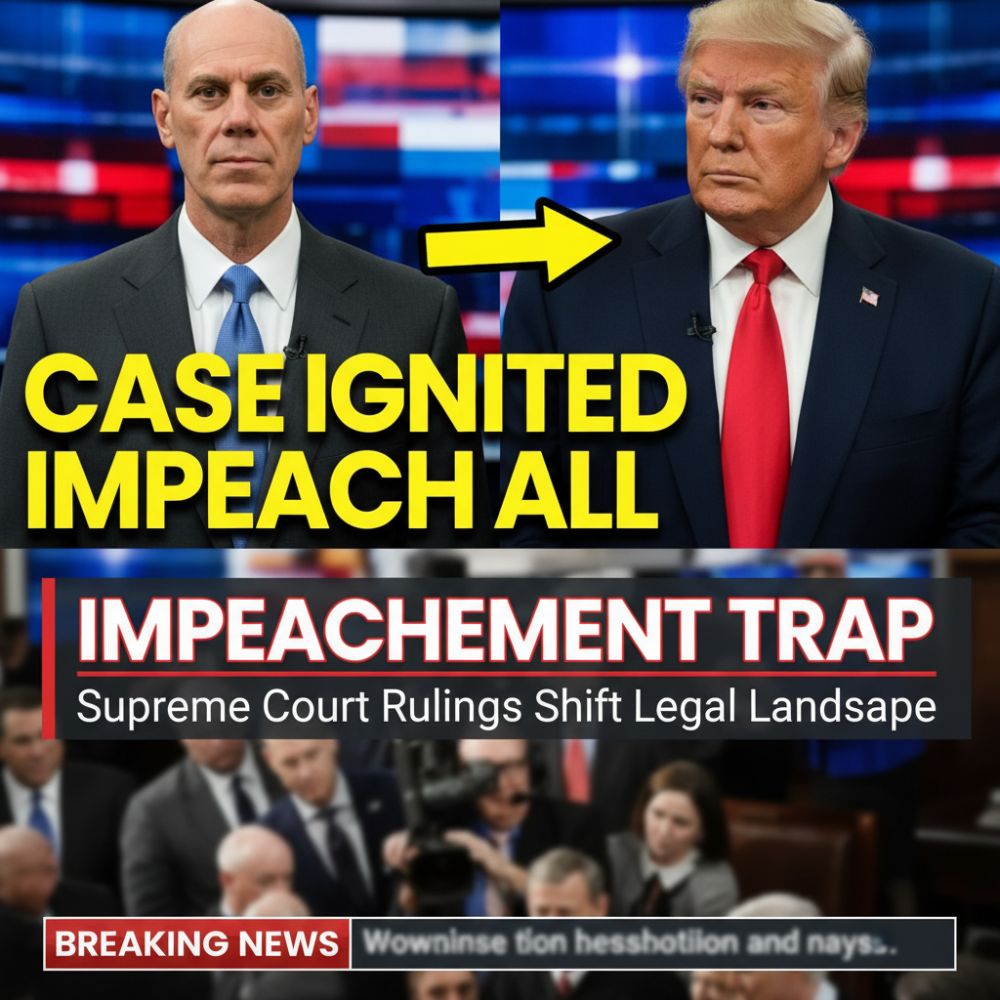
Contrary to viral myths, the Supreme Court cannot “ignite” an impeachment—the Constitution grants that “sole power” to the House. However, through a series of bombshell rulings over the last twenty-four months, the High Court has effectively defined the boundaries of the “impeachment trap.” By ruling on what a President cannot do, the Court has inadvertently handed Congress the blueprints for a “High Crimes and Misdemeanors” case that is more legally grounded than any in American history.
This is the definitive investigative report on the judicial foundation of the Second Term’s most consequential accountability mobilization.
I. THE 6-TO-3 BOMBSHELL: THE TARIFF DEFEAT AS AN EVIDENTIARY BEDROCK
To understand the current momentum in Nadler’s committee, one must look first at the February 2026 IEPA Tariff Ruling.
For the first year of the second term, the administration operated on the premise that the International Emergency Economic Powers Act (IEEPA) granted the President near-total authority to impose across-the-board tariffs. It was the centerpiece of a “Trade War 2.0” that saw approximately $175 billion in revenue collected from global markets.
But on a Friday that the White House has since dubbed “Black Friday,” the Supreme Court issued a 6-to-3 ruling that struck at the heart of this power. Chief Justice John Roberts, joined by two Trump-appointed justices, wrote the majority opinion: “The executive cannot bear such weight.”
By applying the “Major Questions Doctrine,” the Court formally established that the President had exceeded his constitutional limits. In the world of constitutional law, this wasn’t just a policy defeat; it was a formal declaration of Unlawful Conduct.
The Impeachment Connection
In the House Judiciary Committee, this ruling is being treated as Exhibit A. The “High Crimes and Misdemeanors” standard historically requires a showing of an abuse of power or a violation of the law. By having the Supreme Court—the final arbiter of the Constitution—formally declare the tariff scheme “unlawful,” Congress no longer has to debate whether the President broke the law. The Court has already settled that question.
The $175 billion in illegally collected revenue now serves as the quantified “harm” of that unlawful act. As Chairman Nadler noted in a recent closed-door session, “The Court defined the crime; we are simply executing the punishment.”
II. THE IMMUNITY GAP: THE ACLU’S WARNING AND THE REMAINING CHECK
The second pillar of this impeachment earthquake is the fallout from the 2024 Presidential Immunity Ruling.
When the Court expanded the scope of immunity for “core official acts,” it created a vacuum in the American accountability framework. As the ACLU and various constitutional advocacy groups warned at the time, the ruling appeared to hand the executive a “blank check” to bypass criminal prosecution for conduct performed under the guise of official duty.
Shutterstock
However, the Court’s expansion of criminal immunity did not—and could not—touch the political accountability mechanism of impeachment. In fact, several legal scholars have argued that by closing the doors of the courthouse to criminal prosecutors, the Supreme Court effectively funneled all national accountability through the halls of Congress.
The “Only Remaining Check”
This “Immunity Gap” has become the primary driver for the current impeachment inquiry. If a President cannot be prosecuted in a court of law for an “official act” that is nevertheless a gross abuse of power, then impeachment becomes the only constitutional safety valve left.
The House Democratic memo currently circulating in the Judiciary Committee explicitly cites the Immunity Ruling as the reason why an inquiry is not just an option, but an institutional obligation. The Court has made it so that if Congress does not act, no one will.
III. THE DEFIANCE DIMENSION: CONTEMPT AND THE SUPREME COURT’S OWN AUTHORITY
The third dimension of this judicial foundation involves the President’s own response to the Court’s rulings. Following the tariff defeat, the President took to social media to call the High Court “incompetent” and signaled that “he had a job to do,” regardless of the ruling.
This rhetoric has brought the “Court Order Defiance” dimension to the forefront. The Supreme Court has historically been protective of its own institutional authority. Signals from the Court—both in formal opinions and in the procedural handling of emergency stays—have made it clear: A President cannot defy a final judicial order.
When a President hints at or engages in the defiance of a court order, it is no longer just a legal dispute; it is a direct challenge to the Separation of Powers. In the eyes of the Judiciary Committee, this defiance is the ultimate “High Crime.” It is an attempt to place the Executive Branch above the law itself.
The Court, in defending its own existence, has provided Congress with the ultimate justification for removal: the preservation of the constitutional order.
IV. THE “WHOLE ADMINISTRATION” SCOPE: BEYOND THE PRESIDENT
Perhaps the most alarming aspect of the current inquiry for the White House is its scope. Chairman Nadler and Speaker Pelosi are not just looking at the President; they are looking at the entire administration.
The constitutional power of impeachment extends to “all civil officers of the United States.” This includes Cabinet members and senior executive branch officials. The documented accountability landscape currently supports a multi-target approach:
Attorney General Pam Bondi: Facing documented allegations of perjury and obstruction related to the handling of the “Epstein Files.”
FBI Director Kash Patel: Under scrutiny for “contradicting documents” and institutional concerns regarding the weaponization of the Bureau.
The Trade Representative: For the execution of the $175 billion illegal tariff scheme after the Court’s warning.
By expanding the scope to the “Whole Administration,” the House is signaling that the “unlawful conduct” identified by the Court was not the act of one man, but a systemic failure of the executive branch. This comprehensive approach is designed to dismantle the entire infrastructure of the “Second Term” executive power claims.
V. WAR POWERS AND THE BIPARTISAN CROSSOVER
The final foundation of the impeachment earthquake is the Unauthorized Military Action dimension.
While the Supreme Court has defined the domestic limits of power, a bipartisan coalition in the Senate has been defining the international limits. Recent Senate votes—specifically the 52-to-47 and 53-to-47 results regarding military strikes in Iran and Venezuela—established a documented bipartisan judgment that the President had exceeded his authority as Commander-in-Chief.
These War Powers resolutions are being incorporated directly into the impeachment articles. They represent a rare moment of bipartisan consensus: that the President engaged in “unauthorized military action.” When combined with the Supreme Court’s domestic rulings, the picture of an executive branch operating outside the law becomes nearly impossible to refute.
VI. WHAT TO WATCH: THE ROAD TO THE FLOOR
As the investigation moves forward, several specific developments will determine the speed and intensity of the impeachment earthquake:
The Incorporation of the Tariff Ruling: Watch for the formal articles to use the exact language from the Roberts majority opinion to establish the “High Crimes” basis.
The “Accountability Gap” Mobilization: Watch for constitutional advocacy groups to file Amicus briefs directly to the House, arguing that the Court’s immunity ruling necessitates a legislative removal.
The Senate Crossover: Watch for “Accountability Republicans” in the Senate to signal whether they will accept the Court’s definition of “unlawful conduct” as a basis for a conviction vote.
THE BOTTOM LINE
The Supreme Court did not start this fire, but it provided the fuel. By defining the constitutional landscape through the Tariff Ruling, the Immunity Analysis, and the War Powers framework, the Court has stripped away the President’s legal defenses.
Chairman Nadler is no longer operating on political intuition; he is operating on judicial fact. The Court has ruled that the President’s core actions were unlawful. The Constitution mandates that unlawful conduct be addressed through impeachment.
The earthquake is here. The blueprints are drawn. And for the first time in the second term, the “Separation of Powers” is no longer an abstract concept—it is a formal, documented, and potentially terminal accountability mechanism.
Bureau Dispatch will continue to monitor the House Judiciary Committee dockets and the Supreme Court’s active executive power cases as this constitutional collision builds toward its final outcome.