The Empty Checkpoint: Inside the Great Collapse of American Aviation
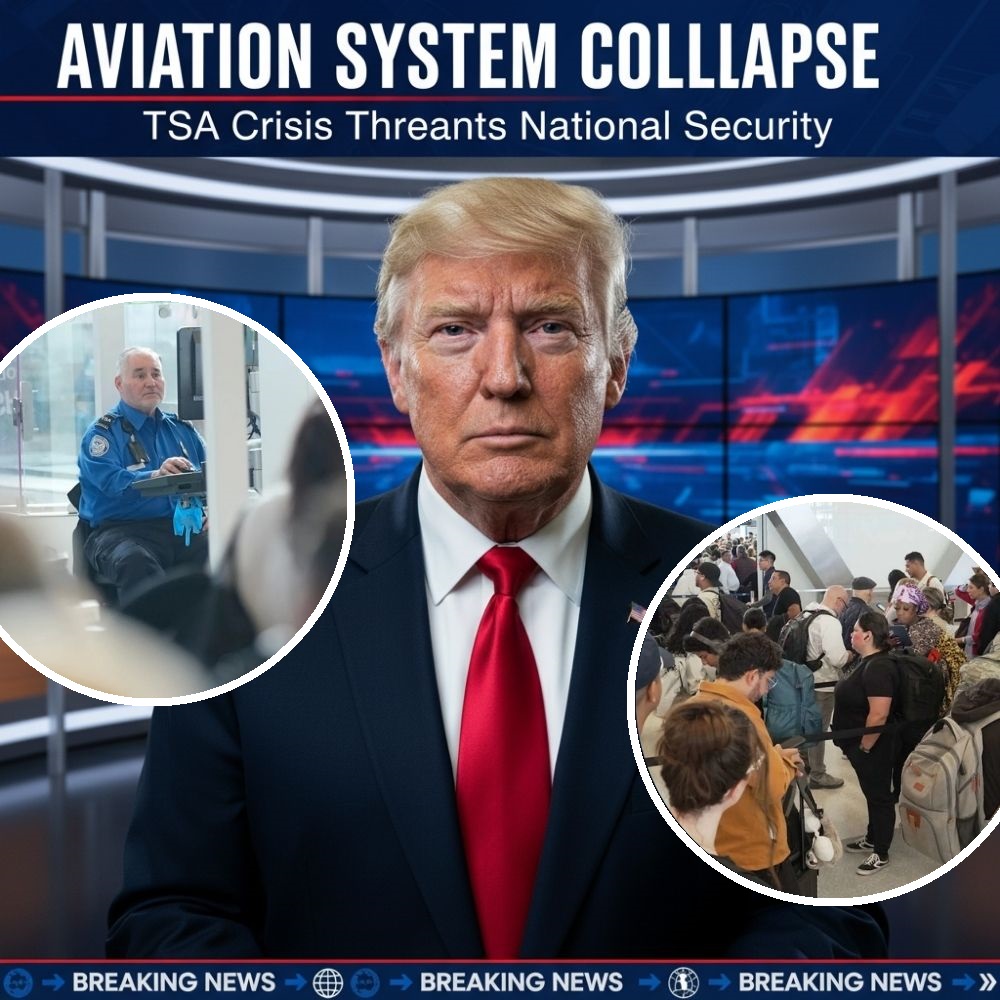
WASHINGTON D.C. — In the hushed, high-stakes world of national security, there is a scenario that planners call “The Dark Terminal.” It isn’t a terrorist attack or a cyber-breach. It is something far more mundane and yet infinitely more difficult to counter: a morning where the people who hold the keys to the kingdom simply don’t show up.
On 2026, the United States stood on the precipice of that reality. For 42 consecutive days, the Transportation Security Administration (TSA)—the thin blue line standing between the American public and the sky—has been in a state of advanced, systemic collapse.
It is a crisis that began not with a bang, but with a series of “zero-dollar” paychecks. As of this week, nearly 61,000 TSA officers have been working without pay for roughly half of the 2026 fiscal year. They have screened millions of passengers, managed chaotic spring break crowds, and operated sophisticated X-ray machinery while their own bank accounts sat in a state of terminal stasis.
The result has been a “natural disaster caused by Congress.” Across the country, airports didn’t just slow down; they began to fracture. Lines stretched to a staggering four and a half hours. Officers, unable to afford the gasoline to drive to work, began sleeping in their cars or selling blood plasma to buy groceries. Now, as back pay finally begins to trickle through a late-night executive order, the true cost of this shutdown is coming to light. The aviation industry isn’t just wounded; it is smaller, more vulnerable, and facing a talent exodus that could take years to repair.
Part I: The Zero-Dollar Reality
The shutdown of the Department of Homeland Security (DHS) began on February 14th—a Valentine’s Day “gift” from a deadlocked Congress. While Republicans and Democrats engaged in a high-stakes game of chicken over immigration enforcement and border “guardrails,” the 61,000 men and women of the TSA became the collateral damage.
This wasn’t a metaphor. TSA officers literally received paychecks that read $0.00. In an unprecedented move, the CEOs of America’s major airlines penned a joint letter to Capitol Hill, calling the situation “simply unacceptable.” They saw what the politicians refused to acknowledge: you cannot ask a workforce to protect the nation’s skies while they are facing eviction notices at home.
“They love this job,” the TSA union president stated in a recent briefing. “But they are quitting because they have no choice. You can’t pay for childcare with a sense of patriotic duty.”
The numbers tell a harrowing story. Before the shutdown, the national “call-out rate”—the percentage of officers who miss a shift—was a manageable 4%. By mid-March, that number had exploded to 11% nationally. At specific hubs, the system hit a breaking point. At Houston’s William P. Hobby Airport, the call-out rate hit 55% on a single day. More than half the staff stayed home, not out of protest, but out of a sheer inability to fund their own commute.
Part II: The Human Toll of “Essential” Labor
To walk through an American airport in March 2026 was to witness a workforce in a state of quiet desperation. In Boise, Idaho, and Pocatello Regional Airport, the terminals featured something never before seen in a federal building: food donation boxes.
Federal security officers, tasked with identifying improvised explosives and high-level threats, were being kept afloat by public donations of grocery store gift cards and household supplies. In Portland, airport officials publicly lauded their “essential partners” while those same partners were taking on second and third jobs just to keep their electricity on.
“Some of our officers are sleeping in their cars in the airport parking lot,” an Atlanta-based union official reported. “They do it to save on gas money because they don’t know when the next real paycheck is coming. Their credit scores are being destroyed, their cars are being repossessed, and they are still standing at that checkpoint for ten hours a day.”
The pressure has manifested in a terrifying spike in checkpoint violence. During the 42-day shutdown, assaults on TSA officers increased by over 500%. When security lines reach the four-hour mark and travelers miss their connections to weddings, funerals, or long-awaited vacations, they often take their fury out on the first person in uniform they see. The officers, already stressed by financial ruin, have become the primary lightning rods for a nation’s frustration.
Part III: The World Cup Vulnerability
The fallout from this shutdown isn’t just a domestic headache; it is an international security risk. The TSA has already lost 480 officers who have resigned and walked away for good.
This loss is not easily replaced. Unlike a retail position, a TSA officer requires four to six months of rigorous training and federal certification before they can work a checkpoint independently. With the United States set to co-host the FIFA World Cup starting June 11th, the timing could not be worse.
The Acting TSA Administrator told Congress point-blank: the staffing losses cannot be made up before the first kick-off. “We are going into the largest international sporting event in history with a depleted, demoralized workforce,” she warned. If new officers were hired today, they wouldn’t be ready until the tournament was nearly over. This creates a tangible “security gap” that adversaries are almost certainly monitoring.
Part IV: The ICE Deployment and the “Hyperbole” of Shutdown
As the crisis peaked in late March, the Trump administration attempted a “quick fix” by deploying ICE (Immigration and Customs Enforcement) agents to major airports to help manage the lines.
However, the “fix” was largely cosmetic. TSA union officials quickly pointed out that ICE agents lack the specific certifications required to operate X-ray machines or perform body screenings. Instead, the agents were relegated to “line management” and guarding exit doors. The actual, high-stakes work of security still fell on the skeletal remains of the TSA staff—officers who were effectively doing the work of three people while starving.
The rhetoric from the top grew increasingly dire. Acting Deputy TSA Administrator Adam Stall appeared on national television to warn that if call-out rates continued to climb, airports would have to shut down entirely. “It is not hyperbole,” Stall stated. “Particularly at smaller, regional airports, we are one bad Tuesday away from a total cessation of flights.”
Part V: The Thursday Turnaround
The fever finally broke on the evening of Thursday, March 26th. Under immense public pressure and facing a total aviation standstill, President Trump directed the newly installed DHS chief to immediately start paying TSA agents through an emergency reallocation of funds. Hours later, the Senate unanimously moved to fund the TSA through the end of the fiscal year.
The effect was instantaneous. In Houston, where lines had peaked at 75 minutes before dawn, wait times plummeted to 9 minutes. In Atlanta, the world’s busiest airport, lines dropped to a 3-minute average within hours of the news.
But while the lines have shortened, the damage to the “human infrastructure” remains.
“Back pay helps, but it doesn’t undo months of financial devastation,” one Atlanta officer noted. “It doesn’t fix a credit score. It doesn’t get you your apartment back if you were evicted last week.”
Conclusion: The Staffing Crisis of October
As we look toward April 1st, the immediate threat of a “Dark Terminal” has receded, but a new, more insidious crisis is forming. The TSA has been forced to work without pay three times in less than a year. The “loyalty” of the workforce has been tested to its absolute limit.
The CEO of the Partnership for Public Service put it bluntly: “Presidents and lawmakers still get paid during these shutdowns. But the people we deem ‘too important to stay home’—the essential workers—they get zero. We are treating our defenders like volunteers.”
The next budget fight is only six months away. In October 2026, the entire cycle could repeat. Recruiters are already finding it nearly impossible to attract new candidates. Who would take a high-stress job making $35,000 a year in New York City when the employer reserves the right to withhold your pay whenever a political disagreement arises?
The TSA is the front door to the American economy. Over the last 42 days, that door was held open by the sheer grit of 61,000 people who were treated as political pawns. They showed up when the government failed them. But as 500 of their colleagues have already proven, everyone has a breaking point.
The security of the American sky no longer depends just on technology or intelligence—it depends on whether Washington will finally decide that the people standing at the checkpoint are worth a paycheck.