Arctic Frost: Inside the Secret FBI Probe That’s Tearing Washington Apart
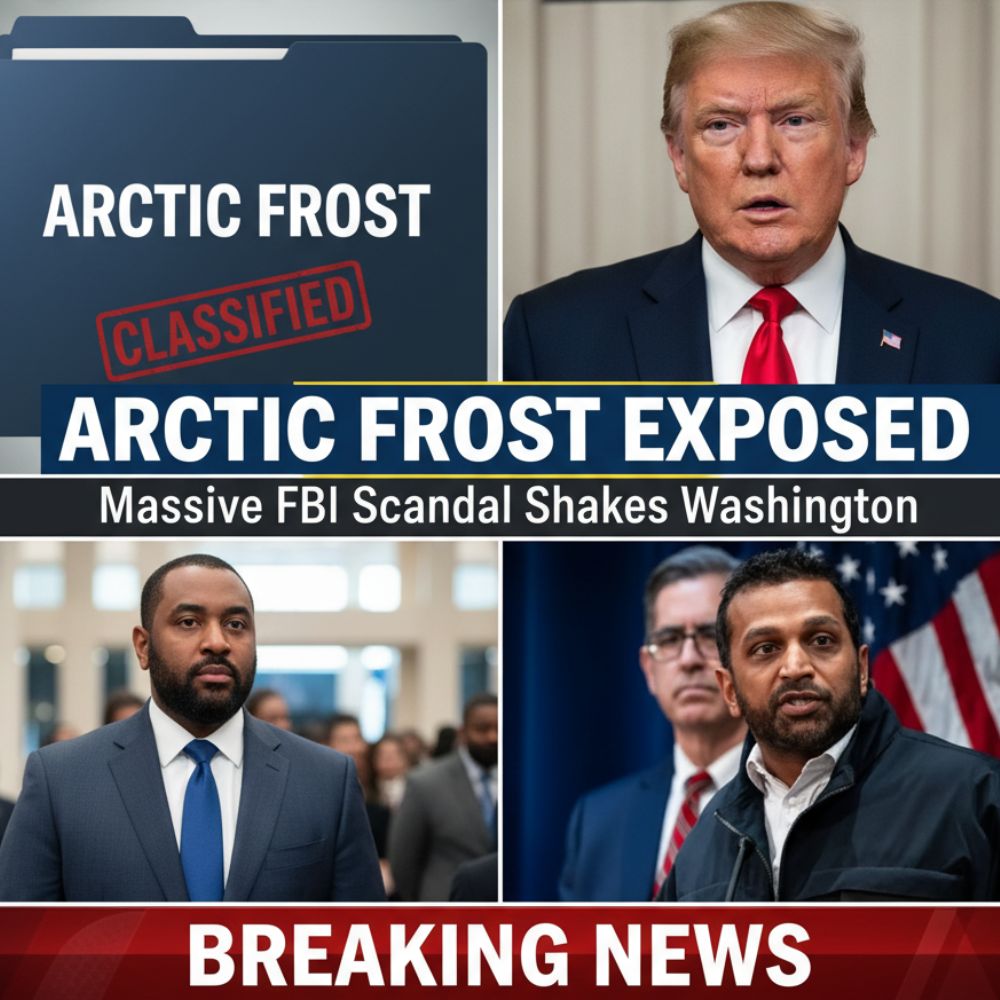
WASHINGTON D.C. — March 31, 2026. In the high-stakes world of federal law enforcement, code names are designed to be forgettable. They are linguistic camouflage, meant to allow sensitive operations to exist in the shadows without drawing the eye of the public or the ire of the politician. But as the cherry blossoms begin to bloom along the Potomac this spring, two words have emerged from the shadows to become the center of a constitutional firestorm that critics are calling the most significant political scandal since Watergate.
Arctic Frost.
To the uninitiated, it sounds like a meteorological forecast. To the hundreds of FBI agents, Department of Justice (DOJ) prosecutors, and United States Senators currently embroiled in a cycle of firings, lawsuits, and subpoenas, it is the name of a ghost that has returned to haunt the American establishment.
New reporting, corroborated by internal documents released this week by Senator Chuck Grassley’s office, reveals that “Arctic Frost” was the secret internal FBI designation for a sprawling, multi-year investigation into President Donald Trump and nearly the entire Republican political apparatus. What began in the quiet corridors of the J. Edgar Hoover Building in April 2022 has, by March 2026, evolved into a fractured landscape of legal warfare.
Today, the “Frost” is no longer secret. It is exploding back into the headlines as fired FBI agents sue the government for political retaliation, while the Senate Judiciary Committee prepares a series of “Modern Watergate” hearings that threaten to dismantle the reputations of the nation’s former top law enforcement officials.
Part I: The Birth of a Shadow Probe
The story of Arctic Frost begins in the spring of 2022. The nation was still reeling from the events of January 6, 2021. While the public focus was on the televised hearings of the House Select Committee, deep within the FBI, a formal federal investigation was being inked into existence.
According to documents unearthed by whistleblowers and released by Senator Grassley, the “predication”—the legal basis—to add Donald Trump as a formal criminal subject of the investigation was initiated by an FBI supervisor named Timothy Thibault.
Thibault, however, was far from a neutral arbiter. Investigative records show that while overseeing the most sensitive political probe in the Bureau’s history, Thibault was actively posting anti-Trump content on social media under his own name and official title. This stunning breach of protocol eventually led to an Office of Professional Responsibility (OPR) investigation, but by then, the “Frost” had already set in.
Thibault sent a high-priority email to a federal prosecutor in Washington D.C., stating there was sufficient evidence to designate the former President as a “predicated subject.”
But Thibault didn’t act in a vacuum. The most disturbing revelation found in the “Grassley Files” is the level of high-level authorization involved. The documents suggest that the three most powerful figures in American law enforcement—Attorney General Merrick Garland, Deputy Attorney General Lisa Monaco, and then-FBI Director Christopher Wray—gave their personal sign-off to open the Arctic Frost file.
Part II: The 400-Target Net
If Arctic Frost had remained a targeted look into the events of January 6th, it might have survived the scrutiny of history. But the scope of the operation, as now revealed, was staggering.
The FBI wasn’t just looking at the former President. The investigative “net” was cast so wide it swept up over 400 Republican organizations and individuals. The list included:
Sitting U.S. Senators: Eight Republican senators had their phone records—metadata, call durations, and location data—seized and reviewed.
Members of Congress: Congressman Scott Perry of Pennsylvania had his physical cell phone seized by agents while traveling.
The RNC: Investigative files show the Republican National Committee itself was placed under the scope.
Think Tanks and PACs: Hundreds of conservative organizations found their communications archived in the Arctic Frost database.
The seizure of Congressman Perry’s phone has become a particular point of contention. The FBI reportedly made a forensic copy of the device’s entire contents, despite the “Speech or Debate Clause” of the Constitution, which is designed to protect legislators from executive branch interference. To critics, this wasn’t an investigation; it was the surveillance of a political party by its rival in power.
Part III: The Jack Smith Handover
In November 2022, the “Frost” moved from an internal FBI matter to a full-scale federal prosecution. Merrick Garland appointed Jack Smith as Special Counsel, and Smith inherited the Arctic Frost files as the foundation for his cases against Donald Trump.
During his public testimony in January 2026, Smith maintained that his decisions were independent and devoid of political motive. “The law was my only guide,” Smith told lawmakers.
However, the “paper trail” released this month shows that Smith’s team utilized the groundwork laid during the secret phase of the FBI probe to issue 197 subpoenas. This massive data-gathering operation swept up the private information of hundreds of people whose only “crime” was their proximity to the 2024 Republican nominee for president.
Senator Grassley has characterized the operation as a “runaway train” that used the machinery of the state to criminalize political affiliation.
Part IV: The Purge—October 2025
The narrative took a dramatic, personal turn in the fall of 2025. Following Donald Trump’s victory in the 2024 election, the federal cases against him were dropped, adhering to long-standing DOJ policy that a sitting president cannot be prosecuted.
Almost immediately, a “thaw” began—or more accurately, a purge.
FBI Director Kash Patel, appointed by the new administration, moved to terminate the agents who had worked on Arctic Frost. Two of these agents, currently identified in federal court as John Doe 1 and John Doe 2, have now filed a blockbuster lawsuit against the government.
The details of their termination, as laid out in the complaint, are evocative of a political thriller:
John Doe 1: A career agent with decades of service was fired on Halloween night. He was reportedly standing on his porch with his children, who were dressed in their costumes for trick-or-treating, when he received the call to report to the Washington Field Office. By midnight, his career was over.
John Doe 2: His situation is perhaps more bizarre. At the time of his firing, he was no longer even working on Trump-related matters. He was the lead investigator on a high-profile white-collar fraud case and had even been briefing Director Patel on its progress.
The lawsuit alleges that U.S. Attorney Jeanine Pirro personally tried to intervene to save John Doe 2, arguing his expertise was vital to her office’s ongoing prosecutions. The plea was ignored. The agents argue their
First and Fifth Amendment rights were violated—that they were fired for the perception of their political beliefs rather than any misconduct.
Part V: The “Watergate” Hearings
As we move through March 2026, the battle has shifted to the halls of the Senate. The Judiciary Committee has officially labeled Arctic Frost a “Modern Watergate.”
The focus of the upcoming hearings is twofold:
The Metadata Mystery: How did Jack Smith’s team obtain the private phone records of sitting Senators? The committee has subpoenaed major telecommunications companies—AT&T, Verizon, and Lumen—demanding to see the legal justifications used to bypass Congressional privilege.
The “Wray Memo”: A watchdog group, the Center to Advance Security in America (CASA), has filed a formal bar complaint against former Director Christopher Wray. They allege that Wray himself authored the internal memo that initiated the “Frost” probe, knowing it lacked proper predication.
“The common thread,” the CASA complaint states, “wasn’t criminal activity. It was a relationship to the President’s chief political rival.”
Part VI: The Great Divide
The American public remains deeply divided on the legacy of Arctic Frost.
To one side, the investigation was a necessary and heroic effort to protect democracy. They argue that the events of January 6th were unprecedented and that the FBI had a moral and legal obligation to follow the evidence, regardless of where it led. To these supporters, the current hearings are nothing more than a “revenge tour” designed to intimidate future whistleblowers and investigators.
To the other side, Arctic Frost represents the ultimate “weaponization” of the federal government. They see a partisan FBI supervisor, backed by the highest levels of the Biden DOJ, using the most powerful surveillance tools on earth to “crush” a political movement. They view the 400 targets not as subjects, but as victims of a domestic spying operation.
Conclusion: A Story With No End in Sight
The “Arctic Frost” saga is far from over. In the coming weeks, the first public testimony from the “John Doe” agents is expected to take place—behind screens to protect their identities from what they describe as “credible threats of physical harm and doxing.”
The courts will eventually decide if the firings were lawful. The Senate will eventually issue a report on the surveillance of its own members. But the damage to the FBI’s reputation as an impartial arbiter of justice may take decades to repair.
As one veteran agent, who requested anonymity to speak about the internal atmosphere, put it: “Inside the building, everyone is looking over their shoulder. The lesson of Arctic Frost isn’t about the law; it’s about the wind. And right now, the wind is blowing everything down.”
On March 31, 2026, the “Frost” is no longer just a code name. It is a permanent fixture of the American political landscape, a reminder of what happens when the lines between law enforcement and partisan politics become blurred beyond recognition.