The Epstein Blackout: Inside the 3.5 Million-Page Dump and the Missing Paper Trail of Trump’s Top Officials
WASHINGTON D.C. — In the world of high-stakes legal forensics, what isn’t there is often more explosive than what is.
For months, the American public has been bracing for the impact of the “Epstein Library”—a gargantuan archive of 3.5 million pages of Department of Justice (DOJ) documents, mandated for release by a bipartisan act of Congress. The promised goal was absolute transparency: the names of co-conspirators, the flight logs of the “Lolita Express,” and the internal mechanics of how the most notorious sex trafficking network in history eluded justice for decades.
But as a prominent non-partisan watchdog group, the Democracy Defenders Fund, began the grueling process of auditing the digital dump, they stumbled upon a statistical impossibility.
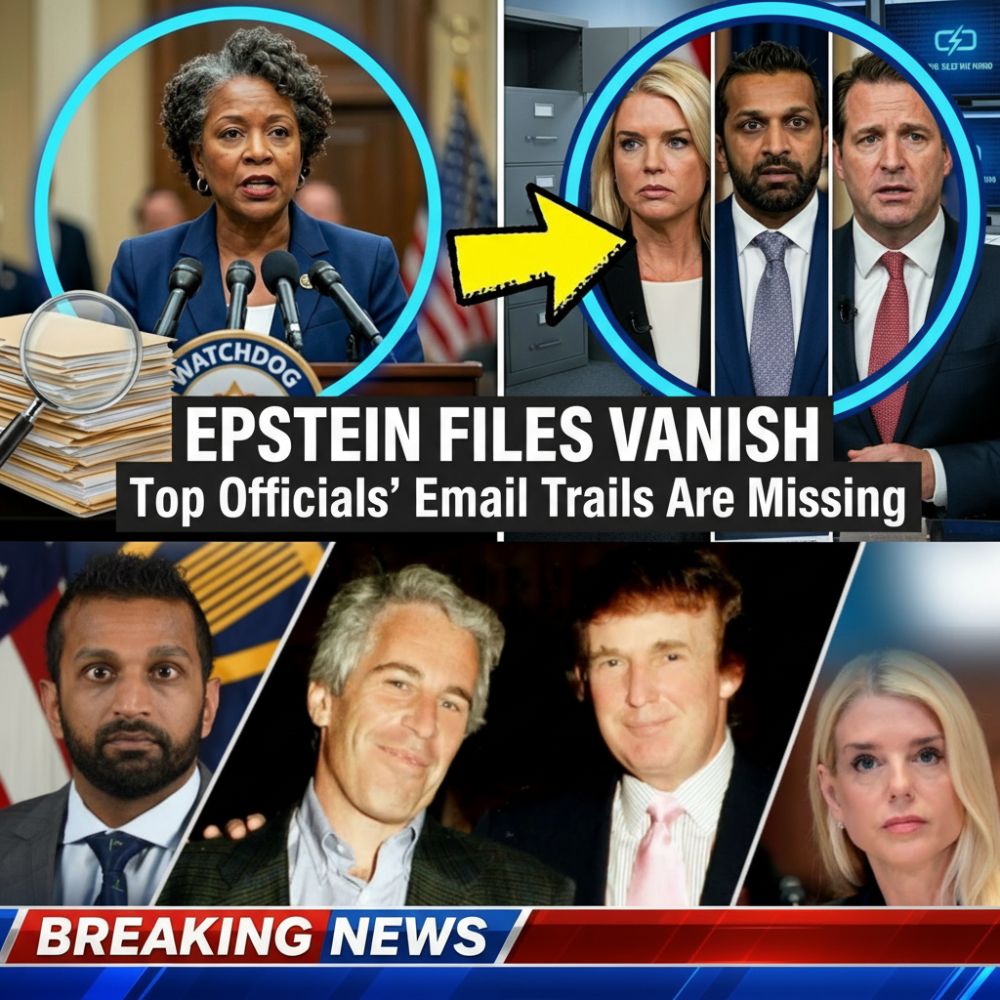
Among those 3.5 million pages, the email trails of the three most powerful officials responsible for managing the release—Attorney General Pam Bondi, Deputy Attorney General Todd Blanche, and FBI Director Kash Patel—are virtually non-existent.
In a formal complaint filed this week with the DOJ’s Inspector General, the watchdog group alleges that the communications of these three officials have been “withheld, destroyed, or redacted beyond all recognition.” This isn’t just a clerical error; it is a direct challenge to a federal law signed by the President himself. As of today, the “transparency” release has become a new center of gravity for allegations of a coordinated federal cover-up.
Part I: The Law That Bypassed the Gates
To understand the current crisis, one must look at the Epstein Files Transparency Act.
Passed by a nearly unanimous Congress and signed into law by President Trump, the act had a singular, sweeping mandate: force the Department of Justice to release everything tied to the Jeffrey Epstein investigation. The public was tired of redactions. The survivors were tired of waiting. Congress wrote the law with what experts call “maximum disclosure language,” specifically narrowing the exceptions for secrecy.
The deadline for full compliance was set for December 19, 2025.
When that date arrived, however, the DOJ delivered what critics called a “token gesture.” They released less than 1% of the total documents. After a month of intense pressure and threats of contempt from both Republican and Democratic lawmakers, the department finally performed a “document dump” on January 30, 2026, releasing over two million additional pages.
Pam Bondi and Kash Patel stood before the cameras, declaring the mission accomplished. “We have fulfilled our legal obligations,” Deputy AG Todd Blanche wrote in a letter to lawmakers.
The Democracy Defenders Fund decided to test that claim.
Part II: The Forensic Void
The audit began with simple keyword searches. The team looked for internal communications between the top three decision-makers regarding the logistics of the file dump. What they found was a digital desert.
Kash Patel (FBI Director): Despite being the most vocal public advocate for the release of the files, the audit found only two documents tied to his name or email address in the entire 3.5 million-page archive.
Pam Bondi (Attorney General): Zero emails tied to her official name were discovered in the context of the Epstein file management.
Todd Blanche (Deputy AG): Virtually invisible in the internal record.
“The Epstein Library should be replete with communications from these officials,” the Democracy Defenders Fund stated in their complaint. “They were making statements to Congress, they were issuing press releases, they were managing a multi-agency task force. For there to be no internal paper trail for these three individuals is not just suspicious—it’s an impossibility.”
Imagine a CEO of a Fortune 500 company being sued and turning over millions of pages of employee memos, while claiming that they, the CEO, never sent a single email about the matter. That is the situation currently unfolding at the Department of Justice.
Part III: The “Heavier Redactions” Mystery
The missing emails are only half of the story. The watchdog group also documented a bizarre pattern of “stealth editing” on the DOJ’s public website.
Before the January 30 dump, the group noticed that more than 70 files that had already been made public were suddenly pulled from the servers. When they were reposted hours later, they contained heavier redactions than the original versions. Sections that were once readable were now blacked out, with no audit trail, no explanation, and no public notice.
“Who does that?” asks legal analyst Sarah Jenkins. “Why would you go back and redact something that has already been downloaded and read by the public? It suggests a panic—a realization that something was missed in the first pass that the higher-ups decided was too dangerous to be in the wild.”
When asked for a response to these specific allegations, the Department of Justice issued a terse, one-sentence statement: “This is a tired narrative; just because you wish something to be true doesn’t mean it is.”
Part IV: The Cross-Party Rebellion
The DOJ’s “tired narrative” dismissal has failed to appease Capitol Hill. In a rare show of unity, Republican Congressman Thomas Massie and Democratic Congressman Ro Khanna—political polar opposites—joined forces to conduct their own review.
The two lawmakers went together to a secure DOJ facility to review unredacted portions of the archive. They emerged with the same grim expression. While they cannot legally disclose what they saw, the fact that they are now coordinating on a bipartisan demand for the “full, unvarnished record” tells a story of its own.
“This is not partisan,” says Jenkins. “When Massie and Khanna are on the same page, the Department of Justice has a massive credibility problem.”
Part V: The Super Bowl Survivors
The push for the truth has also taken to the airwaves. During the 2026 Super Bowl, a group of eight Epstein survivors partnered with an advocacy group to run a high-profile advertisement.
The ad featured the women showing their faces alongside photos of themselves at the ages they were victimized. Their message was direct: “Attorney General Bondi, release the 3 million files.”
The survivors argue that despite the DOJ’s claim of “completion,” there are at least three million additional documents—including the raw FBI interview notes with the “10 co-conspirators” who have never been charged—that remain locked in federal vaults. They allege the DOJ’s release is a violation of the very law Trump signed.
Part VI: The Trump Lawsuit
In tandem with the Inspector General complaint, the Democracy Defenders Fund has filed a formal federal lawsuit against the DOJ. This lawsuit is laser-focused on one specific set of records: references to Donald Trump and Mar-a-Lago.
The suit asks for:
All records mentioning the President or his properties in connection with the Epstein investigation.
All internal DOJ communications about how to handle those specific references.
The allegation is heavy: that DOJ leadership coordinated a strategy to “scrub” or “manage” the President’s name within the Epstein archive before it was released to the public. If the lawsuit succeeds in discovery, it could reveal exactly what Pam Bondi and Todd Blanche were discussing in those “missing” emails.
Part VII: The Legal Dead-End of “Privacy”
The DOJ has frequently cited “victim privacy,” “national security,” and “ongoing investigations” as the legal basis for its redactions. However, the watchdog group’s complaint to Acting Inspector General Don Bertomeu argues that these excuses are legally thin.
“The law was written to maximize disclosure,” the complaint reads. “The exceptions for victim privacy do not apply to internal DOJ memos between officials discussing how to comply with a Congressional mandate. You cannot use a victim’s privacy to hide a Director’s email about a website update.”
The Inspector General’s office has a policy of neither confirming nor denying active investigations, but the sheer volume of complaints—from survivors, from Congress, and from the watchdog—suggests that an internal audit is almost certainly underway.
Conclusion: The Question That Remains
Jeffrey Epstein died in 2019 under circumstances that a large portion of the public still views as suspicious. Ghislaine Maxwell is serving a decades-long sentence. But the “10 or more co-conspirators” identified by the FBI remain at large, their identities shielded by a wall of black ink and a suspiciously clean email server.
As of March 2026, the American public is left with a 3.5 million-page puzzle that is missing its most important pieces.
Why did the top three officials have no paper trail?
Why were public documents secretly re-redacted?
What was in the 3 million pages the survivors say are still missing?
The Department of Justice was built to be the “People’s Lawyer.” But when the lawyer refuses to show their work, the client has every right to be suspicious. This story isn’t just about a sex offender; it’s about whether a federal agency can decide that some truths are too big for the public to handle.
The missing emails of Pam Bondi, Todd Blanche, and Kash Patel are the “missing tapes” of our generation. And until they are found, the Epstein case remains a wound that cannot heal.