The Empty Chairs of Capitol Hill: Inside the Slow-Motion Collapse of Mike Johnson’s House Majority

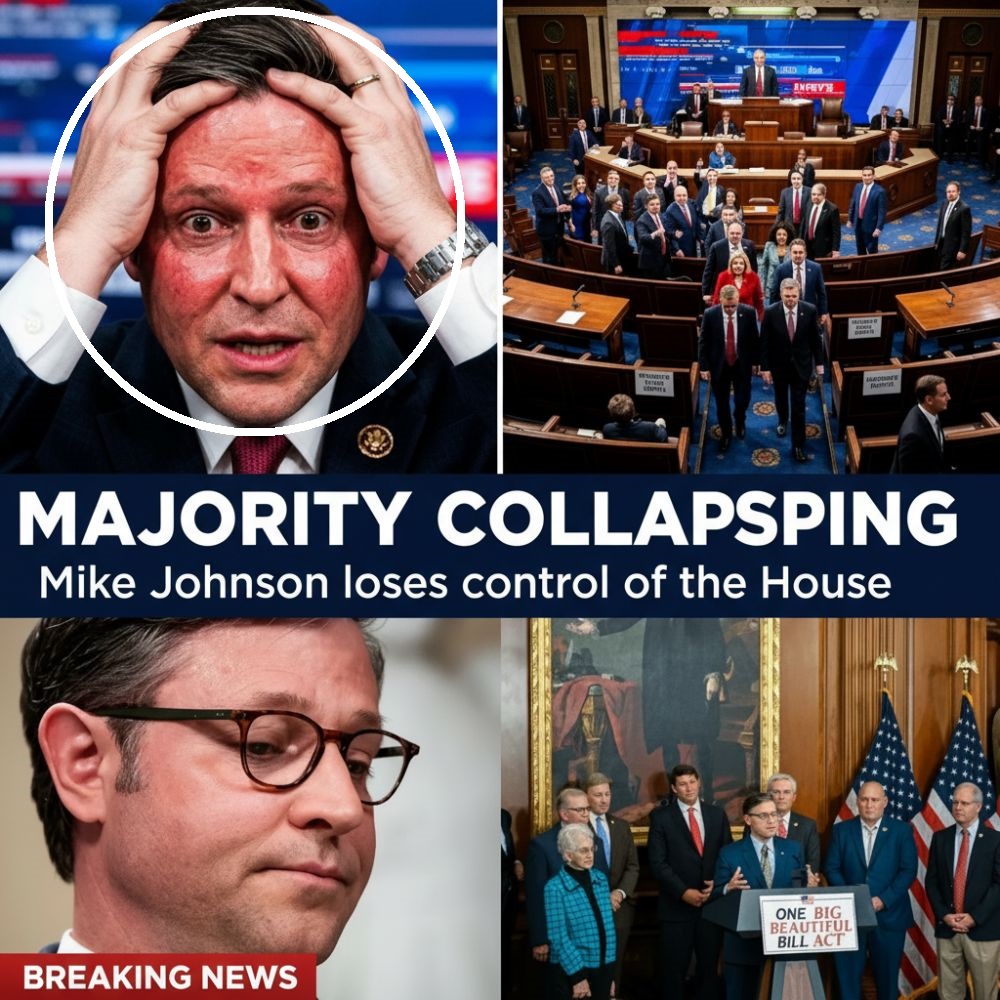
WASHINGTON D.C. — March 31, 2026. If you walked into the gallery of the United States House of Representatives last Tuesday, the first thing you would have noticed wasn’t the heated debate or the rhythmic pounding of the gavel. It was the silence. Specifically, the silence of twenty-two empty seats on the Republican side of the aisle.
In a week where Speaker Mike Johnson needed every “warm body” he could find to keep a sputtering legislative engine alive, nearly two dozen of his own members simply didn’t bother to show up. Publicly, Johnson remains the picture of Southern composure—cool, calm, and collected. But behind the heavy mahogany doors of the Speaker’s suite, the situation is spiraling into what veteran lawmakers are calling an “untenable” crisis of authority.
The Republican party currently holds one of the thinnest majorities in American history—the slimmest margins since the 1930s, before the United States had even entered World War II. The math is not just difficult; it is a mathematical executioner. With 218 Republicans facing off against 214 Democrats, Johnson has a “margin of error” of exactly one. If two Republicans defect, a bill dies. If twenty-two are absent, the majority effectively evaporates.
As the nation drifts into the 42nd day of a Department of Homeland Security (DHS) shutdown, with TSA lines stretching for hours and federal workers missing paychecks, the “House of Cards” is beginning to feel the first gusts of a pre-midterm gale.
Part I: The Math of Despair
To understand why 22 absences on a random Tuesday in March constitute a national news story, one must look at the structural fragility of the 119th Congress.
The Republican agenda currently sits on a razor’s edge. Unlike the Democrats, who can afford a few “no-shows” because they are in the minority and lack the burden of governing, Johnson is responsible for keeping the lights on. But his “team” is increasingly looking like a group of people who have already called for the moving van.
The Great Resignation:
Currently, 36 House Republicans have announced they will not seek re-election. This isn’t just a high number; it’s a record-breaker, surpassing the “Blue Wave” year of 2018, when 34 Republicans walked away. In the world of politics, a member who isn’t running again is a “Lame Duck” with a shortened attention span. They aren’t worried about party discipline; they are worried about their next board seat, their next campaign for Governor, or simply their next vacation.
“Nobody in the conference actually thinks they’re keeping the majority after the midterms,” one House Republican told me, speaking on the condition of anonymity. “Nobody except maybe Johnson himself. And when you think you’re going to lose, you start acting like it. You stop taking the hard votes. You stop showing up on Tuesdays.”
Part II: Governing by Permission Slip
The desperation of the GOP leadership has reached levels that border on the macabre. During a high-stakes War Powers vote on Venezuela earlier this year, leadership kept the voting clocks open for over an hour. Why? They were waiting for Rep. Wesley Hunt of Texas to literally drive to the Capitol and walk through the doors.
But that was nothing compared to the “Mother’s Death” incident. In a moment that has become a dark legend in the cloakrooms, a Republican member was informed while at the Capitol that his mother had passed away. Leadership, cognizant of the one-vote margin, reportedly had to ask the grieving member to stay for several more hours to cast a crucial vote before departing to be with his family.
Then there is the “Medical Flight” case: a Republican member with a severe heart condition was told by his doctors not to fly. Fearing a legislative collapse, GOP leaders called him anyway. He boarded the plane, risked his health, and cast his vote.
This isn’t “leadership”—it’s a hostage situation where the hostages are the legislators themselves. And now, with 22 members missing on a Tuesday, the “hostages” appear to be staging a silent walkout.
Part III: The “Joke” That Shut Down the Government
The attendance crisis is occurring against the backdrop of a catastrophic failure to fund the Department of Homeland Security. We are currently at Day 42 of a partial shutdown that has turned American airports into a theater of the absurd.
Because TSA workers are not being paid, call-out rates have spiked to 40% at some hubs. Over 500 officers have resigned. As spring break travel hits its peak, lines in Atlanta and New Orleans are reaching three-hour wait times.
Last week, the Senate—led by Republicans—passed a bipartisan compromise. It funded the TSA to get the airports moving but excluded new funding for ICE and Border Patrol, a concession required to bypass a Democratic filibuster.
Mike Johnson looked at the deal his own Senate colleagues had hammered out and called it a “joke.” He rejected it, passed a House version that funds everything for only eight weeks (knowing it would never pass the Senate), and then sent the House home for a two-week Easter recess.
Congress is currently on vacation while the people protecting the border and the airports are working for free. It is a visual that Democratic candidates are already using in campaign ads from Maine to California.
Part IV: The Centrist Revolt—The Discharge Petition
While the hardliners are pulling Johnson to the right, the centrists are pulling him apart.
In an almost unprecedented move, four centrist Republicans from “swing” districts did the unthinkable: they signed a Discharge Petition. This is a procedural nuclear option that allows a majority of the House to force a vote on a bill without the Speaker’s permission. They teamed up with Democrats to force a vote on extending Obamacare tax credits for three years.
These aren’t the “usual suspects” or the “troublemakers.” These are the “get-along” members—the ones Johnson relies on for every routine vote. They snapped because they are terrified. Recent polling shows that 74% of voters want those health care subsidies extended. If they expire, premiums will skyrocket, and these four Republicans know they will be the ones held responsible in November.
This marks the fourth discharge petition to reach 218 signatures this year—the most for any Congress since the Great Depression. It is the clearest sign yet that the Speaker has lost the floor.
Part V: The Midterm Dread
The “Empty Chairs” are a symptom of a deeper malaise: the 2026 Midterm Election. Historically, the party in the White House almost always loses seats in the midterms. With a margin of only four seats, Republicans can afford to lose exactly three and still hold the gavel.
But the “vibe” in Washington doesn’t suggest a party confident in its prospects. Democrats have recently over-performed in special elections in Virginia and Tennessee—regions where Republicans expected to walk away with easy wins. These results have sent a chill through the GOP conference.
When swing-district Republicans see their party leadership feuding with Senate Republicans, calling bipartisan deals “jokes,” and presiding over airport chaos, they stop worrying about “The Agenda.” They start worrying about “The Survival.”
Part VI: The Untenable Situation
When CNN’s Manu Raju asked House Minority Leader Hakeem Jeffries if Johnson had lost control of the House, Jeffries didn’t need to use words. He simply smiled and said, “The situation speaks for itself.”
He’s right. When a Speaker has to pull his own priority bills—like the “SCORE Act”—off the floor because his own members are blocking them, he is a Speaker in name only. When he has to cancel votes because he can’t guarantee his members will show up, he is a manager of a ghost town.
Conclusion: The Looming Storm
The biggest votes of the year—housing, surveillance powers, and the final resolution of the DHS shutdown—have yet to happen. If Mike Johnson is losing 22 people on a Tuesday with nothing on the schedule, what happens when the “Real Stuff” hits the floor?
One more resignation, one more health crisis, or one more primary loss, and the Republican majority doesn’t just “flicker”—it goes out.
Right now, Mike Johnson is walking a tightrope across a canyon. He is looking ahead at the 2027 transition, but he is failing to notice that the rope behind him is fraying and the people holding it have already started to let go. This isn’t a story of political strategy; it’s a story of political exhaustion.
Washington is a city built on the premise of “showing up.” And right now, the Republican party is simply staying home.
Expert Follow-up: With 36 re-election opt-outs and consistent high-profile absences, is the House GOP majority currently a “functioning” legislative body, or has the United States entered a period of “Legislative Interregnum” until the 2026 midterms? How does this affect national security during the DHS shutdown?