A Message Echoes Back: A Social Media Clash Draws Global Attention
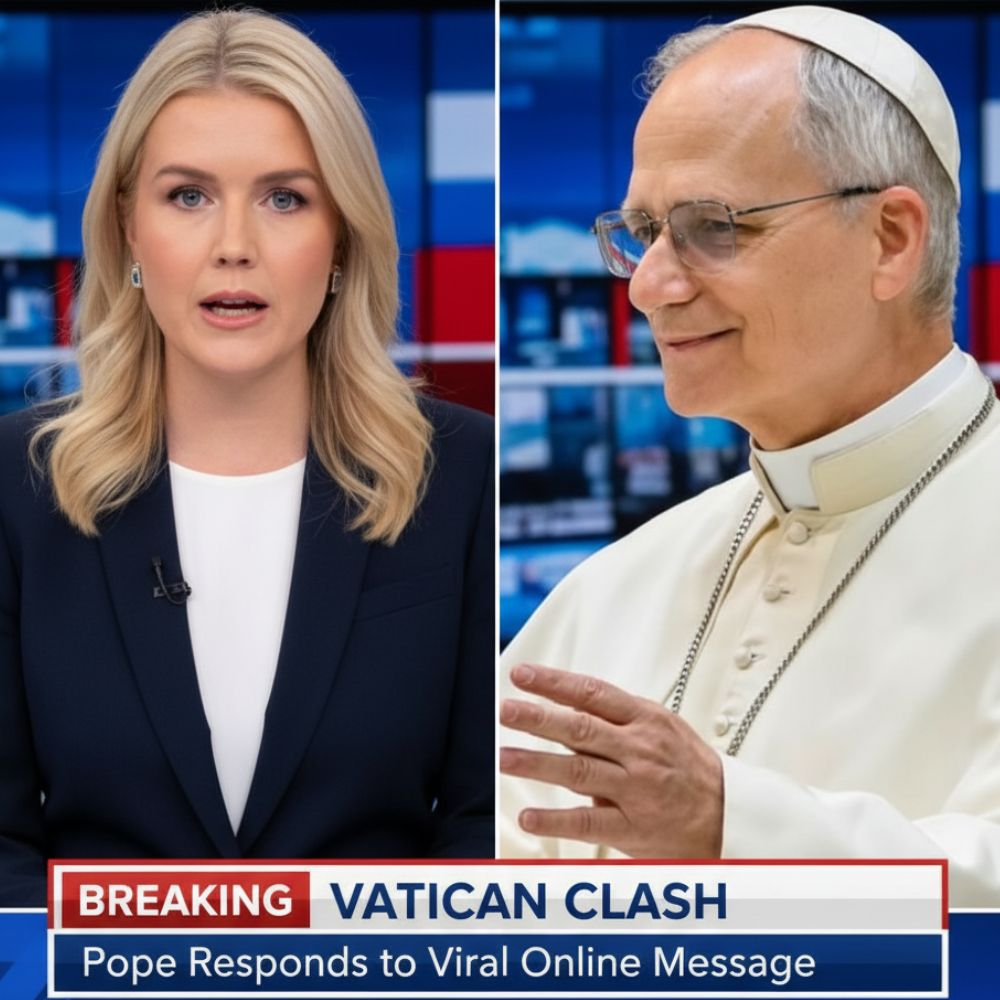
A brief but striking exchange between Karoline Leavitt and Pope Leo XIV has captured international attention, highlighting once again how quickly modern communication can reshape public discourse.
The moment began with a social media post.
Leavitt, known for her direct and often assertive communication style, shared a message that quickly gained traction online. The post, which included the phrase “You need to be silent!”, appeared to respond to recent remarks attributed to the Pope regarding global issues. While the original context of the Pope’s comments varied across reports, they were generally understood to touch on themes of peace, diplomacy, and moral responsibility.
At first, the exchange seemed like another example of the increasingly common intersection between politics and social media.
But what happened next elevated the situation into a widely discussed international moment.
During a televised address from Vatican City, Pope Leo XIV referenced the message directly. In a calm and measured tone, he read the tweet aloud in full, pausing briefly afterward before offering a response that would soon be shared across global media.
Observers described the moment as unexpected and quietly powerful.
Rather than responding with criticism or escalation, the Pope addressed the broader theme of communication and respect. He spoke about the importance of dialogue, especially in times of disagreement, and emphasized that public discourse should aim to build understanding rather than deepen division.
His remarks, while not lengthy, carried a tone that contrasted sharply with the bluntness of the original message.
Within minutes, clips of the televised moment began circulating online. Media outlets including CNN and BBC News highlighted the exchange, noting how the Pope’s response appeared to shift the tone of the conversation.
Analysts were quick to point out the symbolic nature of the moment.
“In today’s media environment, it’s rare to see a response that de-escalates rather than intensifies,” one communications expert explained. “The contrast between the original message and the reply is what made it resonate.”
Leavitt, for her part, later addressed the situation through additional statements, clarifying her position and reiterating her views on the issues that had prompted her initial comment. While she did not retract her words, her follow-up messages reflected an awareness of the widespread attention the exchange had generated.
Public reaction has been diverse.
Some commentators praised the Pope’s approach, viewing it as an example of measured leadership in the face of criticism. Others defended Leavitt’s right to express her perspective, noting that political figures often use strong language to convey urgency or conviction.
The incident has also sparked broader conversations about the role of social media in shaping political and cultural dialogue.
Platforms that allow for instant communication can amplify messages rapidly, often without the context that might accompany more traditional forms of public speech. This can lead to misunderstandings, but it can also create opportunities for unexpected moments of clarity.
In this case, the decision to address the tweet in a formal televised setting added a layer of significance.
Televised addresses from the Vatican are typically reserved for matters of global or spiritual importance. By incorporating a direct reference to a social media post, the Pope effectively bridged two very different forms of communication—one immediate and informal, the other deliberate and ceremonial.
Experts suggest that this blending of formats reflects a broader shift in how public figures engage with audiences.
“The lines between traditional media and digital platforms are increasingly blurred,” said one media analyst. “What we’re seeing is a new kind of dialogue, where messages can move from a tweet to a global broadcast in a matter of hours.”
The implications of this shift are still unfolding.
On one hand, it allows for greater engagement and responsiveness. On the other, it raises questions about tone, accountability, and the long-term impact of public statements made in the heat of the moment.
For many observers, the exchange serves as a reminder of the power of words.
Whether delivered in a tweet or a televised address, language shapes perception and influences how messages are received. The contrast between a brief directive and a measured response can, in itself, become a point of reflection.
As discussions continue, both supporters and critics of the individuals involved are likely to interpret the moment through their own perspectives.
What remains clear is that the exchange has transcended its initial context, becoming part of a larger conversation about communication, leadership, and the evolving nature of public discourse.
In an era defined by rapid information flow and constant connectivity, moments like this stand out not only for what was said, but for how it was said—and how it was answered.
Ultimately, the incident underscores a simple but enduring principle: in public life, every message carries weight, and the way it is delivered can shape its impact far beyond its original intent.