The Two Fronts of Truth: Midnight Missiles and Redacted Files
As the first quarter of 2026 unfolds, the American political landscape is being defined by two distinct but equally explosive crises. One is a conventional war in the Middle East, launched with the flash of a cruise missile in the dead of night. The other is a constitutional war in a D.C. hearing room, fought with the scratch of a highlighter and the weight of a congressional subpoena.
While thousands of miles separate the Zagros mountains of Iran from the wood-paneled walls of the House Judiciary Committee, both events represent a historic stress test for American governance. At the heart of each lies a singular, haunting question: Who controls the record, and what happens when the record is found to be a lie?
I. Operation Epic Fury: The Architecture of an Unauthorized War
On February 28, 2026, the United States and Israel launched a massive aerial offensive against Iran. Dubbed “Operation Epic Fury,” the campaign was presented to the American public via a Truth Social video as a necessary “obliteration” of Iran’s nuclear capabilities. However, as the smoke clears over Tehran and Isfahan, the legal and strategic foundations of the war are under intense scrutiny.
The Constitutional Vacuum
The strikes were executed without a formal declaration of war or specific authorization from Congress. The administration’s reliance on the 2001 Authorization for Use of Military Force (AUMF) has been widely condemned by legal scholars and bipartisan lawmakers alike. To claim that a document intended to target the perpetrators of 9/11 allows for a full-scale assault on a sovereign state like Iran in 2026 is, in the words of Representative Thomas Massie, “a constitutional hallucination.”
The “Obliteration” Contradiction
A central point of contention is the President’s claim of “total victory.” In June 2025, the administration conducted initial strikes, claiming they had effectively neutralized Iran’s nuclear program. Yet, eight months later, those same facilities were targeted again.
The Claim: “We obliterated their program in 2025.”
The Reality: February 2026 strikes targeted the same reactors at Natanz and Fordow.
If the facilities were destroyed in 2025, the current bombing is either redundant or, more likely, the initial claim of “obliteration” was a political fiction. This discrepancy mirrors the “Mission Accomplished” rhetoric of 2003, suggesting that the intelligence being presented to the public is being shaped by political convenience rather than tactical reality.
Politics
II. The Epstein Files: A Masterclass in Manufactured Silence
While missiles fell on Iran, Attorney General Pam Bondi faced a different kind of bombardment on Capitol Hill. The hearing, dominated by the implementation of the Epstein Files Transparency Act, exposed a systemic failure within the Department of Justice (DOJ) to comply with its own transparency mandates.
The Massie Trap: Two Documents, One Truth
The defining image of the hearing was Representative Thomas Massie holding two versions of the same DOJ page. The first, released under the previous administration, was unredacted. The second, released by Bondi’s DOJ, featured a black box over a name that had been public for 18 months.
| Version | Status | Name Visibility |
| Pre-2025 Release | Public | Visible (7 Letters) |
| 2026 DOJ Release | “Transparent” | Redacted (Black Box) |
Massie’s point was surgical: this wasn’t about protecting “national security” or “victim privacy.” It was about reclassification—an attempt to pull information out of the public square and hide it behind the veil of executive privilege.
The Co-Conspirator Label
The tension reached a breaking point when the discussion turned to Leslie Wexner. While the DOJ had previously suggested Wexner was merely a “witness” or an “associate,” Massie produced a document where Wexner was explicitly listed as a co-conspirator in child sex trafficking. The fact that this label had been hidden from the public record until “forced” out by subpoena suggests a deliberate effort to sanitize the history of the Epstein network.
III. The Ted Lieu Exchange: Perjury or Procedure?
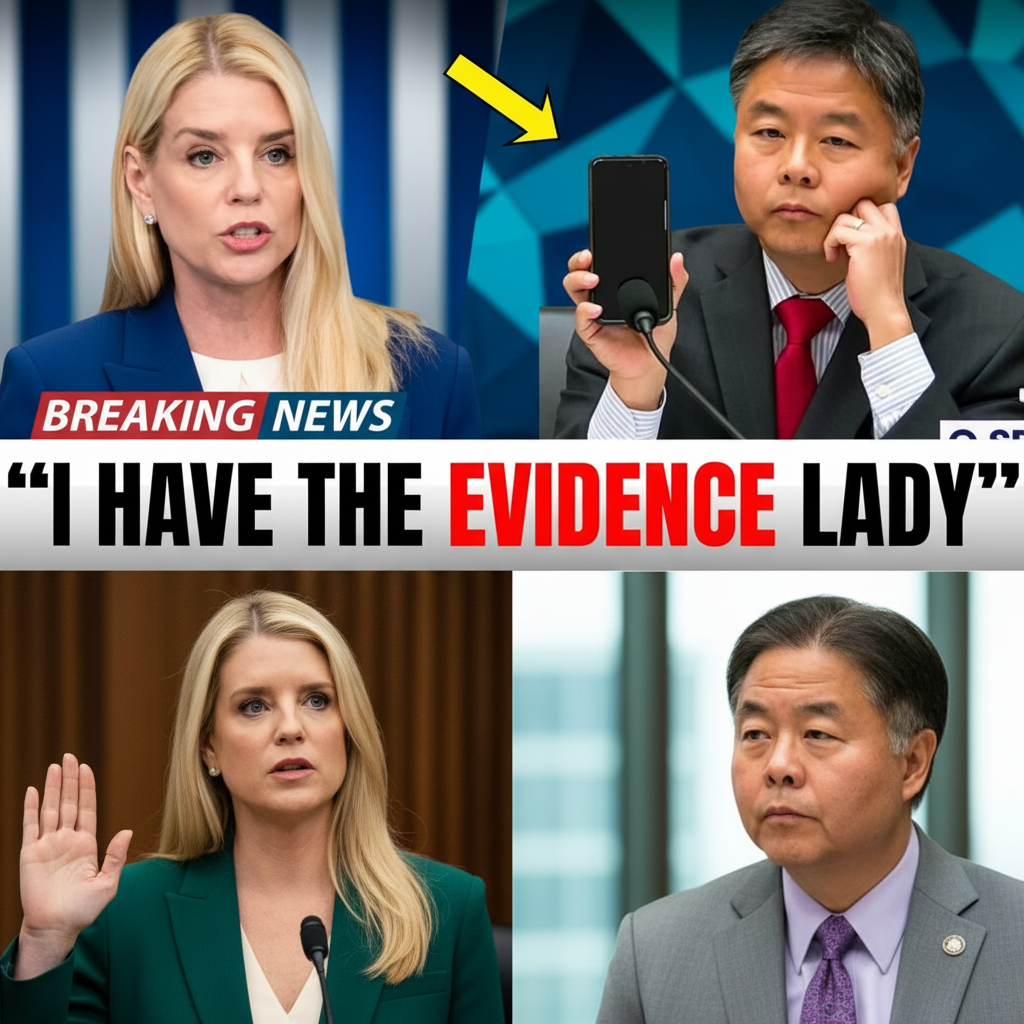
If Massie provided the physical evidence, Representative Ted Lieu provided the legal escalation. In a viral exchange, Lieu confronted Bondi with a document she had just denied existed.
Lieu: “Attorney General Bondi, I am holding a document that matches the exact description you just denied exists. It is stamped, dated, and signed. One of us is telling the truth.”
Bondi’s refusal to even look at the document—opting instead to pivot to the “complexity of the filing system”—created a visual that many observers called the “death of institutional credibility.” When an Attorney General claims she “lost” a subpoenaed document about Jeffrey Epstein’s associates, it is no longer an administrative error; it is a system of avoidance.
IV. The Human Cost of Institutional Defensiveness
Perhaps the most damning moment of the hearings occurred when Representative Pramila Jayapal asked the Epstein survivors present in the room to raise their hands if they had been consulted by the DOJ before their sensitive information (including real names and images) was released.
Every hand went up. The DOJ’s strategy appears to be a cruel inversion of transparency: exposing the victims while shielding the powerful. By releasing 3.5 million pages of “noise” while redacting the specific names of alleged co-conspirators, the department is using the volume of information as a shield against accountability.
V. Conclusion: The Patterns of the Unraveling
History is not repeating as a metaphor in 2026; it is repeating as policy.
-
The Iraq Parallel: Launching a war on exaggerated intelligence without a day-after plan.
-
The Watergate Parallel: Systematic efforts to redact, reclassify, and deny the existence of incriminating evidence.
The “unraveling” of constitutional governance is rarely a single, dramatic collapse. It is a series of quiet decisions: a vote canceled by Speaker Johnson, a name blacked out by a DOJ pen, a document “lost” in a subsection of a subsection.
The American public is being asked to accept a new normal where the executive branch operates beyond the reach of the law and the oversight of Congress. But as Thomas Massie reminded the room, “Ink covers words; it doesn’t cover patterns.” The patterns are now visible for all to see.