Stephen Colbert has built a career exposing political contradictions with humor, but Tuesday night’s segment crossed into something far more surgical and far more damaging.
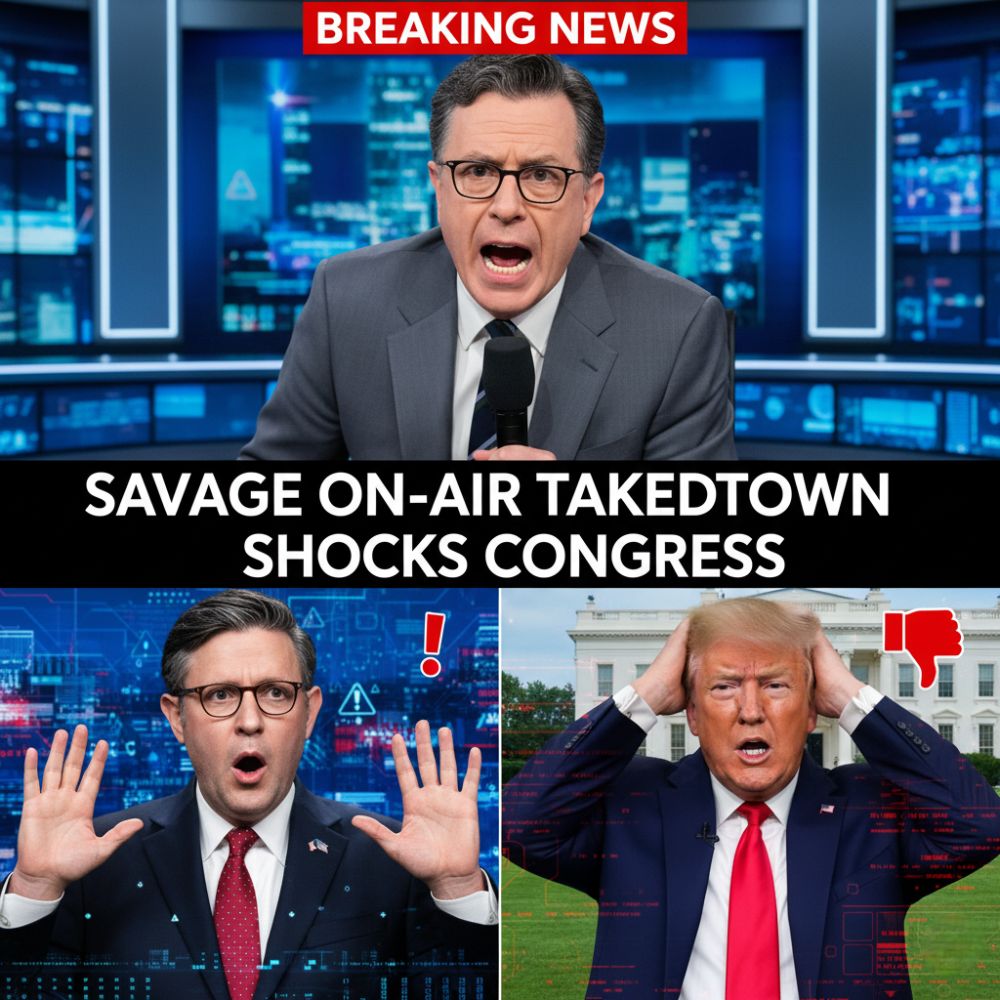
Opening with an almost eerie calm, Colbert targeted Speaker Mike Johnson’s repeated claims of “transparency.”
Then came the line that froze the studio:
“When Johnson talks about transparency,” Colbert said, “he apparently means everyone except himself.”
The audience laughed until they didn’t.
What followed was a meticulously edited montage showing Johnson contradicting himself across multiple interviews, votes, and public statements.
Each clip played side by side. Each contradiction undeniable.
Social media would later dub it “the most merciless on-air fact-check ever broadcast.”
But Colbert wasn’t finished.
The segment escalated when a graphic appeared on screen, highlighting Johnson repeating Donald Trump’s talking points nearly word for word across different appearances.
Colbert paused, looked into the camera, and delivered the line that reportedly sent shockwaves through Capitol Hill:
“It’s almost impressive. A Speaker who doesn’t just support Trump he syncs with him like a teleprompter.”
The laughter stopped. The studio went silent.
According to multiple political insiders, Mike Johnson was watching live and immediately erupted.
One GOP aide described the scene bluntly:
“He absolutely lost it. Yelling. Pacing. Demanding conservative networks hit back immediately.
He kept saying Colbert was running a coordinated political ambush.”
Sources say the meltdown lasted nearly an hour, with frantic calls to allies, media surrogates, and party strategists.
The goal: regain narrative control before the clip spread.
But it was already too late.
Within minutes, the segment exploded online. Millions of views. Trending hashtags. Endless replays.
Commentators across the political spectrum weighed in, many calling it:
“The most humiliating on-air moment any Speaker has suffered in modern political television.”
Some conservatives accused Colbert of weaponizing comedy. Others quietly admitted the segment hit uncomfortably close to home.
Democrats, meanwhile, framed it as long-overdue accountability.
Political analysts now argue that the damage extends beyond Johnson himself.
“What Colbert did,” one media strategist said, “wasn’t just embarrass Johnson.
He exposed the entire operation standing behind him the messaging discipline, the alignment, the lack of independence.”
That assessment may explain the intensity of Johnson’s reaction.
In today’s media ecosystem, perception is power.
And in under ten minutes, Colbert shattered a carefully maintained image – live, unfiltered, and impossible to retract.
Late-night television has often been dismissed as entertainment.
But moments like this remind Washington that comedy, when armed with facts, can be devastating.
As the clip continues to circulate, one question now dominates political conversations:
Did Stephen Colbert merely roast Mike Johnson – or did he permanently redefine how vulnerable modern political leadership has become under the spotlight?
Washington is still reeling. And the aftershocks are far from over.