On a deliberately dramatized late-night segment framed as speculative political theater, Stephen Colbert introduced a hypothetical scenario designed to test how Americans process explosive claims in real time.
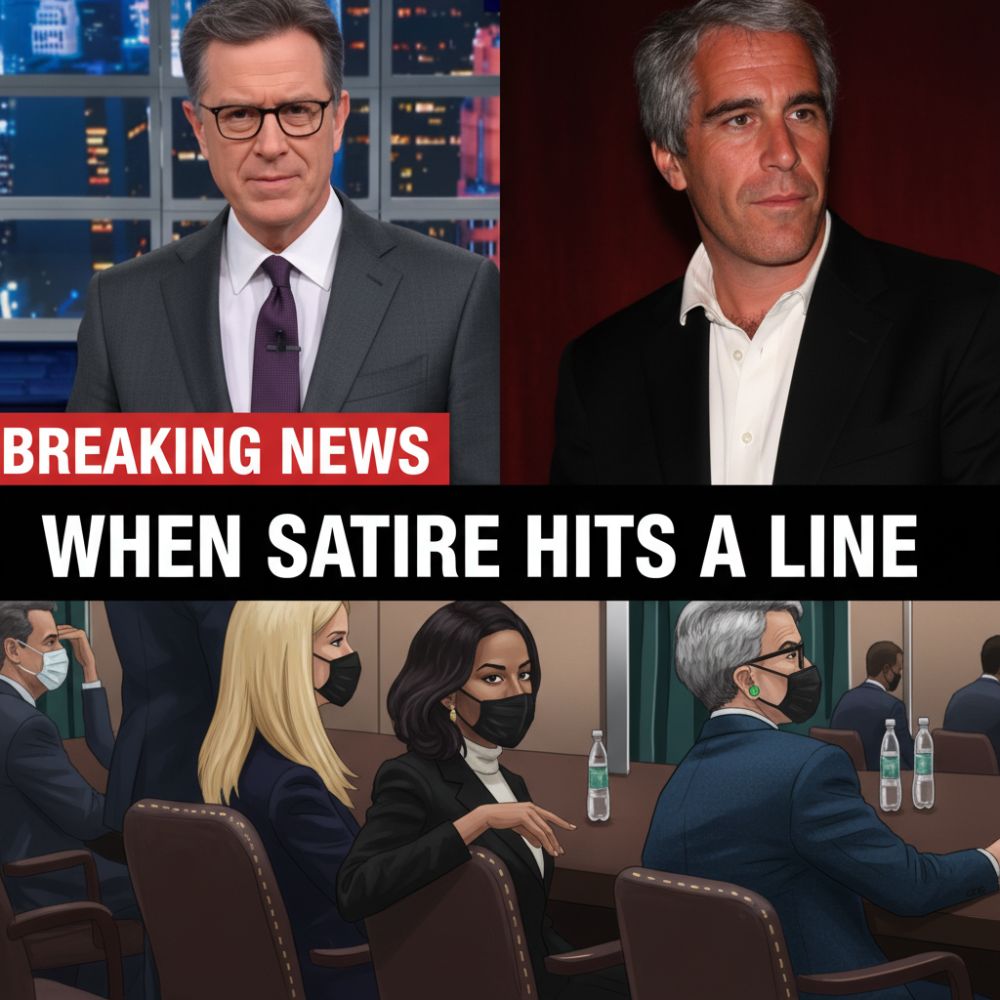
He warned viewers from the outset that the segment was fictional, yet argued that imagination often reveals structural weaknesses in public trust more effectively than straightforward reporting ever could.
In this constructed narrative, Colbert described an imagined mass release by the United States Department of Justice involving tens of thousands of newly unsealed Epstein-related pages.
The fictional scale alone carried psychological weight, because volume suggests significance even before context, verification, or legal interpretation enter the public conversation.
According to the scenario, the documents repeatedly referenced prominent figures, including Donald Trump, framed carefully as mentions rather than conclusions or findings.
Colbert emphasized that repetition does not constitute guilt, while acknowledging that repetition reshapes public perception once fragments circulate independently across social platforms.
The imagined pages allegedly detailed disputed associations, social overlaps, and unresolved rumors connected to Ghislaine Maxwell, presented strictly as narrative elements within the fictional exercise.
Colbert paused repeatedly to stress that satire crosses into danger when audiences replace critical reading with emotional certainty.
Within the hypothetical framework, Jeffrey Epstein functioned less as an individual and more as a symbol of institutional opacity and elite insulation.
The scenario suggested fictional subpoenas and correspondence pointing toward Mar-a-Lago, clearly labeled as imagined constructs rather than actual legal developments.
Colbert framed the exercise as an exploration of how transparency shocks systems built on secrecy, regardless of whether accusations ultimately prove unfounded.
Despite explicit disclaimers, the segment’s breaking-news tone generated urgency that spilled rapidly into online interpretation and reaction.
Clips circulated stripped of qualifying language, as hypothetical framing hardened into declarative captions within minutes.
Supporters of Trump condemned the segment as irresponsible, arguing that fictional narratives still generate reputational harm in polarized information environments.
Critics countered that the segment exposed how secrecy breeds suspicion, insisting the discomfort revealed deeper structural failures.
Media ethicists quickly entered the discussion, debating whether satire should shoulder heavier responsibility when real individuals anchor fictional scenarios.
The fictional storm intensified as commentators argued intent versus impact, questioning whether disclaimers retain power once virality takes over.
Colbert’s imagined insiders whispered about cover-ups, not as accusations, but as reflections of how distrust fills informational vacuums.
The phrase “hidden truth” trended widely, despite never being defined, illustrating how ambiguity itself becomes combustible online.
Political analysts noted how rapidly audiences substitute narrative alignment for verification when emotional payoff is high.
The hypothetical DOJ release became a cultural Rorschach test, revealing ideological reflexes rather than factual conclusions.
Some viewers praised Colbert for exposing America’s appetite for scandal and spectacle, arguing the segment functioned as media literacy by provocation.
Others accused him of blurring boundaries already dangerously thin between satire and perceived reporting.
The debate spilled into daytime television, podcasts, and academic forums examining satire’s role in democratic resilience.
Colbert maintained composure throughout the controversy, reiterating that democracy weakens when judgment is outsourced to outrage cycles.
In the fictional timeline, calls for radical transparency surged, even as legal scholars warned that documents without context mislead.
The segment deliberately mimicked emergency-news pacing to demonstrate how presentation shapes belief before substance is evaluated.
Viewers admitted feeling unsettled precisely because the scenario mirrored real information cascades so closely.
That discomfort became the segment’s core achievement, forcing reflection on how speculation often outruns verification.
As sharing intensified, algorithms rewarded emotional certainty rather than skepticism, accelerating polarization.
The fictional release overshadowed real policy discussions, reinforcing Colbert’s critique of attention economics.
Comment sections fractured into hostile camps accusing each other of blindness or malicious intent.
Educators later cited the segment as a teaching tool demonstrating how hypothetical language collapses during viral transmission.
Law professors emphasized repeatedly that mentions, associations, and subpoenas are not verdicts, regardless of frequency or volume.
The scenario revived broader discussion about Epstein’s legacy as a permanent amplifier of scandal rather than a closed chapter.
Colbert closed the segment by asking viewers to examine their own interpretive discipline.
Can a society distinguish inquiry from indictment once spectacle dominates attention.
That question lingered long after the broadcast ended.
In subsequent days, the fictional storm resurfaced whenever institutional trust wavered.
Supporters and critics alike continued sharing the clip, each convinced it validated their worldview.
The irony was unavoidable.
A hypothetical narrative about misinformation became a live demonstration of its mechanics.
Colbert later reiterated publicly that no such DOJ release existed in reality.
That clarification traveled far slower than the initial shock.
Analysts concluded the episode exposed America’s vulnerability to narrative velocity.
Truth now competes with drama on uneven ground.
The Epstein pages never existed, but the reactions did.
Those reactions mapped fear, loyalty, suspicion, and outrage with unsettling clarity.
In that sense, the segment succeeded beyond satire.
It forced a national argument not about guilt, but about judgment.
Not about documents, but about discipline.
Not about names, but about narratives.
As the debate continues, the lesson remains unresolved.
Transparency without context destabilizes.
Silence without trust corrodes.
And between them, satire exposes both.