From Celebrity Outrage to Political Flashpoint: How a Viral Tirade Reignited America’s Debate on Leadership, Power, and Public Trust
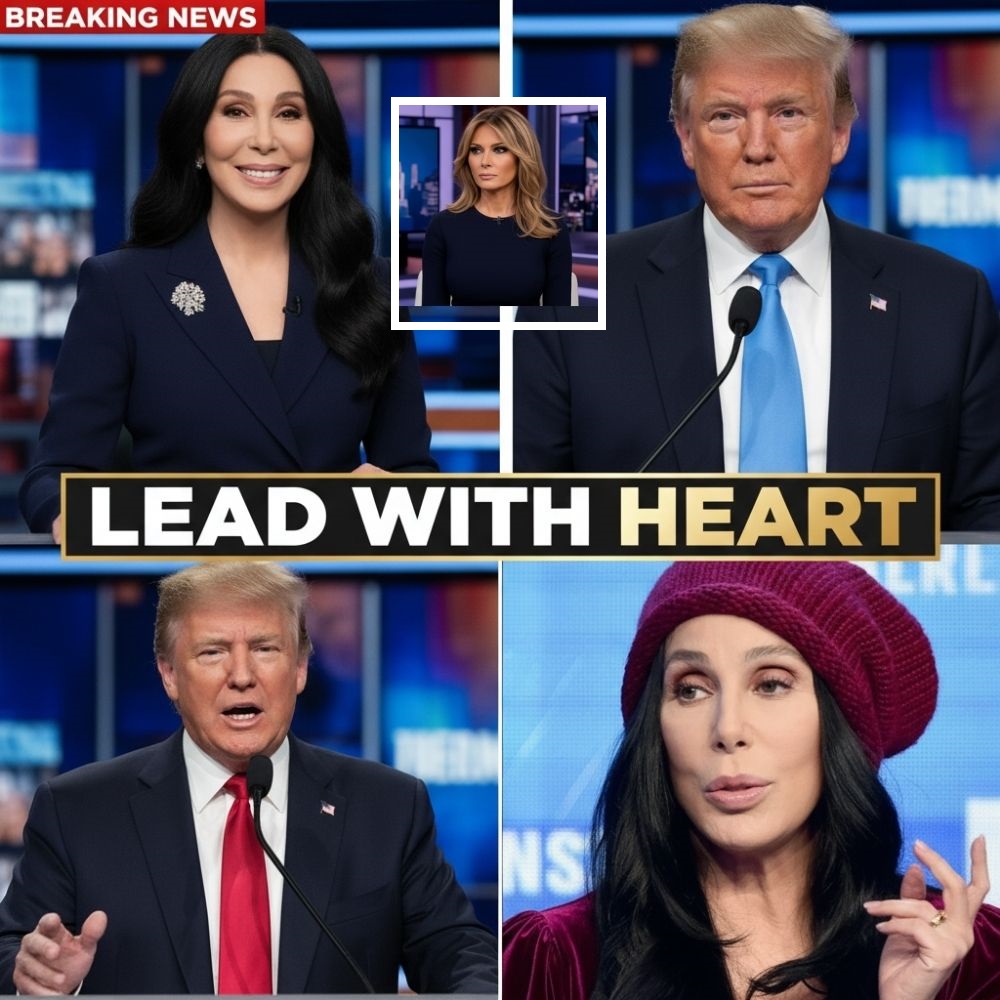
In an age where political discourse increasingly unfolds beyond podiums and press briefings, a single interview can ignite a national conversation. That is precisely what happened when a fiery, deeply personal critique—delivered not by a politician, but by an entertainer—swept across social media, cable news, and political commentary circles.
At the center of the storm was Cher, whose unfiltered remarks about Donald Trump quickly transformed from a moment of celebrity candor into a broader political flashpoint.
What began as a raw, emotional outpouring evolved into something more significant: a renewed national debate about leadership, truth, and the boundaries between personal opinion and political influence.
A Moment That Broke Convention
Unlike carefully scripted political speeches, Cher’s remarks did not follow the rules of diplomacy.
There were no talking points. No measured phrasing designed to appeal across party lines. Instead, what viewers saw was something rare in modern media—a completely unfiltered emotional response.
She described Trump in stark, often harsh terms, questioning not only his competence but his character. She spoke about what she saw as a lack of empathy, a hunger for attention, and a leadership style driven more by performance than responsibility.
“I don’t think he has the milk of human kindness in him,” she said at one point, invoking a phrase that has historically been used to question a person’s basic compassion.
The comment, though dramatic, resonated widely—not because it introduced new criticism, but because it expressed existing concerns in unusually direct language.
Beyond Insult: A Deeper Accusation
While much of the immediate reaction focused on the tone of Cher’s remarks, political analysts quickly noted that her critique went beyond personal insult.
At its core, her argument centered on a fundamental question: Does leadership require empathy?
Cher suggested that it does—and that its absence can have far-reaching consequences.
She argued that Trump’s rhetoric and actions had contributed to a rise in division, mistrust, and what she described as “a certain kind of supremacy.” These claims echoed concerns raised by critics across the political spectrum, who have long debated the social impact of Trump’s political style.
Importantly, she framed her criticism not as partisan disagreement, but as a moral judgment formed over decades of observation.
“I’ve been alive for 14 presidents,” she said. “I’ve never seen anything like this.”
The Power of Personal Testimony
In political discourse, data and policy often dominate the conversation. But moments like this highlight the enduring power of personal testimony.
Cher’s remarks carried weight not because of empirical evidence, but because of lived experience. As a public figure who has witnessed multiple administrations, her perspective was framed as longitudinal—a comparison across time.
This is a powerful rhetorical tool.
It shifts the debate from “Is this policy effective?” to “Is this normal?”
And in doing so, it invites audiences to reconsider their own perceptions.
Trump’s Political Persona: Strength or Spectacle?
Central to Cher’s critique was her characterization of Trump as a figure more interested in attention than governance.
“He doesn’t want to be president,” she said. “He wants the crowds.”
This distinction—between leadership as responsibility and leadership as performance—has been a recurring theme in analyses of Trump’s political career.
Supporters argue that his ability to command attention is a strength. They see his rallies, media presence, and direct communication style as evidence of authenticity and connection with the public.
Critics, however, interpret these same traits differently. They argue that an emphasis on spectacle can come at the expense of substance, prioritizing visibility over policy.
Cher’s remarks aligned firmly with the latter perspective.
The Escalation of Language in Political Culture
One of the most striking aspects of the interview was its language.
The tone was not just critical—it was openly hostile. At times, it bordered on the kind of rhetoric more commonly found in private conversations than public broadcasts.
This raises an important question: What role does language play in shaping political culture?
Over the past decade, the boundaries of acceptable political speech have shifted. Social media has blurred the line between public and private expression, encouraging immediacy and emotional intensity.
In this environment, statements that might once have been considered too extreme for broadcast are now commonplace.
Cher’s interview reflects this shift.
It is both a product of the current media landscape and a contributor to it.
Historical Comparisons and Controversial Analogies
Among the more controversial elements of the interview were historical comparisons.
Cher referenced moments like Brexit, suggesting that public anger can lead to political decisions with unintended consequences.
She also alluded to authoritarian rhetoric, drawing parallels that, while not uncommon in political discourse, remain deeply contentious.
Such comparisons are powerful, but they are also risky.
They can sharpen arguments, but they can also polarize audiences further, reinforcing existing divisions rather than bridging them.
The Role of Celebrity in Political Discourse
Cher is far from the first celebrity to enter the political arena. From actors to musicians, public figures have long used their platforms to express political views.
But the influence of celebrity voices has grown significantly in recent years.
Social media allows celebrities to bypass traditional media filters, speaking directly to millions of followers. Their statements can spread rapidly, shaping narratives and influencing public opinion.
This raises a critical question: Should celebrities play a role in political discourse?
Supporters argue that they have a right—and even a responsibility—to use their platforms for advocacy.
Critics counter that celebrity influence can oversimplify complex issues, reducing nuanced debates to emotional reactions.
Cher’s interview sits at the intersection of this debate.
Public Reaction: Division and Amplification
The response to the interview was immediate and polarized.
Supporters praised Cher for her honesty, viewing her remarks as a courageous stand against what they see as dangerous leadership.
Critics, meanwhile, condemned the tone, arguing that such language contributes to the very division it seeks to criticize.
Social media platforms became battlegrounds for these competing interpretations. Clips of the interview were shared widely, often stripped of context, with each side highlighting different moments to support their narrative.
This pattern is increasingly common.
In the digital age, moments are not just experienced—they are curated.
The Broader Political Context
To understand the significance of this moment, it is important to place it within the broader political landscape.
The United States remains deeply divided along political lines. Trust in institutions is low. Public discourse is often characterized by conflict rather than consensus.
In this context, statements like Cher’s do not exist in isolation.
They become part of a larger conversation about identity, values, and the future of the country.
Her remarks about issues such as healthcare, LGBTQ+ rights, and economic inequality reflect ongoing debates that continue to shape American politics.
Leadership and Empathy: A Central Question
At the heart of the controversy lies a fundamental question: What qualities define effective leadership?
Cher’s critique suggests that empathy is essential—that a leader must care about the people they serve.
This view aligns with a broader philosophical tradition that sees leadership as a form of service.
However, not everyone agrees.
Some argue that leadership requires toughness, decisiveness, and the ability to make difficult decisions, even at the cost of popularity.
The tension between these perspectives is not new, but it is increasingly visible.
Media Responsibility in Amplifying Voices
The role of media in this moment cannot be overlooked.
By broadcasting and amplifying Cher’s remarks, media outlets played a key role in transforming a single interview into a national conversation.
This raises questions about editorial responsibility.
Should media platforms prioritize measured analysis over emotional expression?
Or is their role simply to reflect the full spectrum of public discourse, regardless of tone?
There are no easy answers.
But the impact is clear: media amplification can elevate individual voices into collective debates.
A Reflection of a Larger Trend
Ultimately, this moment is not just about Cher or Trump.
It is about a broader trend in political communication.
The lines between entertainment and politics are increasingly blurred. Emotional expression often takes precedence over analytical reasoning. Public figures—whether politicians or celebrities—are judged as much by their tone as by their ideas.
This creates a complex environment for voters.
Information is abundant, but clarity is often elusive.
Conclusion: Noise, Truth, and the Future of Discourse
As the immediate reactions begin to fade, the deeper questions remain.
What role should emotion play in political discourse?
How should public figures—whether elected or not—use their platforms?
And perhaps most importantly, how can a society maintain constructive dialogue in an environment that rewards conflict?
Cher’s remarks may not provide answers to these questions.
But they highlight their urgency.
In the end, the significance of this moment lies not in the specific words spoken, but in what they reveal about the current state of political communication.
It is louder. More personal. More immediate.
And increasingly, it is shaped not just by those in power, but by those with the ability to command attention.
Whether this leads to greater engagement or deeper division remains an open question.
But one thing is certain:
The conversation is far from over.