A Quiet Reckoning: How a Calm Rebuke Reignited America’s Debate Over Leadership
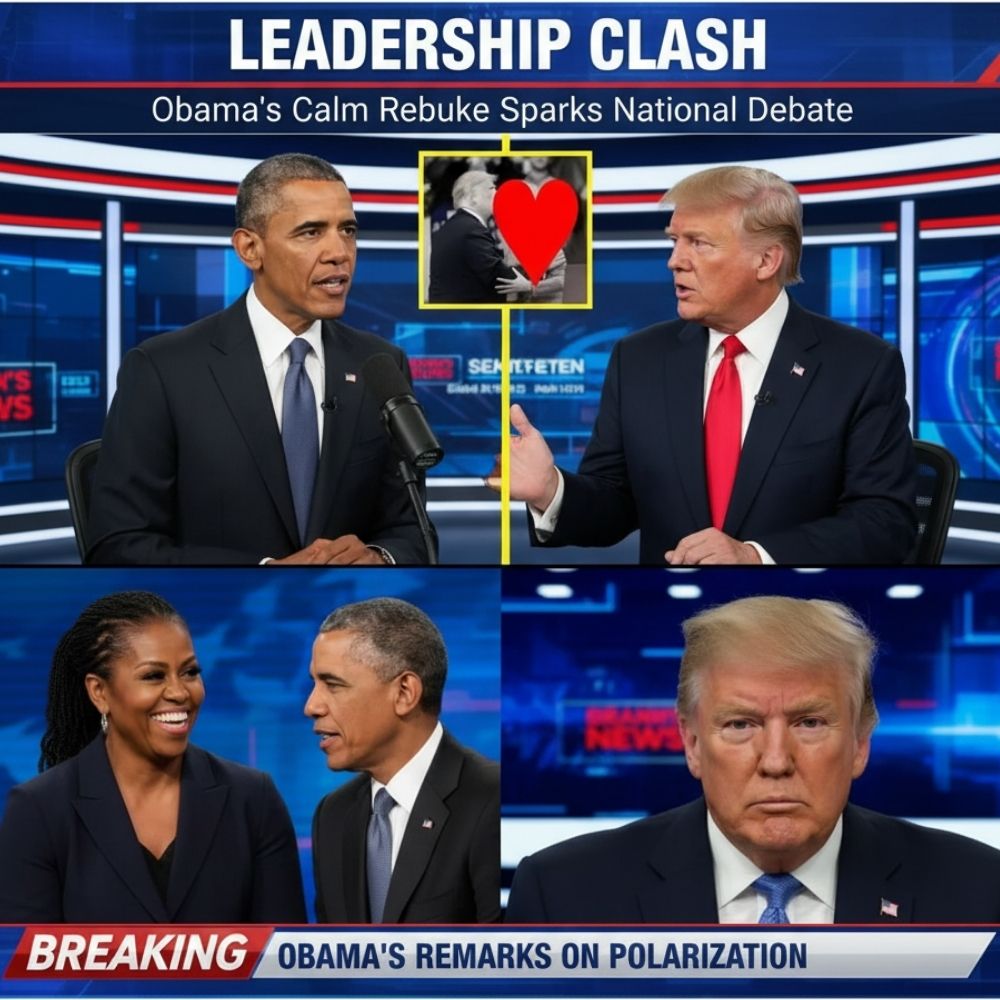
The moment did not begin with shouting. There were no interruptions, no viral outbursts, no immediate flashpoint that signaled what was about to unfold. Instead, it began with a tone so measured that it almost disguised its own significance.
“I want to remind you what I was saying,” came the opening line—steady, deliberate, almost reflective.
In an era defined by volume, the restraint was striking. And yet, within minutes, what began as a familiar political exchange would evolve into something far more consequential: a renewed national debate not just about policy or personality, but about the very nature of leadership in a democracy.
At the center of it all stood two figures whose political rivalry has shaped more than a decade of American discourse: Barack Obama and Donald Trump.
A Statement That Set the Tone
The remarks that triggered the moment were not new in substance, but they carried a renewed urgency. The warning was stark:
“We can’t afford a commander-in-chief who insults, who attacks, who talks down to troops… Somebody so erratic… we can’t afford to give somebody like that the nuclear code.”
The statement echoed concerns voiced in previous election cycles, including by members of Trump’s own party. But what made this moment different was not the criticism itself—it was the delivery.
There was no visible anger. No attempt to dominate the room. Instead, the words were laid out carefully, as if each one had been weighed before being spoken.
For many watching, it felt less like a political attack and more like a case being presented.
The Setting: Calm Before Confrontation
The environment in which the remarks were delivered only amplified their impact. Studio lights cast a warm glow. The audience, expecting a conventional discussion, leaned into what initially felt like a routine exchange about leadership and governance.
But there was a subtle shift in the air.
Observers later described a growing stillness—a sense that something more consequential was unfolding beneath the surface. It was not dramatic in the traditional sense. There were no raised voices to signal escalation.
Instead, the tension came from anticipation.
Obama’s Approach: Precision Over Performance
When Obama began speaking in earnest, he did so with a tone that contrasted sharply with the political climate he was addressing.
He spoke about leadership—not as a concept tied to charisma or dominance, but as a function of responsibility.
He referenced a pattern he had observed over time: a reliance on grievance, a tendency to frame criticism as persecution, and a political style rooted more in spectacle than substance.
“Here’s a 78-year-old billionaire who has not stopped complaining,” he said, referencing Trump’s long-standing public persona. But even in critique, the phrasing remained restrained—more observational than explosive.
This was not rhetoric designed to provoke immediate applause. It was structured to accumulate weight.
Each point built upon the last.
The Power of Contrast
In modern politics, confrontation often follows a predictable script: accusation, rebuttal, escalation. But this moment defied that pattern.
Obama did not attempt to match intensity with intensity. Instead, he removed intensity from the equation altogether.
This created a vacuum—one that forced the audience to focus not on tone, but on content.
He spoke of leadership as something that should transcend personal loyalty. He emphasized that a leader’s responsibility extends beyond supporters to include critics, skeptics, and even opponents.
“The American people deserve honesty,” he said, drawing a line between expectation and reality.
It was a familiar argument, but in this context, it carried renewed force.
Trump’s Political Style Under Scrutiny
For years, Trump’s political identity has been built on disruption. His approach to leadership emphasizes strength, decisiveness, and an unapologetic willingness to confront adversaries.
Supporters view this as authenticity. Critics see it as divisiveness.
In this moment, that divide came into sharper focus.
Obama’s remarks did not attempt to dismantle Trump’s arguments directly. Instead, they questioned the framework itself—the idea that leadership could be conditional, dependent on loyalty rather than responsibility.
He described a system in which power becomes transactional: support is rewarded, dissent is dismissed.
And in doing so, he reframed the conversation.
A Shift From Policy to Principle
As the remarks continued, the focus moved away from specific policies and toward broader philosophical questions.
What does it mean to lead a democracy?
Is leadership defined by strength, or by service?
Should a leader prioritize supporters, or represent the entire population?
These are not new questions. But in a political environment increasingly shaped by polarization, they have taken on new urgency.
Obama’s argument was clear: democracy requires inclusion. It requires a recognition that disagreement is not a threat, but a fundamental component of governance.
The Role of Tone in Political Communication
One of the most striking aspects of the moment was the role of tone.
In recent years, political discourse has become louder, faster, and more reactive. Social media platforms reward immediacy and outrage. Nuance is often lost in the race for attention.
Against this backdrop, Obama’s measured delivery stood out.
It slowed the conversation down.
It forced listeners to engage, rather than react.
And in doing so, it changed the dynamics of the exchange.
Reports of Reaction: A Study in Contrast
While the remarks unfolded calmly on screen, reports from outside the studio painted a different picture.
According to individuals familiar with the situation, Trump reacted with visible frustration. Descriptions included pacing, raised voices, and attempts to craft an immediate response.
This contrast—between composure and agitation—became part of the narrative itself.
It was not just what was said, but how it was received.
Trump’s political strength has long been his ability to dominate chaotic environments. He thrives in confrontation, where speed and intensity can overwhelm opposition.
But this moment offered no such environment.
There was no chaos to counter.
Only silence.
The Audience Reaction: Stillness as Signal
Perhaps the most telling response came from the audience.
There was no immediate applause. No laughter. No visible emotional release.
Instead, there was stillness.
For media analysts, this was significant. In televised political events, audience reactions often serve as cues for interpretation. Applause signals agreement. Laughter signals connection.
Silence, however, signals something else entirely.
It suggests processing.
It suggests that the audience is not reacting emotionally, but thinking.
Leadership as Responsibility
As the remarks reached their conclusion, Obama returned to a central theme: responsibility.
He argued that leadership is not about controlling narratives or winning moments. It is about accountability.
“Leadership is not measured by how often you call yourself strong,” he said. “It is measured by whether you can stand in the light.”
The metaphor was clear.
Transparency, not dominance, defines legitimacy.
And in a democracy, legitimacy is not permanent—it must be maintained.
The Broader Context: A Divided Political Landscape
This moment did not occur in isolation.
It is part of a broader political environment characterized by deep divisions. Trust in institutions remains low. Partisan identities have become more entrenched.
In this context, moments like this take on added significance.
They are not just about individual figures, but about competing visions of governance.
On one side, a model that emphasizes strength, loyalty, and clear boundaries between allies and opponents.
On the other, a model that emphasizes inclusion, service, and the responsibility to represent all citizens.
Media, Amplification, and Narrative Control
The aftermath of the remarks highlights another critical factor: the role of media.
In today’s information ecosystem, moments are not just experienced—they are amplified, reframed, and redistributed across platforms.
Clips are edited. Quotes are isolated. Narratives are constructed.
In this case, the absence of spectacle made the moment more difficult to distort.
There were no outbursts to clip.
No dramatic confrontations to headline.
Instead, the focus remained on substance.
The Question That Remains
As the segment ended and the cameras cut away, one question lingered:
Can a leader effectively govern a country if they only represent part of it?
It is a question without an easy answer.
For some, leadership requires clear alignment—strong support from a defined base.
For others, leadership requires balance—the ability to navigate competing interests and perspectives.
This tension is not new. But it is becoming more pronounced.
A Defining Contrast
In the end, the moment was not defined by victory or defeat.
There was no formal debate. No declared winner.
Instead, it was defined by contrast.
Between noise and silence.
Between performance and reflection.
Between two fundamentally different approaches to power.
Obama did not attempt to overpower Trump.
He did something more subtle.
He reframed the conversation.
Conclusion: Beyond the Moment
Political moments often fade quickly, replaced by the next headline, the next controversy, the next cycle of outrage.
But some moments linger.
Not because they are loud, but because they are clear.
This was one of those moments.
It did not resolve the divisions within American politics. It did not change positions overnight.
But it did something important.
It forced a pause.
It created space for reflection.
And in a political environment defined by speed and noise, that alone is significant.
Because in the end, leadership is not just about power.
It is about responsibility.
And responsibility, as the moment made clear, does not come with conditions.