The hearing room in Rayburn 2154 carried a weight that morning that could not be mistaken for routine oversight.
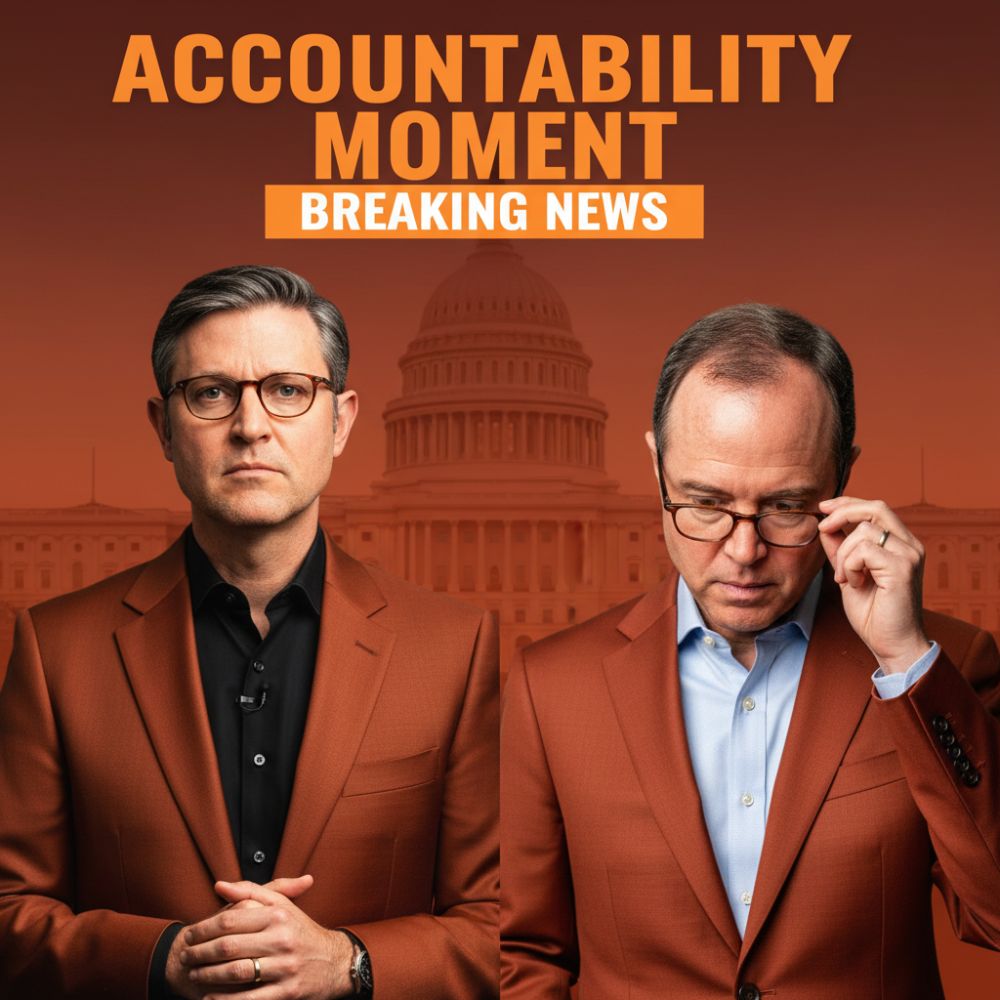
Every seat was filled long before the gavel struck, every camera fixed in place, every journalist leaning forward with the instinctive awareness that something unusually consequential was about to unfold.
It was not simply another political exchange. It was the culmination of years of unresolved claims, conflicting narratives, and one persistent question about the meaning of a single word.
Mike Johnson entered not merely as Speaker of the House, but as someone shaped by a life far removed from Washington’s polished corridors.
His background—rooted in a family that understood sacrifice through lived experience—stood in contrast to the institutional norms surrounding him.
That difference mattered, because it framed the way he approached the moment: not as a performance, but as an inquiry grounded in precision and consequence.
Across from him sat Adam Schiff, a figure equally defined by experience, though of a different kind.
Decades in law and politics had refined his composure into something nearly unshakeable. He understood the stakes, the optics, and the necessity of control.
He had answered versions of these questions before, and he arrived prepared to answer them again.
But preparation, as the morning would show, does not always guarantee control. Johnson’s strategy was deceptively simple.
He did not begin with accusations or rhetoric. Instead, he built a record—methodically, almost clinically—laying out a timeline of statements, appearances, and claiMs. The number itself carried weight: 447 televised instances in which Schiff had asserted the existence of “direct evidence” of collusion.
The repetition was not incidental. It was the foundation of the entire exchange. The word “direct” became the axis around which everything turned.
In legal and investigative contexts, “direct evidence” is not a vague expression. It is precise, bounded, and carries a specific implication: that the evidence itself proves a fact without the need for inference.
Johnson understood this distinction, and more importantly, he understood how the public understands it. When people hear “direct evidence,” they do not think in legal nuance—they think in certainty.
Schiff’s defense rested on a familiar distinction: the difference between evidence suggesting coordination and proof of a criminal conspiracy.
It was a carefully constructed argument, one refined over years of scrutiny. He emphasized context, classification, and the limits of what could be publicly disclosed.
He framed his past statements as interpretations of a broader evidentiary picture. But Johnson did not challenge the distinction itself.
He accepted it, then narrowed the focus. The issue, he insisted, was not whether there had been contacts or suspicious patterns.
The issue was the repeated use of the word “direct.” That word, he argued, could not be reconciled with evidence that required inference.
And more critically, it could not be reconciled with sworn testimony from senior intelligence officials who had stated, under oath, that they had seen no such direct evidence.
That contradiction—between public certainty and private testimony—hung over the room like a question waiting to be answered.
The presence of Robert Callahan in the gallery gave the exchange a dimension that no statistic could provide.
A retired firefighter, he represented a profession where the difference between direct and circumstantial evidence is not academic.
It is operational. It determines decisions, outcomes, and sometimes survival. For him, words were not rhetorical tools—they were instruments of responsibility.
Johnson invoked him not as a prop, but as a standard. What followed was not an explosive confrontation, but something quieter and, in many ways, more revealing.
Schiff maintained his composure, carefully navigating each point, reinforcing his intent, and defending his interpretations.
Then, almost imperceptibly, the ground shifted. In acknowledging that he “could have chosen different language,” Schiff made a concession—measured, controlled, but undeniable.
It was not an admission of wrongdoing in the conventional sense. It was something more subtle: an acknowledgment that the precision of his words had not matched the weight they carried.
Johnson did not interrupt. He did not amplify the moment. He simply let it stand.
Because in that acknowledgment, the central tension of the hearing crystallized. If the language could have been more precise, then the language that was used had, at the very least, the potential to mislead.
Not necessarily by intent, but by effect. And in matters of public trust, effect often matters as much as intent.
Then came the silence. Nine seconds. It was not staged. It was not exaggerated. It was the natural pause of someone weighing an answer in real time, aware that every possible response carried consequences.
In a different context, nine seconds is insignificant. In that room, under those circumstances, it became the most powerful moment of the morning.
Because silence, when it follows a precise question, is rarely empty. It is filled with calculation, hesitation, and the recognition that clarity is no longer easily available.
For Callahan, watching from the gallery, the moment required no interpretation. In his world, pauses like that meant something had shifted.
Not collapsed, not resolved—but shifted enough to matter. The hearing did not end with a dramatic conclusion.
There was no definitive resolution, no sweeping declaration. Instead, it produced something more enduring: a record.
A record that now contained the claims, the contradictions, the testimony, and the concession. And records, unlike narratives, do not adjust themselves over time.
As the room emptied, the significance of what had occurred settled not in the reactions of those present, but in the permanence of what had been said.
The 447 appearances. The withheld transcripts. The sworn statements. The single word that carried so much weight.
And the acknowledgment—quiet, controlled, but unmistakable—that the word may not have been the right one.
In the end, the hearing was not about proving or disproving a conspiracy. It was about something more fundamental: the obligation to match language to evidence, especially when the audience is not a courtroom, but an entire country.
Because when words like “direct” are used, they do more than describe reality. They define it.