Carney Rejects Trump’s Ultimatum as $1000 Billion Energy Deal Unravels

OTTAWA — What was billed as a high-stakes diplomatic showdown has instead become a dramatic reset. In a decisive move that sent shockwaves through energy markets and corporate boardrooms, Canadian leadership has effectively shut down former president Donald Trump’s ultimatum, allowing a massive cross-border energy framework to stall indefinitely.
The framework in question — a proposed $1000 billion energy partnership spanning oil, natural gas, hydroelectric power, and critical mineral supply chains — had been hailed as a potential landmark in North American economic integration. But those ambitions now hang in the balance.
The unraveling began quietly, with reports of mounting pressure from Trump, who had reportedly demanded that Canada accept a series of terms favoring American energy priorities. Among them: guaranteed pricing floors for U.S. buyers, expedited permitting for cross-border pipelines, and reduced Canadian oversight of certain export volumes.
For weeks, Canadian officials listened but did not bend. Then, in a carefully worded statement delivered through intermediaries, Mark Carney — the former central banker now widely seen as a key architect of Canada’s economic strategy — made the position unmistakably clear.
Canada would not move forward under ultimatum-style terms. Period.
“We are not opposed to partnership,” one official aligned with Carney said, speaking on condition of anonymity. “We are opposed to being dictated to. There is a difference between negotiation and submission.”
The response from Trump’s camp was swift and predictably combative. In a social media post issued just minutes after news of the stall broke, the former president accused Canada of “bad faith bargaining” and warned that American patience was not unlimited.
But the damage was already done. Within hours, sources familiar with the negotiations described the talks as “paused” — a diplomatic euphemism that, in this context, carried the weight of a much more serious rupture.
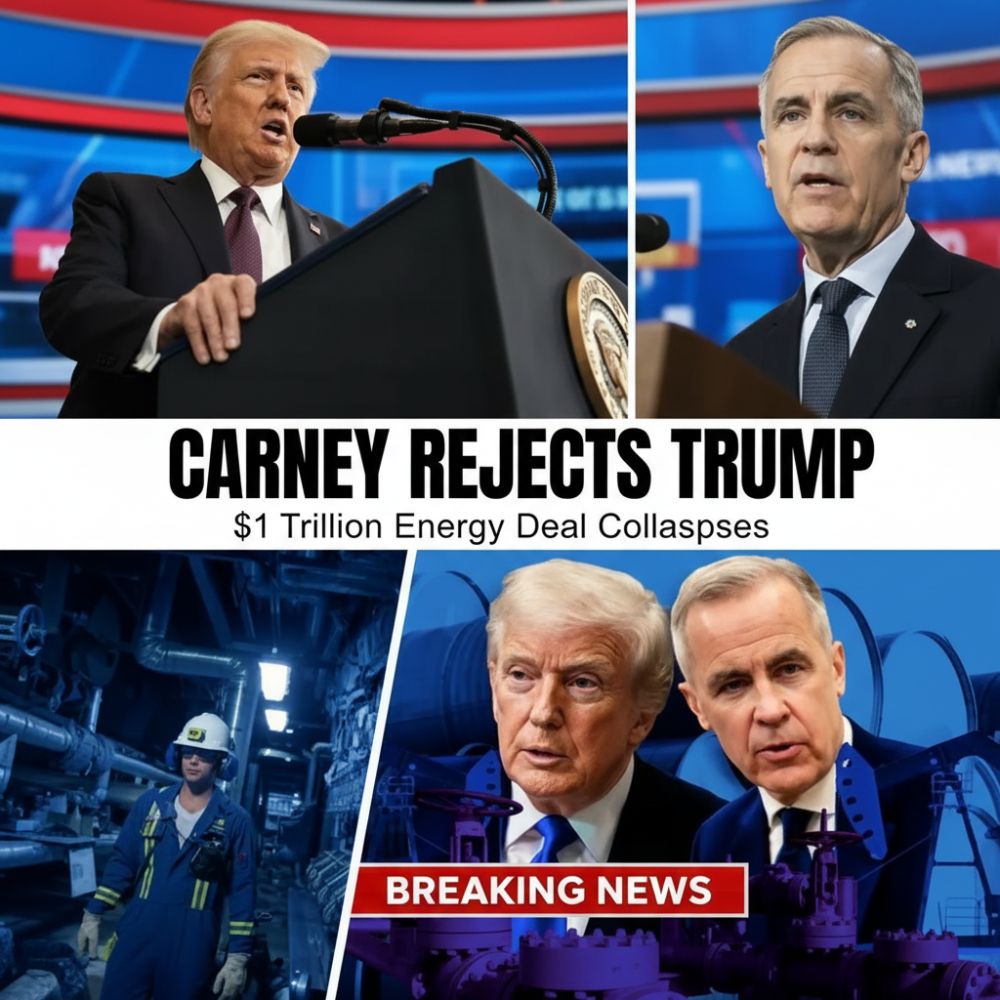
The numbers at stake are staggering. The $1000 billion framework would have represented one of the largest bilateral energy agreements in history, touching nearly every facet of the continent’s power grid and fuel supply.
Energy analysts were quick to assess the fallout. “Even a temporary breakdown affects supply forecasts, infrastructure planning, and investor confidence,” said one industry economist. “When you pause a deal of this magnitude, you don’t just stop negotiations. You freeze billions in pending investments.”
For Canada, the decision to reject Trump’s terms reflects a broader shift in how the country approaches its southern neighbor. The era of reflexive accommodation, Carney-aligned officials suggest, is over.
“We have resources they need,” a senior Canadian trade advisor said. “That gives us leverage. But leverage is only useful if you are willing to use it. Today, we used it.”
Supporters of the Canadian position called it a necessary stand for sovereignty. They argued that accepting Trump’s ultimatum would have set a dangerous precedent, allowing future American administrations to dictate terms regardless of Canadian interests.
Critics, however, warned of significant economic fallout. “This is not a game,” one U.S. energy executive said. “These are jobs. These are power bills. These are heating costs in February. If common ground isn’t found soon, ordinary people will pay the price.”
The timing of the rupture is particularly sensitive. North American energy markets are already under strain from aging infrastructure, transitioning supply chains, and unpredictable weather patterns linked to climate change. Adding political uncertainty to the mix, analysts warn, could amplify existing vulnerabilities.
Carney’s camp has emphasized that the door remains open — but only under the right conditions. “We are not walking away from the table,” an official said. “We are insisting on a table where both sides sit as equals. That is not radical. That is the bare minimum.”
Trump has not formally responded to the pause beyond his initial social media post. But those close to him describe a leader who does not take rejection lightly. The former president, they say, views the Canadian position as a personal challenge.
For now, the $1000 billion framework sits in limbo. Neither side has declared it dead. But neither side has scheduled new talks. In diplomatic terms, that silence is louder than any statement.
As markets adjust and investors recalibrate, one thing is clear: the old rules of North American energy diplomacy have been rewritten. Whether the new rules lead to a stronger partnership or a prolonged standoff remains to be seen. But for the first time in decades, Canada has drawn a line — and held it.