TRUMP’S FOLLY: How Pressuring Canada Handed the Global Wheat Throne to China on a Silver Platter!
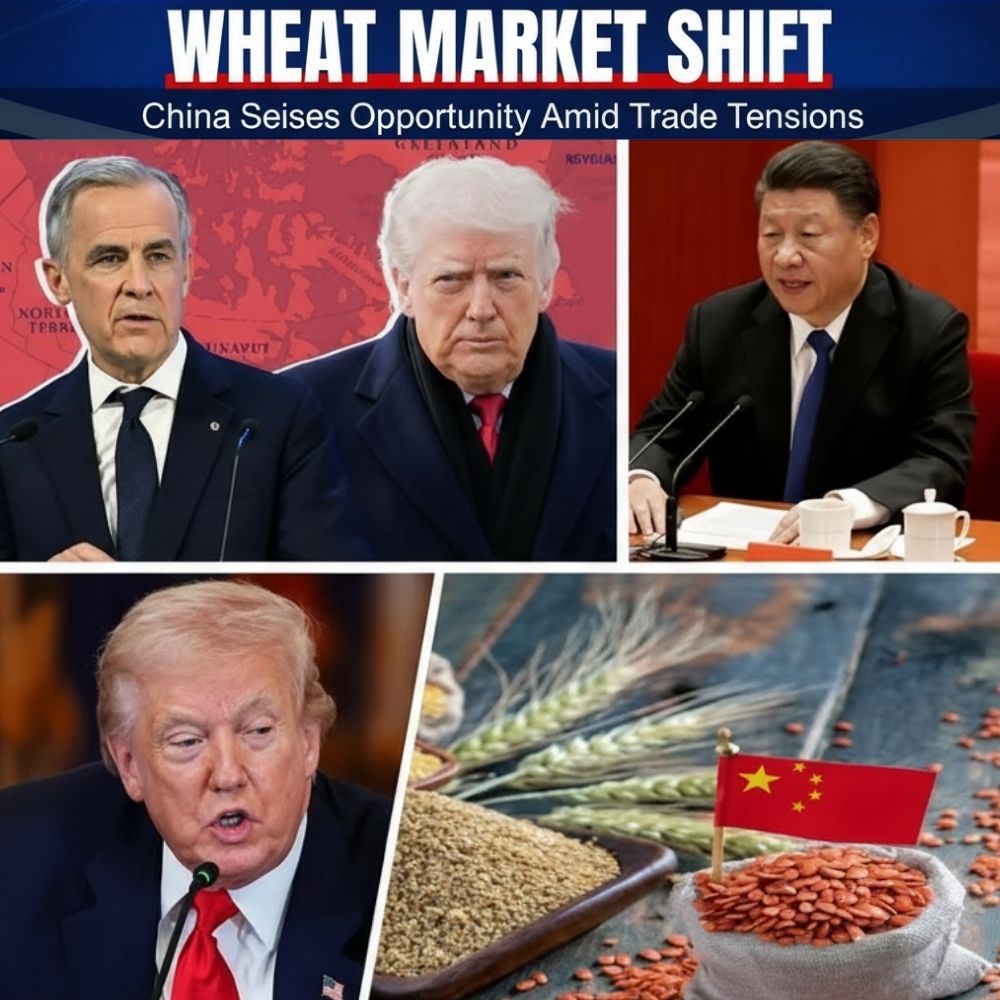
CHICAGO — A sudden and dramatic shift in global grain flows is raising alarms across America’s farm belt. Just as former president Donald Trump escalated trade pressures on Canada, Beijing moved swiftly to absorb Canadian wheat that might otherwise have been destined for U.S.-controlled supply chains — leaving American farmers exposed and commodity traders scrambling.
The sequence happened quickly. Trump’s team, seeking to leverage agricultural access in ongoing North American trade disputes, signaled new restrictions or punitive measures targeting Canadian grain exports. The intended effect was to pressure Ottawa into concessions. But the actual effect was something else entirely.
Instead of buckling, Canadian exporters pivoted. Within days, negotiators had secured alternative buyers for wheat volumes that would have traditionally flowed south or through U.S.-linked logistics hubs. And the buyer of choice? China.
Beijing, which has been quietly diversifying its agricultural supply chains for years, stepped in at scale. According to preliminary trade data, Chinese state-owned grain buyers inked contracts for hundreds of thousands of metric tons of Canadian wheat — deals that one analyst described as “opportunistic but strategically deliberate.”
The timing was impossible to ignore. As U.S.-Canada trade tensions flared, China signaled its willingness to absorb Canadian supply at competitive prices. Whether this was prearranged or simply good fortune for Ottawa, the result was the same: Trump’s pressure backfired.
“The administration thought they had leverage over Canadian wheat,” said a senior commodity analyst based in Winnipeg. “What they didn’t account for was China waiting in the wings with open silos and a long-term strategy to reduce dependence on American grain.”
For American farmers, the implications are immediate and unsettling. The United States has long been a dominant player in global wheat markets, but that dominance depends on predictable trade relationships. When those relationships are disrupted — especially by political brinkmanship — buyers find alternatives.
And alternatives are exactly what China has been building. Over the past five years, Beijing has invested heavily in supply chain redundancy: new port facilities, expanded rail links from Canada and Australia, and long-term purchase agreements with multiple suppliers. The Canadian wheat deal fits perfectly into that architecture.
U.S. commodity traders are now reassessing their exposure. Futures markets showed increased volatility within hours of the news, with traders adjusting positions to reflect the possibility that American wheat could be priced out of key Asian markets for the foreseeable future.
“Contracts are shifting. Shipping lanes are being redrawn. Pricing dynamics are adjusting in real time,” one Chicago-based trader said. “This is not a minor blip. This is structural realignment happening before our eyes.”
What began as tariff brinkmanship — Trump’s effort to use agricultural access as a lever against Canada — may now be accelerating the very outcome Washington feared most: the permanent diversification of global food supply chains away from the United States.
Canada, for its part, has framed the pivot as a matter of survival. “We will not be squeezed between a protectionist United States and an opportunistic China,” one Canadian trade official said. “We will find markets where we are welcomed. If that means selling more to Beijing, so be it.”
Critics of Trump’s approach argue that the former president fundamentally misread the dynamics of modern agricultural trade. In an era of global oversupply and multiple buyers, threatening a major exporter like Canada does not force capitulation. It forces them to look elsewhere.
And elsewhere, China was waiting. Beijing’s grain reserves have been steadily expanding, and Chinese policymakers have made clear their intention to secure supply lines that bypass potential American leverage points. Canadian wheat, along with Australian and Ukrainian supplies, fits that model perfectly.
U.S. farmers are left holding the consequences. Farm belt representatives have already begun calling for emergency trade assistance, warning that lost market share in Asia could take years — if not decades — to recover.
“Once a buyer locks in a new supplier, they don’t come back just because the political mood shifts,” said a former U.S. Department of Agriculture official. “China has made its choice. They will buy Canadian wheat as long as it is available at competitive prices. American farmers will feel that for a long time.”
The long-term picture is still unfolding. Some analysts suggest that the shift could be temporary, especially if U.S.-China trade relations improve. But others see the Canadian-Chinese wheat deals as a harbinger of a more fragmented global trading system.
For now, the message is clear: when Trump pushed Canada, China did not stand by. Beijing took the wheat market — and in doing so, may have permanently altered the balance of power in one of the world’s most essential commodity flows.