WASHINGTON — What was expected to be a routine procurement review has escalated into a full-blown diplomatic confrontation, as the Pentagon has issued pointed warnings to Canada over its advancing plans to purchase Swedish-built Gripen fighter jets. The move, which would scale back Canada’s commitment to the American F-35, has exposed deep fissures in the long-standing defense relationship between the two allies.

The warnings, delivered through both public statements and private channels, signal more than routine alliance concern. At the core of the dispute is influence, not aircraft specifications. Analysts say Canada’s pursuit of the Gripen path threatens Washington’s decades-long leverage over North American airpower, supply chains, and the interoperability rules that govern continental defense under the North American Aerospace Defense Command .
The crisis traces its origins to January, when U.S. Ambassador to Canada Pete Hoekstra issued a stark warning in an interview with CBC News. If Ottawa proceeded with plans to purchase Swedish-made Gripen jets instead of completing its order of 88 F-35s, Hoekstra said, the NORAD agreement “would have to be altered” .
“If Canada is no longer going to provide that capability, then we have to fill those gaps,” Hoekstra said, adding that the United States would likely purchase more F-35s for its own air force and fly them more frequently into Canadian airspace to address approaching threats . The remarks, described by former Canadian national security official Vincent Rigby as “clearly a political pressure tactic,” set the stage for months of escalating tension .
At the heart of Washington’s concern is a technical but critical issue: the Link 16 communications system. The encrypted network, which allows NATO and NORAD aircraft to share data seamlessly, is owned and controlled by the United States. Countries seeking to integrate their forces with American systems must obtain U.S. approval to acquire the necessary encryption terminals .
Defense experts warn that the Trump administration could wield this as a powerful lever. “If Canada is the first country where the U.S. draws the red card then we have a problem,” said Lt.-Col. Johan Legardt, commander of Sweden’s NATO air policing detachment, using a soccer analogy to describe the potential denial of access .
Swedish and Danish air forces have demonstrated that Gripens and F-35s can operate together effectively during NATO missions in Iceland, where the two aircraft types have been training and sharing data without issue . But that cooperation relies on American-supplied Link 16 terminals—approval that Washington could theoretically revoke.
Saab, the Swedish manufacturer of the Gripen, has pushed back forcefully against interoperability concerns. “Gripen meets Canada’s interoperability and security needs. This is not up for debate,” said spokesperson Sierra Fullerton, noting that Gripens, GlobalEye surveillance aircraft, and F-35s routinely exchange data in European operations .
The company has sweetened its pitch with promises of domestic production. Saab CEO Micael Johansson told investors that the company is providing “detailed information” on how quickly it could establish a local Gripen manufacturing facility in Canada, potentially positioning the country as an export hub for future Gripen sales .
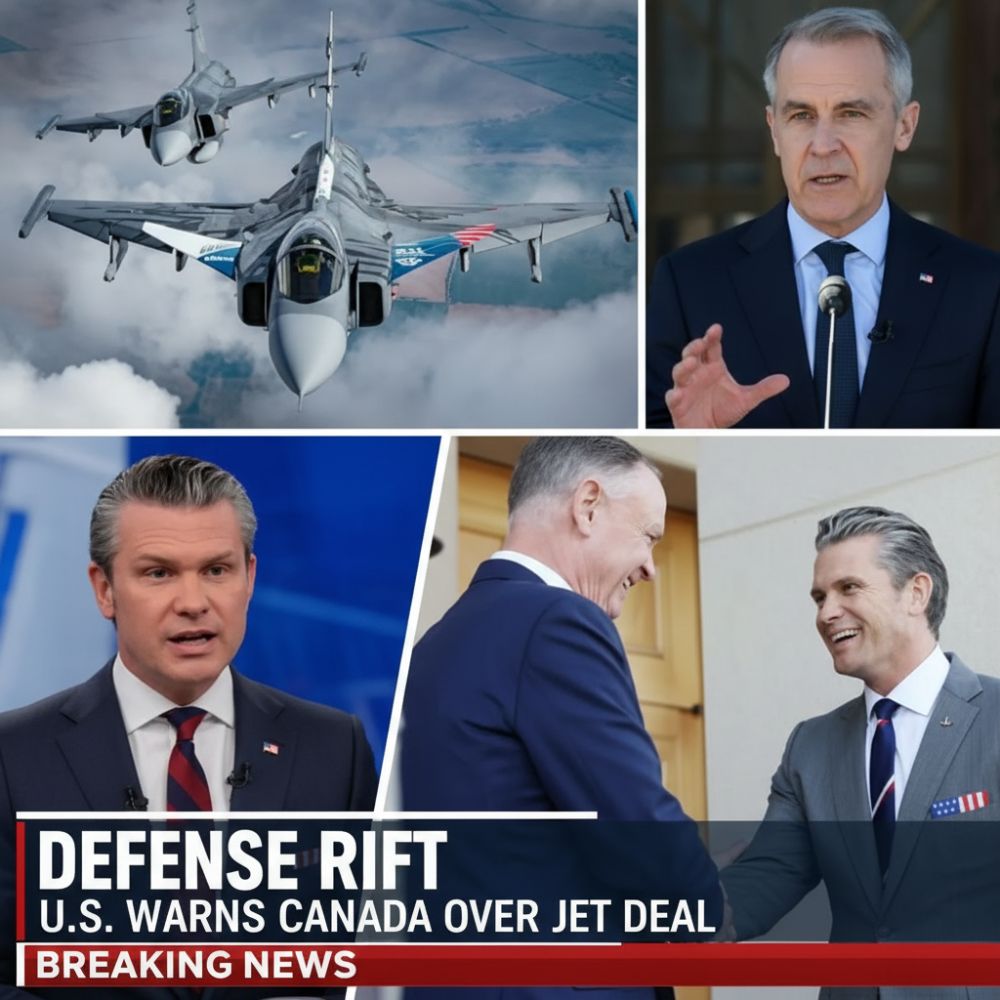
For Canada, the fighter jet review has become intertwined with broader questions of sovereignty. Prime Minister Mark Carney’s government has been reviewing the F-35 purchase for nearly a year, with reports suggesting Ottawa might cut the order in half and accept a Swedish offer for 72 lower-cost Gripens . The review was prompted in part by President Trump’s repeated threats of tariff wars and his suggestion that Canada become the “51st state” .
The geopolitical timing makes the moment particularly destabilizing. Across the Atlantic, three NATO allies—the United Kingdom, Finland, and the Netherlands—announced this month that they are exploring a new joint defense procurement mechanism aimed at aggregating demand and reducing reliance on any single supplier . While not explicitly framed as a challenge to American dominance, the initiative reflects a growing desire among European allies to diversify their defense industrial bases.
Defense analyst Rob Huebert described the potential American leverage over Link 16 as a looming threat. “Under the Trump era, is anything possible? Absolutely,” he said . Yet he expressed hope that the long history of U.S.-Canada cooperation under NORAD would prevail. “We’ve been able to figure it out in a way no other countries have been able to do it,” Huebert noted .
Former Royal Canadian Air Force commanders have strongly opposed any move away from the F-35. A dozen retired senior leaders reportedly signed a letter to Prime Minister Carney warning that a mixed fleet would be “close to useless in a wartime situation” and that canceling F-35 orders would be “cutting our nose off to spite our face” .
But critics note that the F-35 program itself has faced serious challenges. Government Accountability Office reports have revealed that F-35s delivered since 2023 have software usable only for training, while availability and mission-capable rates remain well below threshold values . The promised Block 4 upgrade package, which was to deliver new sensors and computing power, has been delayed and scaled back .
The confrontation marks a turning point in U.S.-Canada defense relations. For 70 years, Canada has bought American fighter jets, integrating its air force seamlessly with its southern neighbor . The decision to consider a non-U.S. alternative represents the first seismic fracture in that arrangement—a shift that analysts say could inspire broader diversification across the alliance .
Whether Washington follows through on its implied threats remains unclear. Saab officials express skepticism that the United States would deliberately blow up its intelligence and defense relationship with Canada. “They are very keen in keeping—and doing—interoperability, interconnectivity with all the allies, and with Canada,” said Jussi Halmetoja, a former combat pilot at Saab. “I find it very, very unlikely” .
What began as a Pentagon warning may now mark a turning point—exposing a deeper struggle over who truly sets the limits of Western defense decisions. As one Swedish commander put it, if the United States draws the red card against Canada, “then we have a problem” . For now, both sides wait to see who will blink first.