WASHINGTON — In what officials on both sides of the border described as a moment of diplomatic rupture, President Trump presented the Canadian government with a list of five sweeping demands this week — and Prime Minister Mark Carney rejected every single one, delivering a unified refusal that left American officials scrambling to recalibrate.
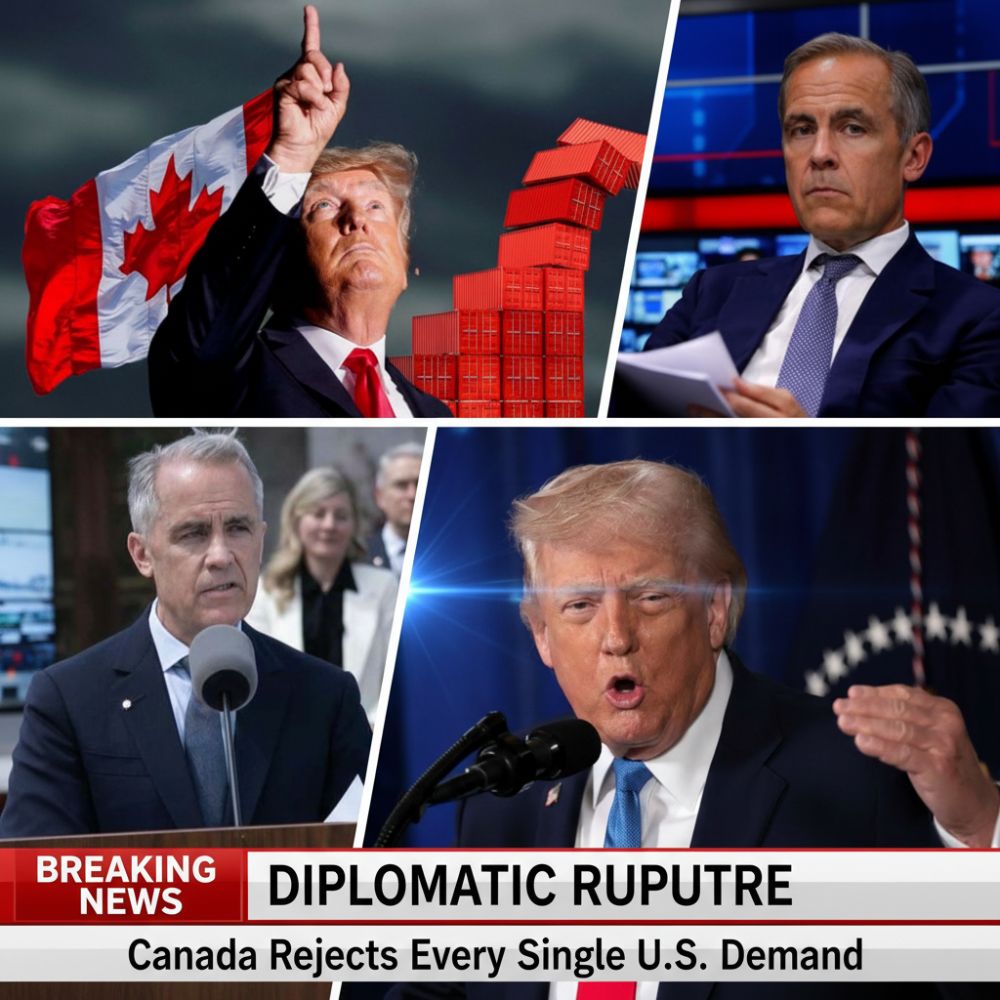
The exchange, which took place over a series of calls and diplomatic cables, was intended by the White House as a pressure campaign aimed at extracting concessions on trade, energy, and defense. Instead, Ottawa’s response landed as a flat denial, with no room for negotiation and no acknowledgment of American leverage.
“We received the requests. We considered them. And we declined them, in full,” a senior Canadian official said, speaking on condition of anonymity to describe the private deliberations. “There was no negotiation point by point. It was a single, clear answer: no.”
For a Canadian government that has historically sought to manage tensions with Washington through compromise and quiet diplomacy, the response represented a striking departure. Officials in Ottawa said the decision to issue a blanket refusal was deliberate — a signal that the era of piecemeal concessions was over.
“The old approach assumed that if you gave a little on one thing, you could protect the rest,” said a former Canadian cabinet minister who spoke on condition of anonymity to discuss the shift in strategy. “That assumption is gone. We are no longer negotiating from a position of fear.”
The five demands, according to officials familiar with the exchange, touched on some of the most sensitive areas of the bilateral relationship. They included increased Canadian defense spending beyond previous commitments, greater American access to Canadian critical minerals, a renegotiation of dairy and agricultural trade terms, restrictions on Canadian energy exports to third countries, and changes to border enforcement protocols.
Taken together, the requests represented an effort by the Trump administration to lock in a set of structural advantages that would tilt North American trade and security arrangements further in Washington’s favor. Instead, they provoked a unified Canadian front that surprised even some of Ottawa’s closest allies.
“I don’t think anyone expected Canada to say no to everything,” said a European diplomat who follows North American relations closely. “It was a gamble on their part. But it also exposed something important: the United States does not have as much leverage as it once did.”
The White House did not immediately issue a formal response to the Canadian rejection. But President Trump, in a brief exchange with reporters following the news, expressed frustration with what he called “unfair treatment” of American interests.
“Canada has taken advantage of the United States for a very long time,” Mr. Trump said. “We’re not going to let that continue. They’re going to have to come to the table, and they’re going to have to be reasonable.”
Behind the scenes, however, officials in Washington acknowledged that the administration had miscalculated. The Canadian refusal came just weeks after Ottawa finalized a sweeping economic and energy pact with the European Union, an agreement that analysts have described as a game-changer for Canadian trade diversification.

That treaty, which gives Canada guaranteed access to European markets for its energy and critical minerals, has fundamentally altered the dynamics of U.S.-Canada negotiations. For the first time in generations, Canada has a significant alternative to the American market — and the confidence to use it.
“They have options now,” said a senior Trump administration official, speaking on condition of anonymity to discuss internal deliberations. “A few years ago, they didn’t. Now they do. And they’re not afraid to remind us.”
The Carney government has framed its approach not as confrontation, but as sovereignty. In public statements, the prime minister has emphasized that Canada will defend its economic interests and make decisions based on what is best for Canadians, not what is demanded by Washington.
“We are a proud, independent nation,” Mr. Carney said at a news conference following the exchange. “We will work with the United States where it serves our shared interests. But we will not be dictated to. We will not trade away our sovereignty. And we will not make concessions that harm Canadian workers, Canadian industries, or Canadian families.”
The response has resonated domestically. Polling conducted in the aftermath of the exchange showed a surge in support for the prime minister’s handling of the U.S. relationship, with Canadians across the political spectrum expressing approval of the government’s firm stance.
But the defiance also carries risks. The Trump administration has shown a willingness to use tariffs, border restrictions, and other economic tools to pressure allies it views as uncooperative. Officials in Ottawa are bracing for potential retaliation, including possible tariffs on Canadian goods or renewed threats to withdraw from the United States-Mexico-Canada Agreement.
“This is not a cost-free decision,” said Laura Dawson, executive director of the Center for North American Prosperity and Security. “Canada has drawn a line. Now we find out whether the United States will accept that line — or try to cross it.”
For now, the ball is in Washington’s court. The White House has not announced any immediate retaliatory measures, and officials said the administration was reviewing its options. But the exchange has fundamentally altered the terms of the relationship.
“What we saw this week was not a negotiation,” the senior Canadian official said. “It was a statement. Canada is not the same country it was five years ago. We have options. We have allies. And we are not afraid to say no.”
As the two nations brace for the next chapter in their long and complex relationship, one thing has become clear: the old rules no longer apply. And for the first time in a generation, it is Canada that is setting the terms.