An unexpected moment during an international media and cultural discussion event has quickly gone viral, igniting widespread debate about public discourse, respect in high-profile settings, and the evolving dynamics of modern media conversations.
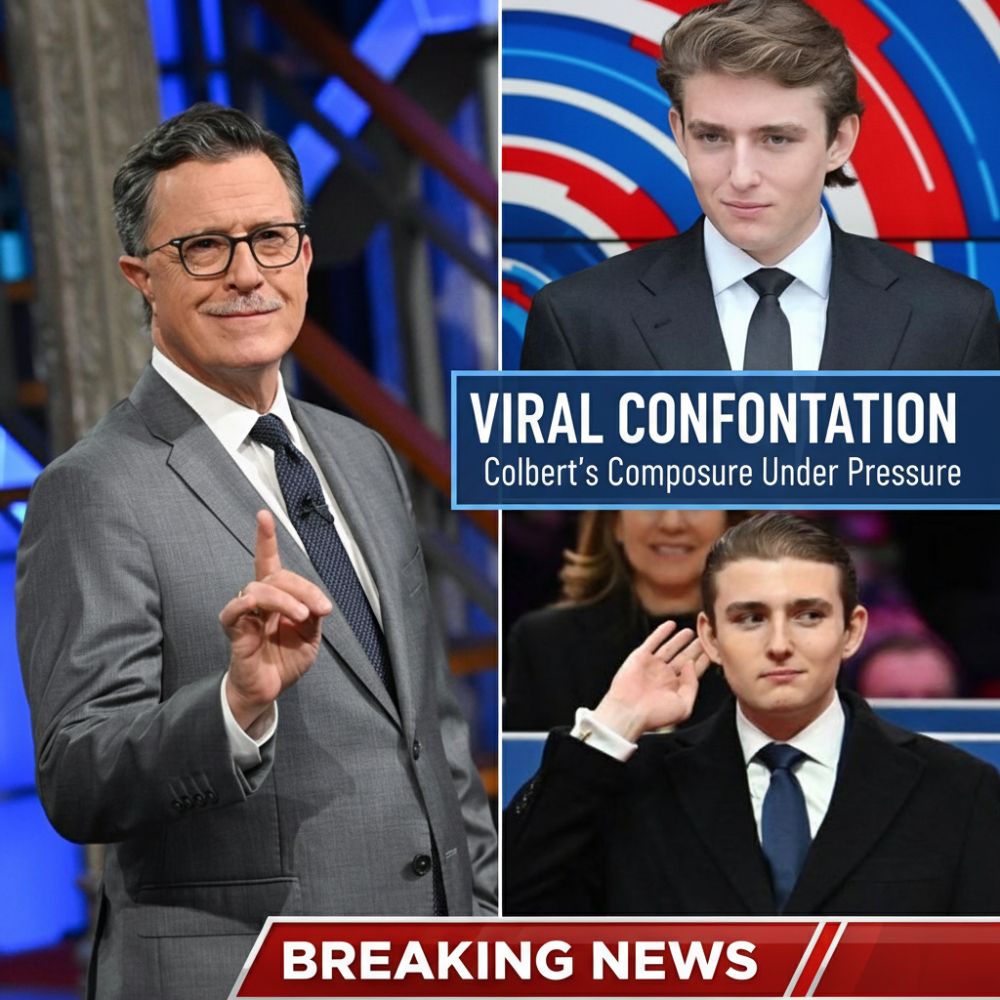
The incident, which unfolded during what had been a structured and serious panel discussion, took an unanticipated turn when a sudden remark referencing Stephen Colbert’s education and career drew audible reactions from the audience. The comment, described by attendees as abrupt and out of place, immediately shifted the tone of the event.
Up until that point, the discussion had focused on global media trends, cultural influence, and the role of communication in shaping public understanding. Panelists had been engaging in thoughtful exchanges about the challenges facing journalism and entertainment industries in a rapidly changing digital landscape.
The interruption, however, introduced a moment of tension that quickly became the focal point of the event.
Observers noted that Stephen Colbert remained composed in the aftermath of the remark. Rather than responding with visible frustration, he appeared to pause briefly before offering a measured reply that redirected the conversation back to the topic at hand. The response, while concise, was widely interpreted as both controlled and effective.
Within minutes, clips of the exchange began circulating online. Social media users quickly latched onto the moment, sharing reactions and debating the appropriateness of the comment. Some described it as an example of how quickly discussions can derail, while others focused on Colbert’s response as a demonstration of professional restraint.
Media analysts say the rapid spread of the clip highlights the power of short-form content in shaping narratives. “In today’s environment, even a few seconds can define an entire event,” one analyst explained. “People may not watch the full discussion, but they will engage with a viral moment.”
The broader reaction has been mixed. Supporters of Stephen Colbert praised his handling of the situation, noting that maintaining composure under pressure is a hallmark of experienced media professionals. “He didn’t let the moment spiral,” one commentator said. “He brought it back to substance.”
Others, however, have raised concerns about the increasing tendency for public discussions to veer into personal territory. They argue that events designed to address serious issues should remain focused on ideas rather than individuals.
“This reflects a larger trend,” one observer noted. “There’s a growing overlap between entertainment-style exchanges and formal discussions, and that can blur the line between constructive debate and distraction.”

The incident has also reignited conversations about boundaries in public discourse. While high-profile figures are often subject to criticism, there is an ongoing debate about where to draw the line—particularly in settings intended for professional or academic exchange.
Experts emphasize that tone and context play a crucial role in how remarks are received. A comment that might be acceptable in a comedic or informal setting can have a very different impact in a formal environment.
For Stephen Colbert, the moment adds another chapter to a career defined by navigating the intersection of comedy and commentary. As the host of a major late-night program, he is accustomed to both delivering and receiving sharp remarks, but the context of a global forum presents a different set of expectations.
The event organizers have not issued a detailed statement regarding the exchange, though sources indicate that the discussion continued without further disruption. Many attendees have emphasized that, despite the viral moment, the broader conversation included valuable insights and meaningful dialogue.
Still, the clip has taken on a life of its own online. Users continue to analyze the exchange, often focusing on the contrast between the unexpected remark and Colbert’s measured response. Memes, commentary threads, and reaction videos have extended the reach of the moment far beyond the original audience.
The situation underscores the challenges faced by public figures in an era of constant visibility. Every word, reaction, and interaction can be captured, shared, and interpreted in real time, often without the full context in which it occurred.
As the discussion continues, many observers are calling for a renewed focus on maintaining respectful and constructive dialogue, particularly in settings designed to address complex and important topics. While moments of tension are inevitable, how they are handled can shape both immediate perceptions and long-term reputations.
For now, the unexpected exchange involving Stephen Colbert serves as a reminder of the unpredictable nature of live events—and the lasting impact that even a brief remark can have in a globally connected media landscape.
Whether viewed as a moment of disruption or a demonstration of composure, it has become a focal point in the ongoing conversation about communication, professionalism, and the power of words in the public sphere.