Washington, D.C. — A high-stakes courtroom proceeding turned into a defining public moment when U.S. District Judge Beryl Howell repeatedly pressed Representative Jasmine Crockett during a tense exchange—only to see the atmosphere change after Crockett delivered a calm, deliberate response that resonated far beyond the courtroom.

The hearing, centered on legal arguments and procedural challenges tied to a broader federal matter, was expected to follow a tightly structured path. Instead, it became a vivid demonstration of pressure, composure, and the power of precise language under scrutiny.
A PROCEEDING UNDER INTENSE SCRUTINY
The courtroom was filled to capacity. Attorneys, clerks, reporters, and observers packed the benches, aware that the issues at hand carried national implications. Proceedings began with formal arguments, each side presenting motions, citations, and interpretations of the law.
Judge Howell, known for a direct and probing judicial style, quickly established a rigorous pace. Questions were pointed, interruptions frequent, and expectations for clarity unmistakable.
Crockett, appearing in a high-profile capacity, was called upon to address specific legal positions and respond to the court’s inquiries.
THE PRESSURE BUILDS
As the exchange progressed, the tone sharpened.
Judge Howell pressed for precision on key points—statutory interpretation, evidentiary standards, and the limits of the arguments being advanced. At several moments, she interrupted mid-response to demand clarification.
“Counselor, I need a direct answer,” the judge stated firmly at one point. “We are not moving forward without it.”
Observers described the atmosphere as intense but controlled—a courtroom operating at full rigor.
Still, the repeated interruptions created visible pressure.
Crockett paused more than once, reorganizing her thoughts as the questioning narrowed. The back-and-forth grew tighter, more focused, and increasingly demanding.
A MOMENT OF TENSION
The turning point came during a sequence of rapid-fire questions about legal authority and procedural boundaries.
Judge Howell leaned forward.
“Where is your authority for that position?” she asked, her tone firm, expecting a precise citation.
The room quieted.
Crockett began to respond, but the judge interjected again, pressing for specificity. The exchange, while within the bounds of courtroom procedure, carried an intensity that drew the full attention of everyone present.
Pens stopped moving. Typing paused. Even the usual shuffling of papers faded.
CROCKETT HOLDS THE MOMENT
Instead of rushing, Crockett stopped.
She took a breath.
Then she spoke.
“Your Honor,” she began, her tone steady, “the authority isn’t just in a single line—it’s in how the law has been consistently applied across cases, contexts, and consequences.”
The response did not raise in volume. It did not push back aggressively.
But it reframed the question.
THE SHIFT
For a brief moment, the courtroom was still.
Judge Howell did not interrupt.
Crockett continued, now laying out her reasoning with greater structure:
“When we reduce complex legal standards to isolated citations, we risk losing the very framework that gives them meaning. The authority is in the pattern—in the consistency of application, not just the text in isolation.”
The words landed.
Observers later described the shift as immediate but subtle—a recalibration rather than a confrontation.
THE COURTROOM REACTS
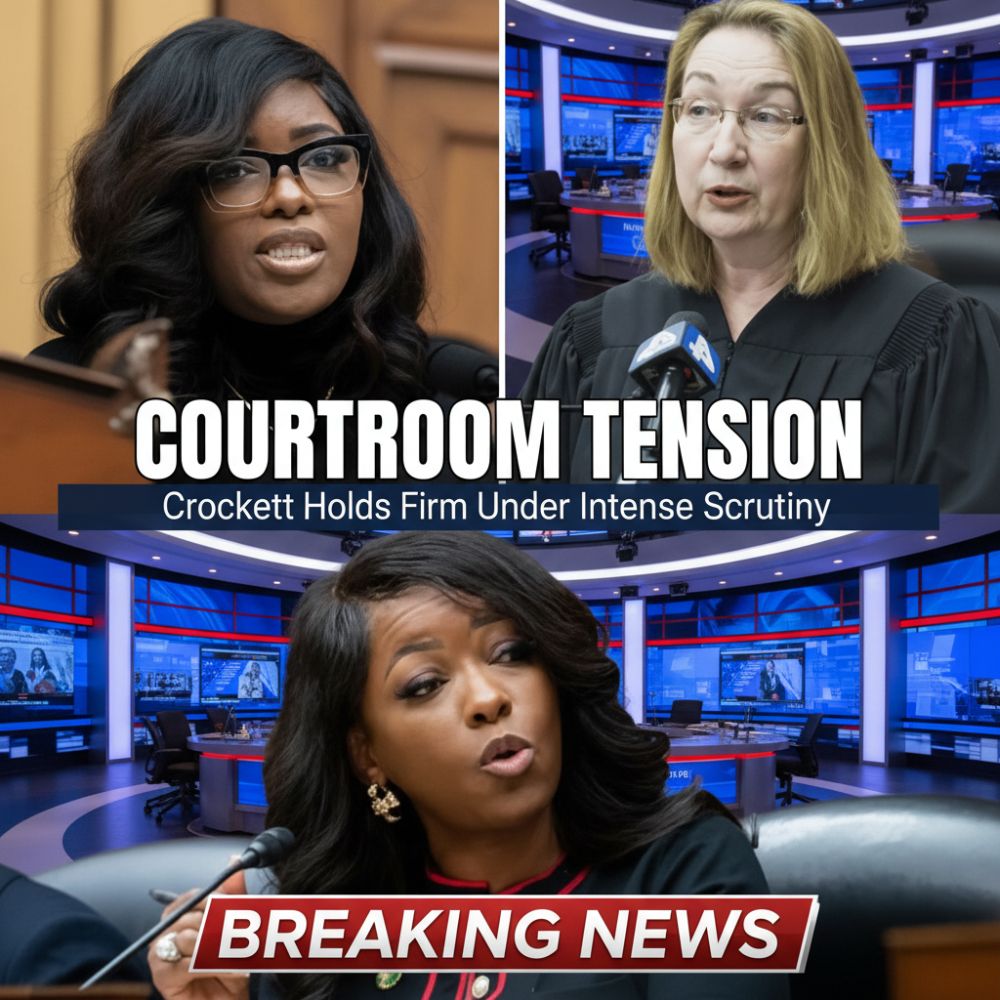
There was no applause—this was a courtroom, after all.
But the reaction was visible in other ways.
Reporters looked up. Attorneys exchanged brief glances. The judge, for the first time in several minutes, allowed the response to stand without interruption.
“It changed the rhythm,” one legal observer said afterward. “Not dramatically, but enough that everyone noticed.”
JUDGE HOWELL’S RESPONSE
Judge Howell responded in kind—measured, precise, and grounded in procedure.
“Then articulate that pattern clearly,” she said, her tone firm but no longer cutting through the response.
The exchange moved forward.
But the moment had already marked a turning point.
WHY THE RESPONSE RESONATED
Legal analysts later highlighted several reasons Crockett’s words had such an impact:
Reframing under pressure: She shifted the question from a narrow citation to a broader legal principle.
Composure: Her calm delivery contrasted with the intensity of the questioning.
Clarity: The explanation made complex legal reasoning accessible without oversimplifying it.
“It’s not easy to do that in real time,” one analyst noted. “Especially under direct judicial pressure.”
BEYOND THE COURTROOM
Though the exchange occurred within a formal legal setting, its impact extended far beyond.
Clips and transcripts began circulating across media platforms, drawing attention not just from legal professionals, but from a broader audience interested in public discourse and institutional dynamics.
The moment resonated because it captured something universal: the challenge of responding clearly and effectively under pressure.
A BROADER CONVERSATION
The exchange has sparked wider discussion about courtroom dynamics, judicial questioning, and the expectations placed on those presenting arguments.
Key themes include:
The balance between rigorous questioning and allowing full responses
The role of composure in high-pressure environments
The importance of framing in legal and public communication
For many observers, the moment served as a reminder that effective advocacy is not just about knowledge—but about delivery, timing, and clarity.
THE HUMAN ELEMENT
Behind the legal terminology and procedural structure lies a human reality.
Courtrooms are places of precision, but also of pressure.
Participants must think, respond, and adapt in real time—often with little margin for error.
Crockett’s response, in that context, stood out not because it was dramatic, but because it was controlled.
CONCLUSION
The exchange between Beryl Howell and Jasmine Crockett will likely be remembered as a moment where pressure met composure—and where a carefully delivered response shifted the tone of an entire proceeding.
It was not a confrontation.
It was not a spectacle.
It was something quieter—and, in many ways, more powerful.
A reminder that in the most demanding environments, the ability to pause, think, and speak with clarity can carry as much weight as any argument itself.