Washington, D.C. — A high-level legal exchange inside a packed courtroom quickly transformed into a defining moment of tension, discipline, and rhetorical precision when Supreme Court Justice Clarence Thomas sharply challenged the legal reasoning of Representative Jasmine Crockett—only to see the tone of the proceeding shift after Crockett delivered a calm, structured response that resonated across the legal community.

What unfolded was not simply a disagreement over legal interpretation, but a vivid example of how authority, pressure, and composure interact in real time under national scrutiny.
A HEARING UNDER THE MICROSCOPE
The courtroom was already charged before the exchange began.
Legal observers, journalists, and policy analysts filled the gallery, aware that the issues under discussion carried significant implications. The proceeding focused on complex constitutional questions, statutory interpretation, and the boundaries of federal authority—topics that demand both precision and clarity.
Justice Thomas, known for his direct questioning and analytical rigor, entered the discussion with a series of pointed inquiries aimed at testing the strength of the arguments presented.
Crockett, stepping into a high-stakes legal role, was tasked with defending a position that required navigating both legal complexity and judicial scrutiny.
THE INITIAL CHALLENGE
The moment that set the tone came early.
Justice Thomas leaned forward slightly and posed a question that cut directly to the core of Crockett’s argument.
“Counsel, your position seems to rest on a rather selective reading of the statute,” he said, his tone measured but unmistakably critical.
The phrasing carried weight.
Observers in the room noted the subtle but clear implication: the argument, as presented, lacked completeness.
Crockett began her response, outlining the framework behind her interpretation. But before she could fully develop the point, Thomas followed up—tightening the focus.
“Where, exactly, is the limiting principle in your argument?” he asked.
PRESSURE BUILDS
From that moment on, the exchange intensified.
Justice Thomas returned repeatedly to the same core issue, pressing for clarity, consistency, and precision. His questions came in quick succession, each one narrowing the space for response.
“Is that grounded in the text?”
“Or are you asking the Court to infer beyond it?”
“How do we prevent that reasoning from expanding indefinitely?”
The pattern was clear: test the argument, identify its limits, and expose any gaps.
Crockett responded each time, but the rhythm of the exchange made it difficult to fully develop her points. The constant follow-ups created a sense of compression—an environment where every word had to count.
THE MOMENT OF TENSION
The turning point came when Justice Thomas paused, then delivered a remark that drew immediate attention.
“That’s a creative interpretation,” he said. “But I’m not sure it’s a legally sustainable one.”
The statement, while framed as critique, carried an unmistakable edge.
The room went quiet.
Reporters looked up. Pens hovered over notebooks. Even the usual background movement seemed to pause.
CROCKETT DOES NOT RUSH
At that moment, Crockett had a choice: respond quickly and risk being cut off again, or take control of the pace.
She chose the latter.
She paused.
Not long—but long enough to reset the rhythm.
Then she spoke.
THE RESPONSE THAT SHIFTED THE ROOM
“Your Honor,” Crockett began, her tone steady, “the interpretation is grounded not just in the text, but in how the Court has consistently applied that text in context.”
She did not raise her voice. She did not react to the critique directly.
Instead, she reframed the premise.
“When we evaluate statutory meaning,” she continued, “we’re not only looking at isolated language—we’re looking at how that language operates within a broader legal structure.”
The courtroom remained silent.
No interruption came.
BUILDING THE ARGUMENT
With the pace now under her control, Crockett continued.
“The limiting principle,” she said, addressing the earlier question directly, “comes from the Court’s own precedent—cases where similar language has been interpreted in a way that balances scope with restraint.”
She referenced patterns of reasoning rather than a single citation, emphasizing consistency over selectivity.
“The concern about expansion,” she added, “is precisely why those precedents matter. They define the boundaries—not in theory, but in practice.”
A NOTICEABLE SHIFT
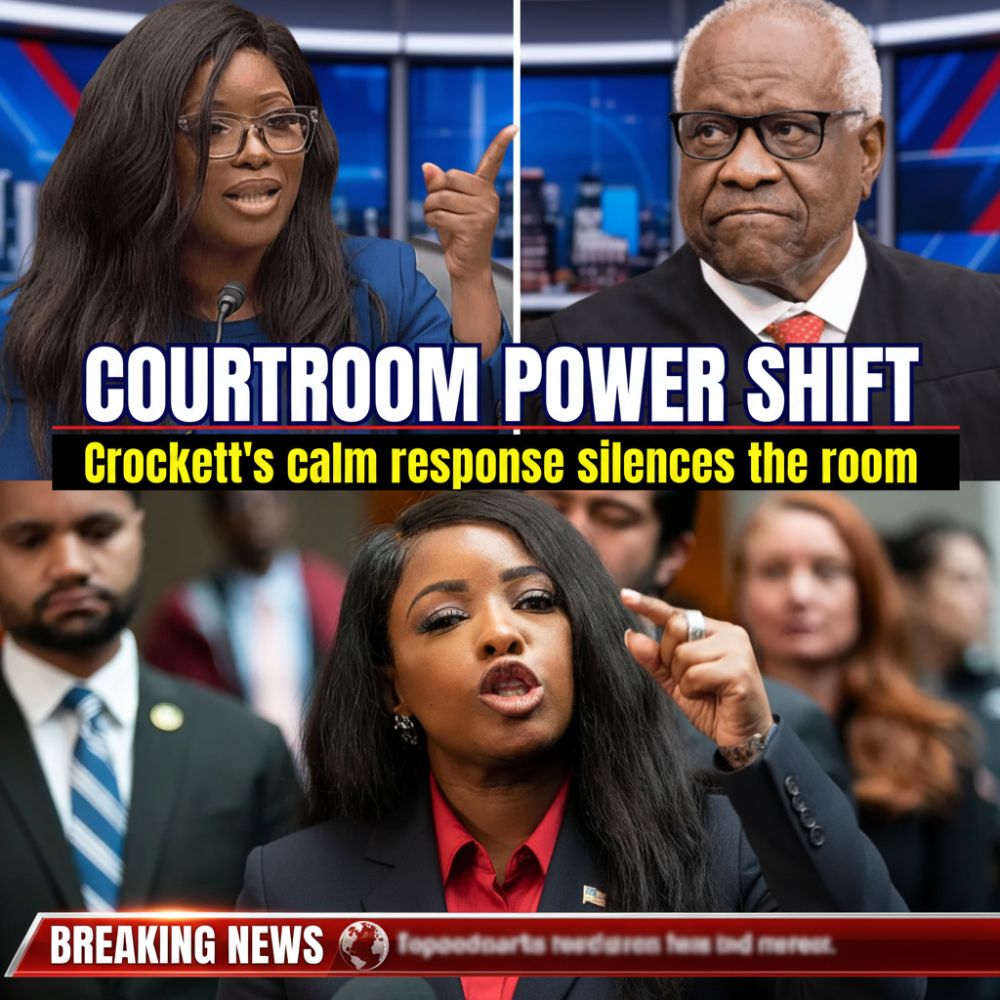
Observers described the change as subtle—but undeniable.
Justice Thomas did not interrupt.
He listened.
The rapid-fire questioning slowed. The exchange became more measured, more structured.
“It wasn’t dramatic,” one legal analyst noted. “But the dynamic changed. She wasn’t reacting anymore—she was directing.”
JUSTICE THOMAS RESPONDS
When Thomas spoke again, his tone had shifted slightly.
“Then your argument depends heavily on those precedents,” he said.
The statement was still probing—but no longer dismissive.
Crockett nodded.
“Yes, Your Honor. Because they demonstrate not just what the law says—but how it functions.”
WHY THE MOMENT RESONATED
Legal experts later pointed to several reasons the exchange stood out:
Control of pacing: Crockett broke the rapid questioning cycle by pausing.
Reframing under pressure: She shifted from defending a point to explaining a framework.
Clarity without escalation: Her tone remained calm, even as the pressure increased.
“In that environment, composure is everything,” one analyst said. “And she maintained it.”
BEYOND THE COURTROOM
Though rooted in technical legal discussion, the exchange quickly spread beyond legal circles.
Clips and summaries circulated widely, drawing attention from a broader audience interested in communication, leadership, and performance under pressure.
The moment resonated not because it was loud—but because it was controlled.
A LESSON IN ADVOCACY
For many observers, the exchange became a case study in effective advocacy.
Don’t rush under pressure
Don’t mirror intensity
Don’t lose structure
Instead:
Pause
Reframe
Deliver clearly
These principles, demonstrated in real time, offered a powerful example of how to navigate high-stakes environments.
THE HUMAN ELEMENT
Courtrooms are often seen as purely analytical spaces—but they are also deeply human.
Participants must think, respond, and adapt instantly, often under scrutiny from multiple directions.
Crockett’s response stood out not because it was dramatic—but because it was deliberate.
CONCLUSION
The exchange between Clarence Thomas and Jasmine Crockett will likely be remembered as a moment where pressure met precision—and where composure reshaped the course of a high-stakes legal discussion.
Justice Thomas applied rigorous scrutiny.
Crockett responded with clarity and control.
And in that moment, the balance of the exchange shifted—not through confrontation, but through carefully chosen words delivered at exactly the right time.