🚨🔥 JUST IN: Australia Extends Rare Parliamentary Platform to Carney — Strategic Signals Ripple Across the Indo-Pacific
In the days after Mark Carney addressed the World Economic Forum in Davos, his remarks were widely interpreted as familiar Canadian multilateralism — a polished appeal for cooperation in an increasingly fractured global economy. Within a week, however, a swift response from Australia suggested that something more consequential was taking shape.
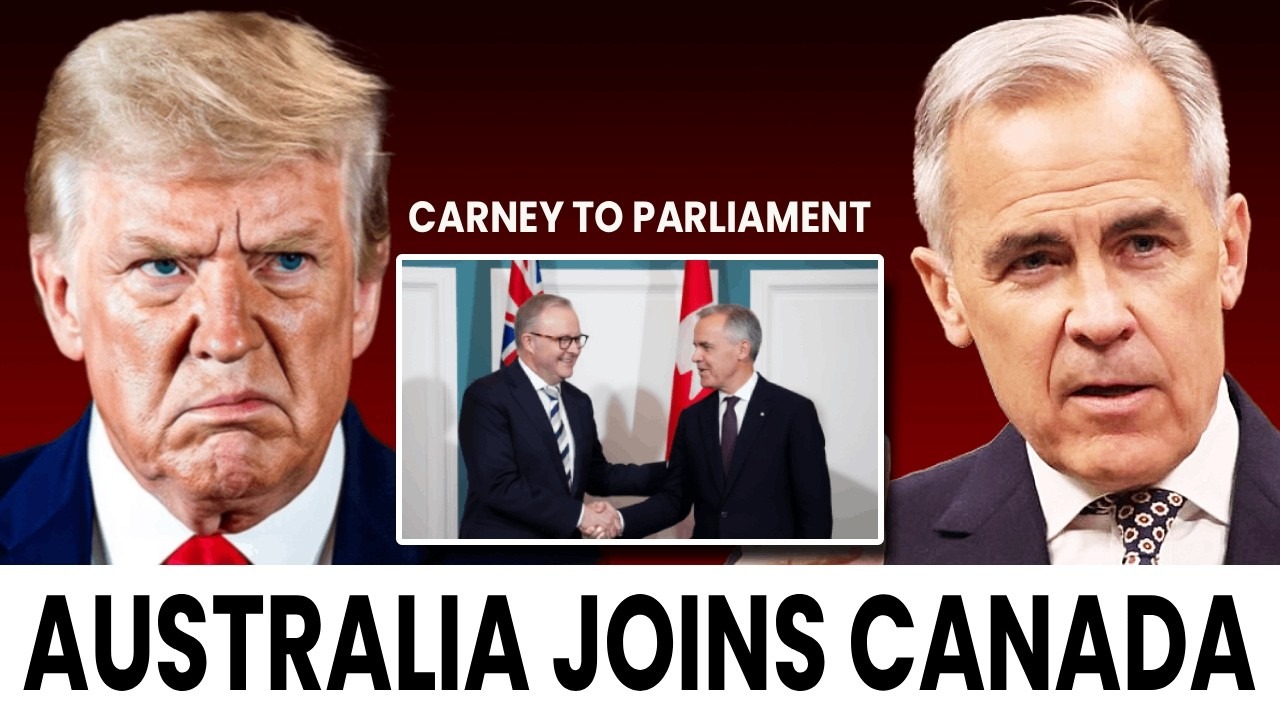
Standing before cameras in Sydney in late January, Prime Minister Anthony Albanese announced that Mr. Carney would visit Canberra in March to address Parliament. More striking than the invitation itself was Mr. Albanese’s unambiguous endorsement of Mr. Carney’s message: middle powers, he said, must be prepared to act together to reduce their vulnerability to economic coercion.
The statement was brief. Its implications were not.
At Davos, Mr. Carney argued that the era in which countries could rely on a stable, rules-based trading order had eroded. Tariffs and export controls, once exceptional measures, had become routine tools of geopolitical competition. Economic interdependence, long praised as a stabilizing force, was increasingly being used as leverage.
For Canada — a country that still sends roughly two-thirds of its exports to the United States — the risks are tangible. Alliance, Mr. Carney suggested, no longer guarantees insulation from economic pressure. Diversification is no longer optional; it is strategic necessity.
Australia heard echoes of its own experience. Though a formal ally of Washington, Canberra has in recent years navigated trade disruptions and shifting geopolitical currents that exposed the fragility of concentrated economic ties. Heavy reliance on a narrow band of partners has left the country susceptible to sudden market shocks and diplomatic rifts.
Mr. Albanese’s decision to elevate Mr. Carney’s argument to a parliamentary platform signaled that Canberra viewed the proposal not as rhetorical flourish but as a basis for policy exploration. In diplomatic language, endorsement at that level constitutes commitment.
The alignment did not emerge in a vacuum. In October, Canada and Australia signed an agreement to deepen cooperation on critical minerals — resources essential to advanced manufacturing, renewable energy systems and defense technologies. Both countries are major producers of minerals such as lithium, nickel and rare earth elements, yet both face structural disadvantages in global processing capacity, much of which is concentrated elsewhere.
By coordinating production, standards and investment, Ottawa and Canberra hope to increase bargaining power and reduce exposure to market manipulation. The Davos speech and the parliamentary invitation now appear as steps in a deliberate sequence: sectoral cooperation followed by strategic framing, then institutional engagement.
Other governments have taken notice. In Mexico City, President Claudia Sheinbaum publicly welcomed Mr. Carney’s call for greater middle-power coordination. Analysts in South Korea, Brazil and Indonesia have debated whether a more structured framework could emerge — sometimes described informally as an “M50,” a grouping of advanced and emerging middle economies seeking to strengthen collective leverage.
Such proposals remain speculative. The obstacles are formidable. Middle powers differ in political systems, regional priorities and domestic pressures. Aligning trade policy, industrial strategy and diplomatic posture across continents would require sustained negotiation and trust-building. Existing institutions offer limited templates. The Group of 7 remains dominated by the largest economies; the Group of 20 is broad but often unwieldy.
Yet the underlying logic has grown harder to dismiss. Middle-income and advanced economies outside the traditional great-power blocs collectively account for substantial shares of global output, technological capacity and resource production. Their challenge has been less about capacity than coordination.
For Canada, the stakes are particularly acute. Economic integration with the United States has delivered decades of prosperity, but it has also narrowed strategic options. Efforts to diversify trade — through agreements in Europe and the Asia-Pacific — have reduced dependence incrementally, but exposure remains significant. Any future escalation in tariffs or industrial subsidies among major powers could ripple quickly through Canadian supply chains.
Australia confronts comparable dilemmas. Geographic distance provides a measure of insulation but complicates logistics. The country’s resource wealth gives it leverage, yet its export profile leaves it sensitive to demand fluctuations and political disputes.
In this context, Mr. Carney’s argument reframes diversification as collective action rather than solitary pursuit. Acting alone, a mid-sized economy risks retaliation or marginalization. Acting in concert, a coalition can shape standards, coordinate investment and distribute risk.
Skeptics caution that rhetoric often outpaces implementation. Domestic audiences may question whether ambitious international coordination distracts from pressing internal concerns. Mr. Carney’s critics at home have argued that global positioning must translate into visible benefits for workers and firms.
Supporters counter that the two are inseparable. Securing alternative markets for critical minerals, building resilient supply chains and expanding trade corridors directly affect employment, investment and price stability. In a world where economic tools double as political instruments, they argue, strategic diversification is domestic policy by another name.
The March address in Canberra will test whether endorsement can evolve into structured cooperation. Parliamentary engagement creates space for formal dialogue, committee work and potential agreements. Success could encourage other capitals to explore similar arrangements; failure could reinforce caution.
For decades, the architecture of global trade rested on the assumption that stability flowed from great-power stewardship. Smaller economies adapted accordingly. Today that assumption appears less secure. Tariffs are deployed against allies as readily as rivals. Supply chains are scrutinized for vulnerability. Energy and technology flows are recast as strategic dependencies.
Whether middle powers can build a durable counterweight remains uncertain. But the rapid alignment between Ottawa and Canberra suggests that the search for alternatives is no longer abstract. It has moved from conference halls to parliamentary chambers — and from theory toward experiment.