Expectations heading into this week showed projections of about 50,000 new jobs being created in the United States in February. As it turns out, according to the new report from the Bureau of Labor Statistics, the totals fell far short of those expectations. CNBC reported:
Nonfarm payrolls fell by 92,000 for the month, compared to the estimate for 50,000 and below the downwardly revised January total of 126,000. February marked the third time in the past five months that payrolls declined, following a sharp revision showing a drop of 17,000 in December.
At the same time, the unemployment rate edged higher to 4.4% as jobs declined across key areas.
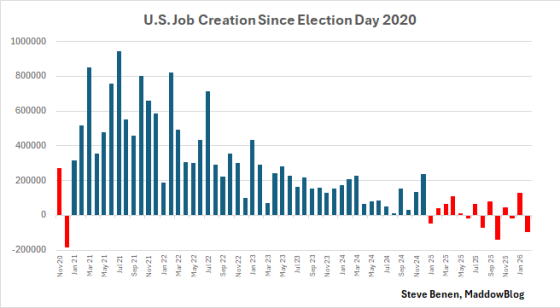
There is no good news here. In fact, during Joe Biden’s four years in the White House, there wasn’t a single month in which the U.S. economy actually lost jobs. It’s become far more common lately: The economy not only shed jobs in February, it also lost jobs in two of the last three months, three of the last five months and five of the last nine months.

All told, Donald Trump has been in the White House for 14 months, and during that time the cumulative total is 150,000 jobs. Over the 14 months preceding the Republican president’s return to power, the American economy added 1.74 million jobs.
That’s a stunning reversal, which the Republican administration has made no credible effort to explain or justify.
On the contrary, Trump publicly insists on a near-daily basis that the U.S. currently has the single greatest economy in the nation’s history. The latest employment report clearly proves otherwise.
To contextualize the data, I put together this chart to show month-to-month totals since the 2020 election. The blue columns point to Biden’s presidency, while the red columns point to Trump’s.
It remains to be seen whether the president responds to the developments by firing the head of the Bureau of Labor Statistics (again).
The question for the White House remains simple: If Trump has created the greatest economy in history, why has American job growth slowed to its lowest pace since the Great Recession?