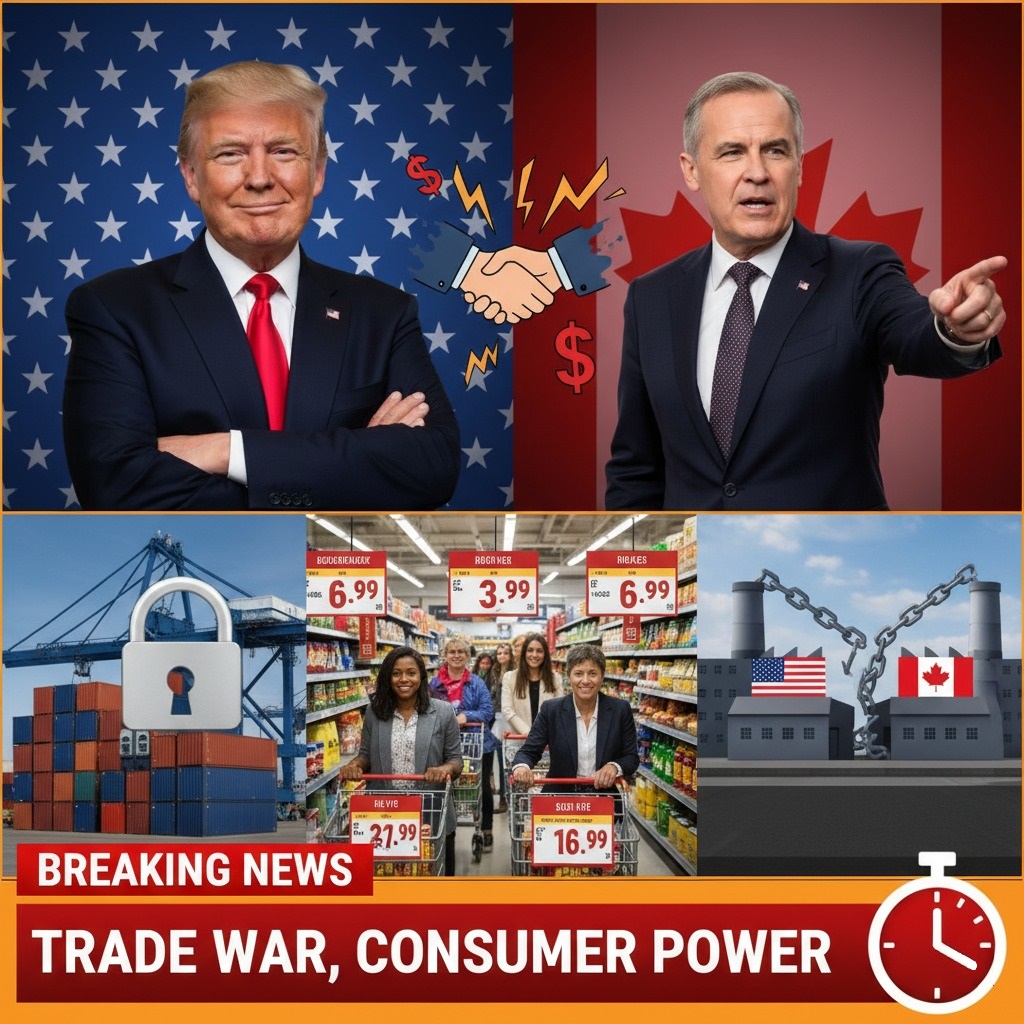
What began as a dismissed consumer protest has evolved into a serious economic shock for the United States. Since early 2025, a growing Canadian consumer boycott—sparked by tariffs imposed during Donald Trump’s second term—has upended trade, tourism, and political assumptions in Washington. American alcohol has vanished from Canadian shelves, U.S. exports have plunged, and tourism revenue has cratered. The most striking part? Ottawa never officially retaliated. Instead, everyday Canadian purchasing decisions delivered a form of pressure that tariffs never anticipated. Now, as negotiations intensify, the U.S. is learning a hard lesson: consumer trust can be more powerful than any trade weapon.
For months, officials in Washington brushed it off as noise.
A few angry headlines. Some social media outrage. Maybe a temporary dip in sales. That was the prevailing assumption when Canadian consumers began quietly turning away from American products earlier this year. But by mid-2025, the reality was impossible to ignore: the boycott was real, it was coordinated, and it was hurting the U.S. economy in measurable ways.
The chain reaction began shortly after Donald Trump’s second term started in January 2025. His administration moved quickly to reimpose and expand tariffs on Canada, framing them as a necessary response to cross-border drug trafficking. The message was blunt: economic pressure would force compliance.
Canadian officials pushed back immediately—not with counter-tariffs, but with facts. Ottawa emphasized that the vast majority of fentanyl entering the United States did not come from Canada. To demonstrate good faith, Canada tightened border security, increased inspections, and deepened cooperation with U.S. law enforcement.
None of it mattered.
Tariffs stayed. Rhetoric escalated. And when Trump publicly questioned Canada’s sovereignty and dismissed its economic relevance, something shifted north of the border—not in Parliament, but in kitchens, grocery stores, and travel plans.
What followed was not a government-ordered retaliation, but a grassroots consumer response.
Provincial liquor boards across Canada began pulling American alcohol from shelves. Whiskey, wine, and beer from the U.S. disappeared almost overnight. This wasn’t symbolic. These boards control massive purchasing power, and the impact was immediate. In some categories, American liquor sales collapsed by as much as 70%.
That shock rippled outward. U.S. agricultural producers, distributors, and retailers—many already operating on thin margins—suddenly lost one of their most reliable export markets. Unlike tariffs, which can be negotiated away, lost shelf space proved harder to recover.
Then came tourism.
Canadians have long been one of the largest sources of international visitors to the United States. In normal years, they pour billions into American hotels, restaurants, entertainment, and retail. But by mid-2025, Canadian travel to the U.S. had dropped nearly 30%. Families canceled Florida vacations. Snowbirds reconsidered winter homes. Instead, Canadians stayed domestic—or flew to Europe.
The estimated loss: more than $8 billion in tourism revenue.
Only then did the tone in Washington begin to change.
As talks resumed, U.S. negotiators quietly pivoted. The original focus on drugs and border enforcement faded into the background. In its place emerged a different set of priorities: restoring access to Canadian markets, lifting bans on American alcohol, dairy, and consumer goods, and repairing damage to U.S. exporters.
It was a revealing reversal.
The administration that once framed tariffs as leverage now found itself reacting to a form of pressure it couldn’t easily counter. Ottawa hadn’t broken trade rules. It hadn’t imposed sweeping sanctions. Canadians had simply… stopped buying.
That distinction matters.
Tariffs are blunt instruments. They operate at the level of policy and can be reversed with signatures. Consumer behavior operates at the level of trust, and once that trust erodes, recovery is slow and uncertain. No executive order can force shoppers to return to brands they now associate with disrespect or instability.
The deeper lesson for Washington is uncomfortable: economic power doesn’t only flow through governments. It flows through people.
Canada’s response exposed a blind spot in U.S. strategy—the assumption that allies will absorb economic pressure indefinitely, especially when framed as domestic politics. Instead, Canadians demonstrated a different kind of leverage, one rooted in daily choices rather than formal retaliation.
As negotiations continue, the U.S. faces a steep challenge. Market share lost is not easily regained. Tourism habits, once broken, take years to rebuild. And political relationships strained by rhetoric do not reset overnight.
This episode may mark a turning point in North American relations—not because of a trade deal or a tariff schedule, but because it shattered a long-held assumption in Washington: that Canada will always endure quietly.
It didn’t.
And now, the costs are adding up.