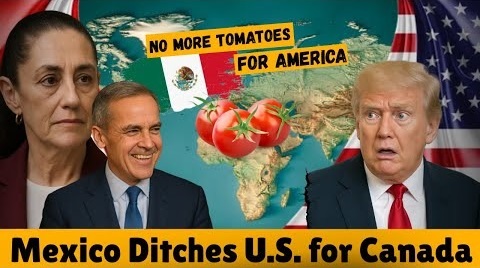
U.S. tomato exports have plummeted following Canada’s abrupt ban on imports, creating a vacuum that Mexico is seizing with a staggering $18 billion investment in agricultural infrastructure. The fallout is immediate and devastating for American farmers, particularly in California, where nearly 70% of tomatoes consumed in the U.S. are sourced. The Trump administration’s imposition of a 17% tariff on Mexican tomatoes had already strained relations, but the recent Canadian decision has turned a trade dispute into a full-blown crisis.

At the U.S.-Canada border, the usual hustle and bustle of trucks transporting fresh produce has come to a standstill. Instead of thriving markets, farmers are faced with empty fields and crumbling futures. The Canadian Food Inspection Agency’s ruling, couched in regulatory language, belies a calculated maneuver to shift agricultural power dynamics in North America. The decision has halted the entry of nearly 150 truckloads of California tomatoes at key border crossings, representing a $340 million loss that directly jeopardizes the livelihoods of 2,400 American farming families.
As American farmers grapple with this sudden loss, Mexico has stepped in to fill the gap with unprecedented speed. The country is not merely expanding its agricultural output; it is transforming into a powerhouse of production, bolstered by investments from European agricultural giants. Regions like Sinaloa and Baja California are evolving into hubs of advanced greenhouse operations, utilizing hydroponic systems that consume significantly less water than traditional farming methods. This shift is not just about quantity; it’s about quality and efficiency, with Mexican tomatoes already undercutting American prices by nearly 25% in European markets.

The implications of this crisis extend far beyond tomato exports. The ripple effects are devastating small towns that depend on agriculture. Processing plants are shuttering, trucking companies are downsizing, and local economies are collapsing under the weight of lost agricultural revenue. Unemployment in farming counties has surged over 30%, and rural communities are witnessing an exodus as families seek stability elsewhere. Schools face dwindling enrollments and funding cuts, while local hospitals are forced to scale back services due to a decline in patient numbers.
This crisis reveals the fragility of America’s agricultural dominance. The U.S. has long been a reliable supplier of food, but the sudden shift in trade relationships has exposed vulnerabilities that could extend to other critical crops like wheat and corn. With technological advancements in Mexico outpacing those in the U.S., the agricultural landscape is changing rapidly. Automated systems and smart farming techniques are putting Mexican producers at a competitive advantage, while American farmers are left grappling with outdated methods.
As the U.S. government remains mired in bureaucratic inertia, the consequences of inaction become increasingly dire. The Department of Agriculture’s slow response to the crisis, characterized by studies and discussions rather than decisive action, has allowed competitors to solidify their positions. While Mexico and Canada move swiftly to bolster their agricultural sectors, American farmers are left in a state of uncertainty, facing rising loan delinquencies and a growing number of bankruptcy filings.
The question now looms large: Can American agriculture recover from this blow, or are we witnessing the beginning of a permanent decline? The tomato crisis serves as a stark warning of the potential for broader disruptions in U.S. agriculture, raising alarms about national food security and the future of rural economies. As the landscape shifts, the stakes have never been higher, and the urgency for action has never been clearer.