A seismic political shift is unfolding across Canada as multiple provincial governments have simultaneously declared their intent to pursue statehood within the United States. The coordinated move by Alberta, Saskatchewan, Manitoba, British Columbia, Quebec, Yukon, and Nunavut represents an unprecedented threat to Canadian Confederation, driven by decades of regional grievances and economic frustration.

Premier Danielle Smith of Alberta finds herself at the epicenter of the crisis, compelled by a citizen-led petition bearing over 404,000 verified signatures. The petition legally forces the provincial legislature to consider a referendum on Alberta’s future within Canada. Smith, who has long stated such decisions must be citizen-driven, now faces immense pressure to allow the democratic process to proceed or risk a devastating backlash from her base.
The legal pathway for separation, while complex, is established. A 1998 Supreme Court ruling holds that a clear majority vote to secede obligates the federal government to negotiate in good faith. Alberta’s referendum mechanism, mirrored quietly by Saskatchewan in recent years, provides the vehicle. The political will to use these frameworks has now reached a critical mass, rendering federal opposition in Ottawa potentially irrelevant.
Economic discontent fuels the fire. Alberta and Saskatchewan cite the systematic extraction of western wealth through federal equalization payments and the repeated blocking of energy export infrastructure. Premier Smith’s October ultimatum—that without pipeline progress, Alberta would intensify efforts to build south to American markets—now appears prophetic. Saskatchewan’s Premier Scott Moe joined the breakaway after projections showed federal policies costing the province $111 billion by 2035.
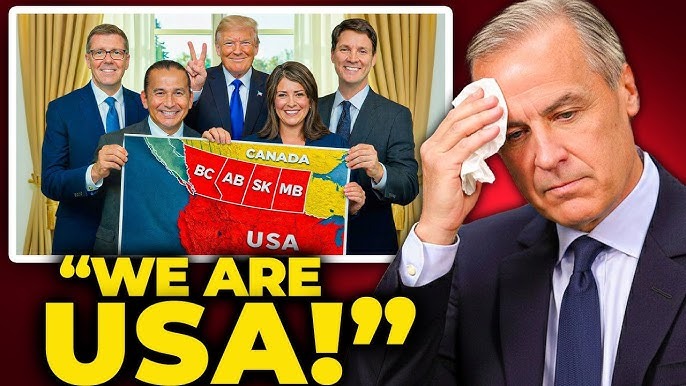
British Columbia’s inclusion shocked observers, marking a dramatic expansion beyond traditional prairie separatism. Premier David Eby’s government, frustrated with equalization and environmental double standards, sees greater promise in integrating Vancouver’s vital port with the U.S. West Coast economy. The long-standing Cascadia movement’s vision of bioregional alignment is suddenly accelerating from theory to imminent reality.
Quebec’s decision to join the coalition may be the most devastating blow to Canadian unity. While the Parti Québécois eyes a 2030 sovereignty referendum, participation in this multi-region breakaway suggests a willingness to fast-track the process. The prospect of constitutional protections for the French language and culture within the American system, akin to Louisiana, presents a compelling alternative to isolated independence.
The northern territories of Yukon and Nunavut bring strategic Arctic sovereignty and vast mineral resources into the equation. Their involvement transforms the movement from a provincial rebellion into a comprehensive re-drawing of North American maps, offering the United States control over crucial northern passages and rare earth deposits.
Manitoba’s declaration underscores the brutal pragmatism of geography. With Alberta and Saskatchewan moving toward the U.S., Manitoba would become a landlocked enclave, physically severed from eastern Canada. Its leadership concluded that joining the Western coalition was the only viable option for economic survival.
Prime Minister Mark Carney’s government awoke to a nation fracturing in real time. The departing regions collectively represent the majority of Canada’s landmass and a colossal share of its economic output. Ottawa is legally obligated to convene a federal-provincial conference and negotiate, but its leverage appears minimal against a coordinated bloc.
The United States has remained officially silent, but the scale of the proposed accession—the largest since Alaska and Hawaii—would redefine its geopolitical and economic landscape. Congressional procedures for admitting new states are lengthy and uncertain, but the mere existence of formal declarations from seven Canadian regions initiates an irreversible process.
This is no longer a fringe separatist fantasy. It is a mainstream constitutional crisis propelled by citizen action, prepared legislation, and a profound collapse of faith in the federal system. The next 18 months will determine whether Canada continues as a nation or undergoes a peaceful dissolution, its constituent parts seeking a new future under the American flag. The Confederation, as it has existed for over 150 years, is now fighting for its life.