Washington, D.C. — Inside the Latest Epstein Files: What 30,000 Newly Released Documents Reveal About Power, Proximity, and the Limits of Proof
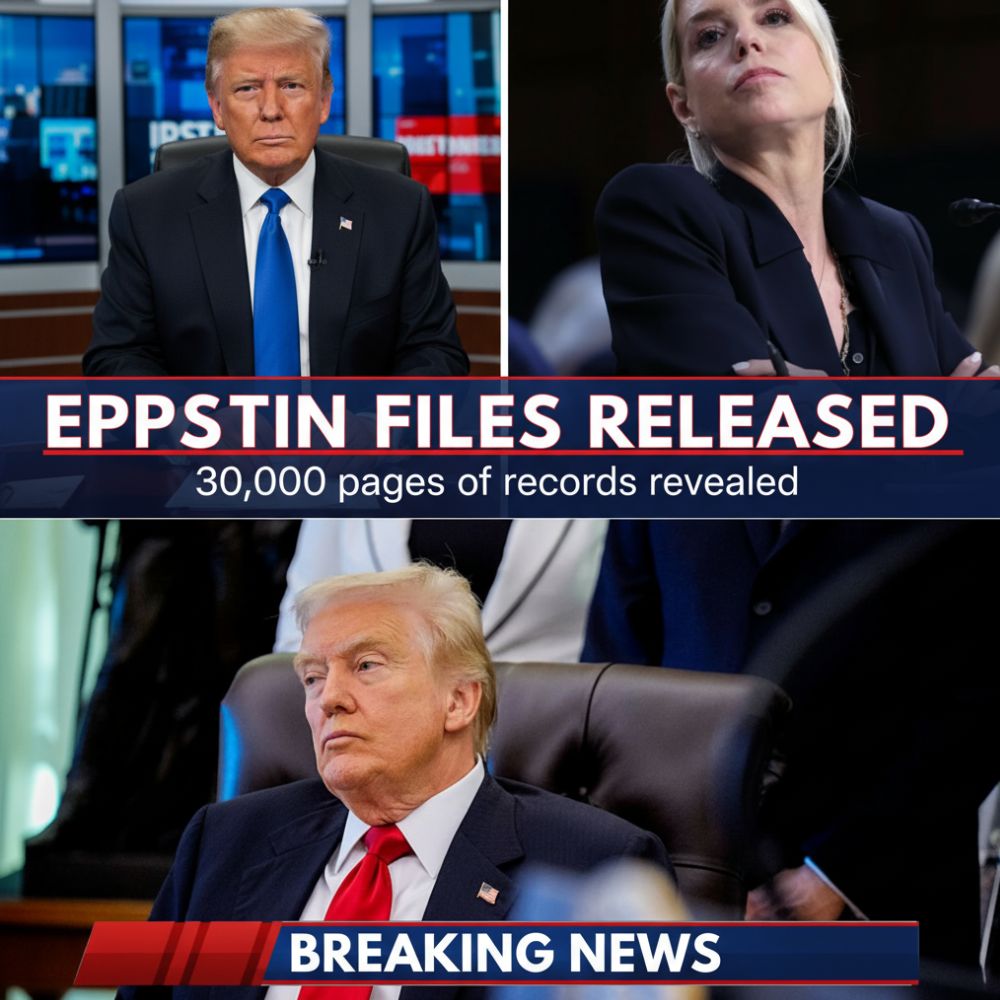
In a development that is already reshaping public conversation around one of the most scrutinized criminal networks in modern history, the U.S. Department of Justice has released a sweeping new tranche of documents tied to the investigations of Jeffrey Epstein and his longtime associate Ghislaine Maxwell.
The release—totaling more than 30,000 pages—marks the third major disclosure under the Epstein Files Transparency Act, a law signed by Donald Trump in late 2025 after overwhelming bipartisan support in Congress. The legislation required the Department of Justice to make public all unclassified materials related to Epstein’s criminal investigations.
What has emerged is not a single revelation, but a dense mosaic of records: internal emails, court filings, subpoenas, travel logs, and personal correspondence. Some documents are mundane. Others are deeply unsettling. And a few—carefully parsed—raise questions that are likely to persist far beyond this news cycle.
A Document Dump Years in the Making
For years, critics argued that the full scope of Epstein’s network—who knew what, when, and how—remained obscured by sealed records, redactions, and institutional caution. The Transparency Act was designed to change that.
This latest release, dated December 23, 2025, is the most extensive yet. It follows earlier disclosures that drew criticism for heavy redactions and even the unexplained removal of certain files from official government websites.
This time, the volume alone signals a shift toward broader disclosure.
But transparency, as the documents show, does not automatically produce clarity.
The Trump Flight Records: Context Without Conclusion
Among the most widely discussed revelations is an internal 2020 email written by a federal prosecutor in the Southern District of New York. The message summarizes newly reviewed flight logs and notes that Donald Trump appeared as a passenger on Epstein private jet at least eight times between 1993 and 1996.
The email was marked “for situational awareness”—a phrase commonly used within prosecutorial teams to flag information that may become relevant during litigation.
It also notes that:
Ghislaine Maxwell was present on at least four of those flights
One flight included only Trump and Jeffrey Epstein
Another included a 20-year-old passenger whose identity remains redacted
Two additional flights included women later identified as potential witnesses in the Maxwell case
At first glance, the details appear significant.
But legally, they are limited.
The Department of Justice emphasized—both in the documents and in a public statement—that these records do not constitute allegations of wrongdoing. Being listed on a flight log, even alongside individuals later implicated in criminal activity, does not establish knowledge, participation, or complicity.
This distinction—between presence and proof—is central to understanding the release.
As one legal analyst summarized: “Flight logs are facts. Interpretation is something else entirely.”
The “Invisible Man” Email and Royal Implications
If the Trump-related documents dominate domestic headlines, an international dimension has emerged through a different set of records—an email exchange from 2001 involving an unidentified sender using the alias “the invisible man.”
The message, sent to Ghislaine Maxwell, references a stay at Balmoral Castle—a private residence long associated with the British royal family.
In the email, the sender asks:
“Have you found me some new inappropriate friends?”
Maxwell’s reply is curt:
“I have only been able to find appropriate friends.”
The sender is not explicitly identified in the documents.
However, circumstantial indicators—including the Balmoral reference, timing, and known associations—have led many observers to speculate about a connection to Prince Andrew.
Prince Andrew has previously faced scrutiny over his relationship with Epstein, including a civil case brought by Virginia Giuffre, which he settled without admitting wrongdoing.
The documents do not confirm the sender’s identity.
But they reinforce a broader pattern: Epstein’s network extended into some of the most powerful institutions in the world.
The Mar-a-Lago Subpoena: A Different Kind of Link
Another key document is a 2021 federal subpoena issued to Mar-a-Lago, the private club owned by Donald Trump.
The subpoena requested employment records for an unnamed individual as part of the prosecution of Ghislaine Maxwell.
Though heavily redacted, the context suggests the records may relate to Virginia Giuffre, who has publicly stated that she was recruited into Epstein’s network while working at the club as a teenager.
If so, the subpoena reflects a standard investigative step: establishing timelines and verifying accounts.
Importantly, it does not indicate that Mar-a-Lago itself was under criminal investigation.
This distinction again underscores a recurring theme in the documents: proximity does not equal culpability.
A Passport, Diamonds, and the Architecture of Escape
Among the more unusual discoveries detailed in the files is a fraudulent Austrian passport found in Epstein’s Manhattan residence during a 2019 search.
The passport featured Epstein’s photograph but listed a different name and identified Saudi Arabia as the holder’s residence.
Alongside it were:
Approximately $70,000 in cash
48 loose diamonds
Epstein’s legal team previously claimed the passport was intended as a precaution—something to be used in emergencies involving kidnapping or political instability.
Whether that explanation holds weight remains uncertain.
What is clear is that the document reflects a level of contingency planning that aligns with Epstein’s broader lifestyle: one built on mobility, secrecy, and access.
The DOJ’s Disclaimer—and Its Limits
In releasing the documents, the Department of Justice issued a statement warning that some materials contain “untrue and sensationalist claims.”
The statement emphasized that:
Not all claims in the documents have been verified
Some allegations were submitted without substantiation
Inclusion in the files does not imply credibility
Critics, however, have pointed out that the DOJ did not specify which claims fall into this category.
This ambiguity leaves interpretation largely in the hands of the public—raising concerns about misinformation, selective reading, and political framing.
Transparency, Imperfectly Delivered
Despite the scale of the release, the process itself has drawn scrutiny.
Issues include:
Documents briefly appearing online before being removed
Redactions applied inconsistently
A technical flaw allowing hidden text to be recovered in some files
These problems have fueled skepticism about whether the government has fully complied with the Transparency Act’s intent.
For many observers, the release feels incomplete—not because of what it reveals, but because of what remains unclear.
The Role of Media Framing
Coverage of the documents has varied widely across media outlets.
Networks such as Fox News have emphasized the DOJ’s disclaimer and the absence of formal accusations against Donald Trump, while still reporting the factual contents of the documents.
This approach—reporting the records while contextualizing them—reflects a broader editorial challenge:
How do you present information that is factual, incomplete, and potentially misleading if misinterpreted?
There is no simple answer.
The Unanswered Questions
For all the information contained in the 30,000 pages, key questions remain:
Who were the “co-conspirators” referenced in internal DOJ communications?
Why were certain individuals never charged?
What additional evidence remains classified or unreleased?
Perhaps most importantly:
What does accountability look like when the central figure—Jeffrey Epstein—is no longer alive to stand trial?
A Story Still Unfolding
The release of these documents does not close the chapter on Epstein.
If anything, it expands it.
The files provide fragments—snapshots of a vast, interconnected network that operated across decades and continents. They offer evidence of relationships, patterns, and behaviors.
But they do not, on their own, resolve the deeper questions of responsibility.
As more documents are expected to be released, the public—and the press—will continue to sift through the details.
Not just looking for answers.
But trying to understand what, if anything, those answers ultimately mean.
Conclusion: Transparency Without Resolution
The Epstein files were released in the name of transparency.
And in that sense, the law has succeeded.
The public now has access to information that was once hidden.
But transparency is not the same as closure.
What these documents reveal is not a single narrative, but a complex and often uncomfortable reality:
Powerful people moved in the same circles.
They shared spaces, conversations, and, at times, transportation.
Whether those connections carried deeper implications remains, in many cases, unproven.
And that uncertainty—more than any single revelation—may be the most enduring legacy of this release.