The political storm surrounding Representative Ilhan Omar has once again erupted, fueled by a dramatic narrative describing a high-stakes congressional hearing, financial allegations, and emotional testimonies that appear to shake the foundations of public trust.

Yet, beneath the surface of this widely circulated story lies a crucial question: how much of it is grounded in verified fact, and how much is constructed storytelling designed to provoke reaction?
According to the circulating account, the controversy centers on allegations that Omar directed approximately $2.78 million in campaign funds to a consulting firm owned by her husband, raising concerns about potential conflicts of interest and possible violations of campaign finance laws.
The narrative frames this as a central issue in a supposed House Ethics Committee hearing, where these financial transactions are portrayed as highly irregular compared to typical campaign spending patterns.
However, while campaign payments to firms connected to family members can raise ethical questions, they are not automatically illegal if properly disclosed and compliant with Federal Election Commission regulations.
Public records do show that Omar’s campaign made payments to her husband’s firm, but whether those payments constitute wrongdoing depends on legal interpretation and enforcement findings—not narrative presentation.
The story further escalates by linking Omar to the “Feeding Our Future” fraud case in Minnesota, a real and documented federal investigation involving the alleged misuse of approximately $250 million in pandemic-related food aid funds.
The narrative emphasizes that several individuals charged in the case were donors to Omar’s campaign, implying a connection that raises suspicion.
Yet, this is where nuance becomes essential.
Being a political donor does not establish complicity or knowledge of criminal activity.
Large political campaigns often receive contributions from thousands of individuals, and unless there is direct evidence of coordination or involvement, such associations remain circumstantial.
Even the narrative itself acknowledges that there is no direct claim Omar participated in or knew about the fraud—an important distinction that can easily be overlooked when the story is told in a more dramatic tone.
Another major claim presented is the significant increase in Omar’s net worth, described as rising from approximately $51,000 to $30 million within eight years.
This figure is used to suggest unexplained wealth accumulation, a common theme in political controversies.
However, publicly available financial disclosures for members of Congress do not support such an extreme figure.
While politicians can increase their wealth through book deals, speaking engagements, investments, and other income streams, claims of dramatic financial growth must be verified through official filings.
Without corroborated data, such numbers should be treated with skepticism.
The narrative also introduces emotionally charged testimony from constituents, describing families who allegedly did not receive promised benefits from government programs.
These accounts are powerful and humanizing, illustrating the real-world impact of fraud when it occurs.
But their inclusion within a broader accusatory storyline can blur the line between documented events and implied responsibility.
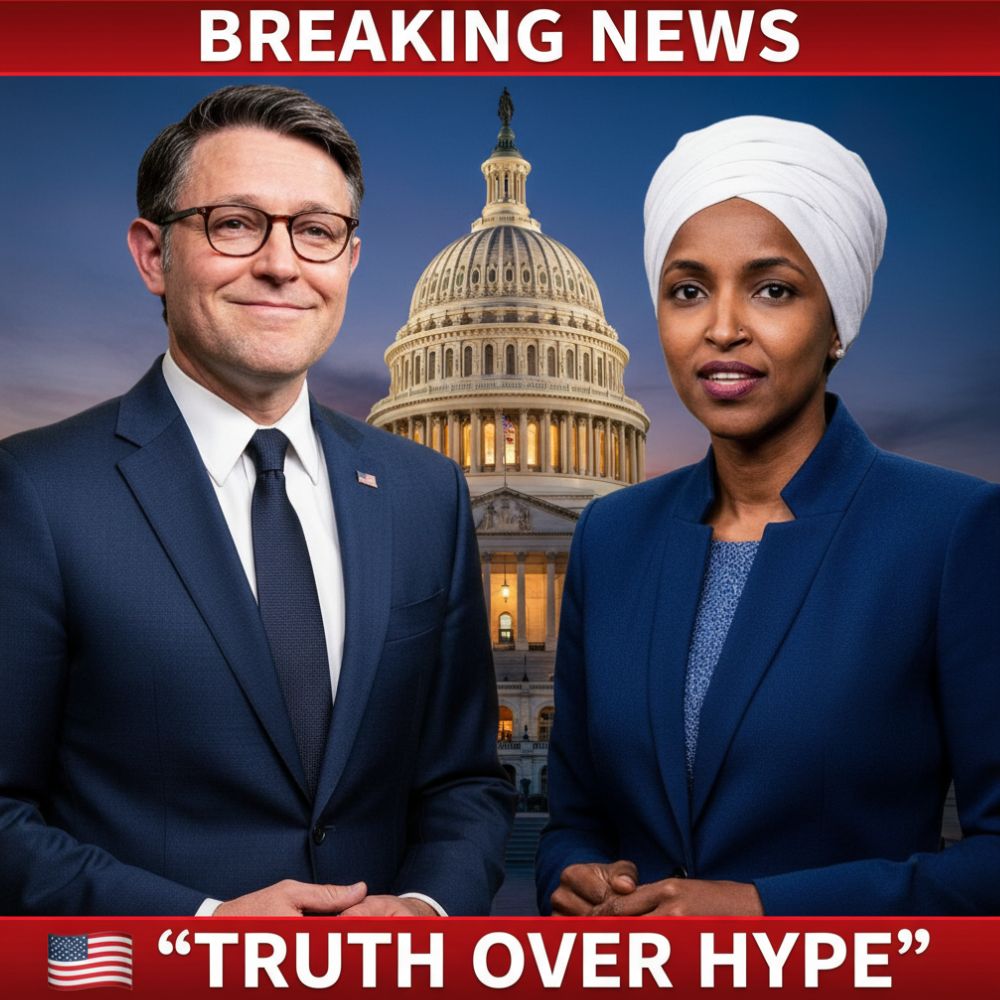
Equally striking is the portrayal of a confrontation between Omar and political leadership, including accusations of bias and responses emphasizing documented evidence over identity-based arguments.
This moment is framed as a Decision clash between emotion and data, identity and accountability.
Yet, there is no verified public record of such a detailed, dramatic exchange occurring exactly as described.
Congressional hearings are documented, transcribed, and widely reported.
A hearing of this magnitude—featuring explosive financial claims, direct accusations, and viral exchanges—would be covered extensively by major news organizations.
The absence of such coverage suggests that the narrative may be fictionalized or heavily embellished.
This raises a broader issue about modern information consumption.
Stories like this often blend real elements—such as known investigations, public figures, and genuine controversies—with invented dialogue, exaggerated figures, and dramatized scenarios.
The result is a hybrid narrative that feels authentic but may not be entirely accurate.
For readers, the challenge is distinguishing between verified reporting and compelling storytelling.
The “Feeding Our Future” case is real.
Campaign finance questions are legitimate topics of scrutiny.
Political debates over ethics and accountability are ongoing.
But when these elements are woven into a cinematic narrative complete with scripted dialogue, precise emotional beats, and unverified claims, the line between journalism and fiction becomes blurred.
This does not mean concerns about transparency or accountability should be dismissed.
Public officials should always be subject to scrutiny, and legitimate investigations play a vital role in maintaining trust in democratic institutions.
But scrutiny must be grounded in evidence—not narrative construction.
In this case, the story’s power comes from its structure: a clear antagonist, a dramatic confrontation, emotional witnesses, and a decisive conclusion.
It reads less like a verified report and more like a political drama designed to influence perception.
And that is precisely why it resonates.
In an era where information spreads rapidly and narratives often outpace facts, stories that feel true can become more influential than those that are actually verified.
The danger lies not in asking questions, but in accepting answers that have not been proven.
As the debate continues, one thing remains clear: separating fact from fiction has never been more important.