Europe’s Quiet Trade Revolution in an Age of American Uncertainty
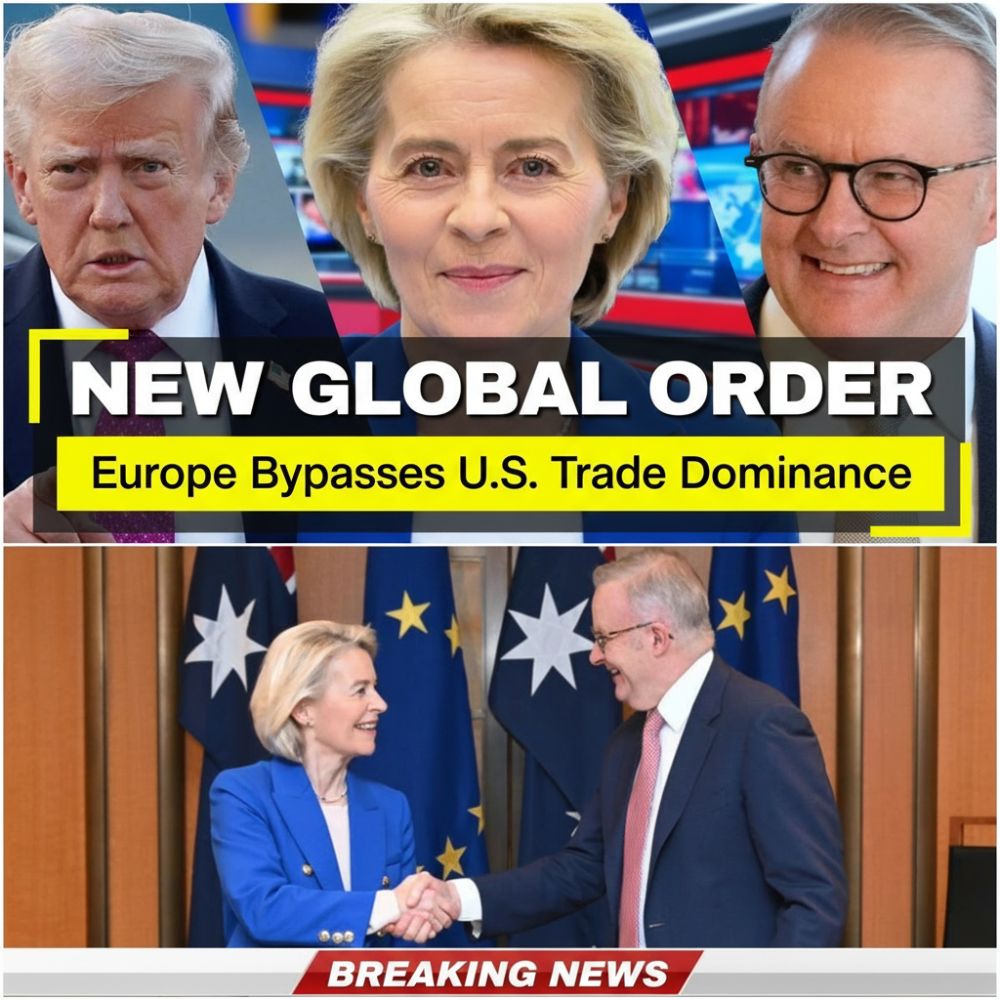
In the coming days, European Commission President Ursula von der Leyen is expected to travel to Australia to revive and potentially finalize a free trade agreement that collapsed just two years ago. In 2023, negotiations broke down over something as specific—and symbolic—as beef quotas. The talks were declared dead.
Today, they are very much alive.
The speed of this reversal is striking. What once appeared to be an intractable disagreement has, in less than a year, transformed into a near-final agreement. The catalyst, many analysts suggest, has not been a sudden shift in agricultural policy, but a broader disruption in global trade dynamics.
At the center of that disruption is the United States.
Since returning to office, President Donald Trump has reignited a strategy of aggressive tariffs, unilateral trade actions, and demands that allies align more closely with American economic and security priorities. These moves, intended to reassert U.S. dominance, have instead introduced a level of unpredictability that many countries now view as a structural risk.
Allies are adapting accordingly.
For decades, the global trade system rested on a simple assumption: the United States served as the central anchor, with allies operating within its economic orbit. That framework is now being tested in real time. As Washington’s policies grow less predictable, other actors are stepping in to fill the void.
Europe, in particular, is moving with unusual سرعت.
Von der Leyen has acknowledged the shift in stark terms, telling EU ambassadors recently that “the West as we knew it no longer exists.” Her remarks were not rhetorical flourish. They reflect a growing recognition within European institutions that the old transatlantic model is fragmenting.
In its place, the European Union is positioning itself as a stable and rules-based alternative.
The numbers reinforce this narrative. Roughly 87 percent of global trade occurs outside of the United States. Within the EU’s own trade portfolio, a significant majority is conducted with non-U.S. partners. This reality is shaping policy decisions in Brussels, where officials are accelerating efforts to secure new agreements across multiple regions.
Recent months have seen a surge in activity.
The long-delayed Mercosur agreement, involving Argentina, Brazil, Paraguay, and Uruguay, was finalized after decades of stalled negotiations. Trade talks with India have advanced rapidly. Agreements with Mexico, Indonesia, and Switzerland have either been concluded or brought close to completion.
Australia now sits at the center of this expanding network.
But the EU-Australia deal is about more than tariffs on wine or automobiles. Its strategic significance lies in critical minerals—lithium, cobalt, and rare earth elements—that are essential to the global energy transition and digital economy. Australia, as the world’s largest lithium producer, represents a crucial partner in Europe’s effort to diversify supply chains.
This effort is not occurring in isolation.
China’s dominance in battery and solar manufacturing has underscored the risks of concentrated supply chains. Europe’s response has been to build alternative networks, linking trade agreements directly to industrial policy. Investments in mining, refining, and energy infrastructure are being coordinated alongside diplomatic efforts.
The result is a form of economic statecraft that blends commerce with strategy.
European institutions, including the European Investment Bank, are already deepening ties with Australian partners to ensure stable and sustainable sourcing of critical materials. At the same time, European companies are expanding operations across the continent, embedding themselves within these emerging supply chains.
This is not merely globalization—it is reconfiguration.
Meanwhile, negotiations continue with countries across Southeast Asia, the Middle East, and Africa. The pace is notable. European officials themselves have remarked that their trade network has never expanded so quickly.
If this trajectory continues, the implications could be profound.
By the end of the decade, the European Union may have formalized trade relationships covering a substantial portion of the global economy—potentially excluding the United States from the central role it once held. This does not imply American isolation, but it does suggest a dilution of its leverage.
In geopolitics, alternatives matter.
When countries can access markets, capital, and supply chains through multiple partners, their dependence on any single power diminishes. This, in turn, reshapes the balance of influence. The United States remains a major economic force, but its ability to dictate terms may be gradually eroding.
The shift is still unfolding.
Whether Europe emerges as a new center of global trade, or whether the world moves toward a more multipolar system, remains uncertain. What is clear, however, is that the architecture of global commerce is changing—and it is changing faster than many expected.
The revival of the EU-Australia trade deal is not an isolated ঘটনা.
It is part of a broader pattern—one in which uncertainty in one part of the system creates opportunity in another. As Washington recalibrates its approach, Europe is quietly, methodically, building something new.
A parallel framework for global trade, grounded not in dominance, but in diversification.