Canada’s Quiet Pivot to China Locks the U.S. Out of Billions as Trump’s Leverage Crumbles
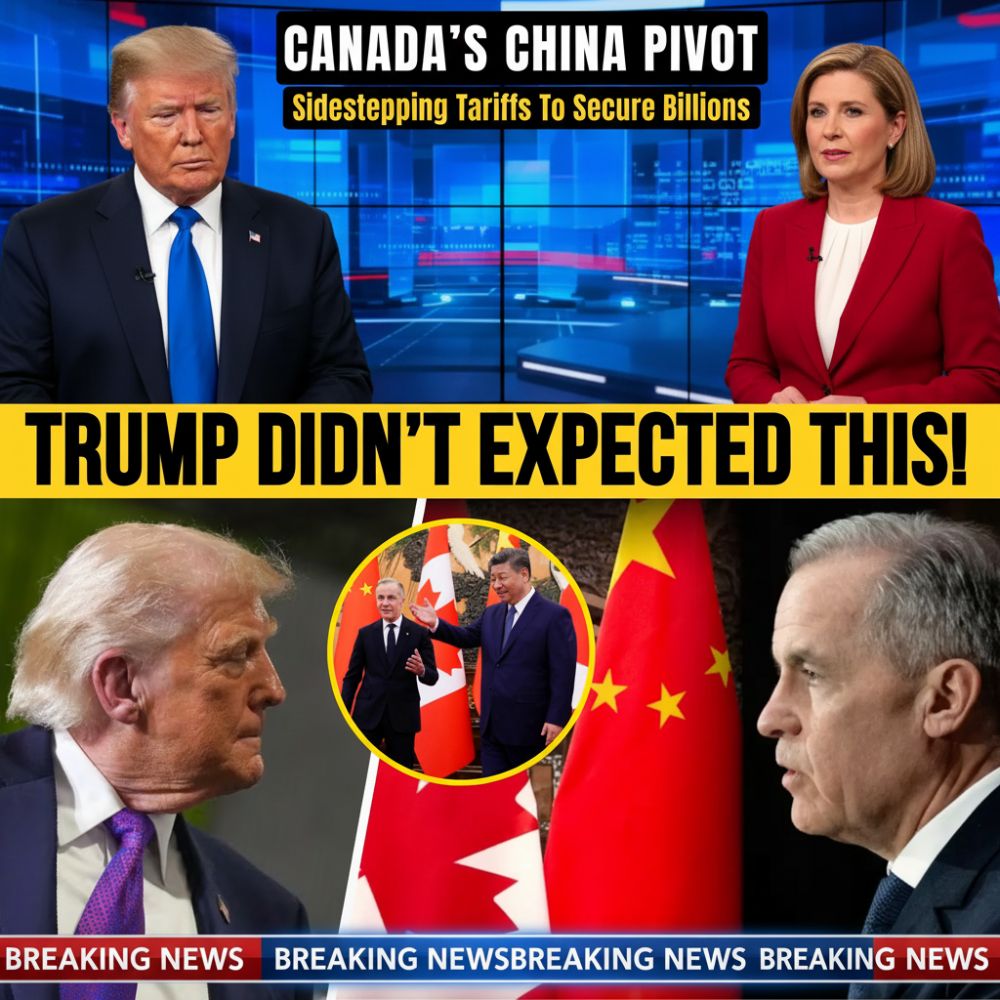
A quiet shift unfolded in Beijing this week, and Washington is only now realizing what it means. Canada and China have reopened trade and diplomatic channels that remained frozen for nearly a decade, and the ripple effects are moving far beyond symbolism.
Sources familiar with the negotiations say talks that began as a tentative reset are quickly evolving into something structural. Trade flows are being redirected. Markets once thought lost to Canadian exporters are reopening. And a form of American leverage that Ottawa once had no way to escape is rapidly weakening.
“This is not a gesture,” said Wendy Cutler, a former U.S. trade negotiator now at the Asia Society Policy Institute. “This is Canada building a parallel track. And the United States is not on it.”
The timing is what makes this moment different. President Trump’s tariffs, public threats, and social media broadsides did not pull Canada closer to Washington. Instead, they pushed Ottawa to build options elsewhere—faster than almost anyone expected.
For years, the United States relied on a simple assumption: Canada had no real alternative. Ninety percent of Canadian oil exports flow south. Seventy-five percent of all Canadian goods exports go to the United States. That dependency was Washington’s trump card.
But dependency cuts both ways. When Trump imposed tariffs on Canadian steel, aluminum, dairy, and most recently wheat, he reminded Ottawa that relying on a single customer is a vulnerability, not a strength.
“The Americans thought geography was destiny,” said Fen Hampson, a professor of international affairs at Carleton University in Ottawa. “They forgot that destiny can be rerouted. It just takes time, money, and a sufficiently unreliable partner.”
The China pivot did not happen overnight. Behind the scenes, Canadian trade officials have been quietly rebuilding relationships with Beijing since late 2024. The public face of that effort was Prime Minister Mark Carney’s state visit to China two months ago.
What emerged from that visit was a roadmap. China agreed to accelerate approvals for Canadian canola oil, pork, and seafood—three sectors that lost billions when diplomatic relations collapsed following the Huawei executive dispute in 2018.
Now, those approvals are final. Canadian canola shipments to China are expected to double by the end of this year. Pork exports, which fell to nearly zero during the freeze, are projected to return to pre-2018 levels within eighteen months.
The numbers are not trivial. Before the freeze, China was Canada’s second-largest trading partner, with bilateral trade exceeding $100 billion annually. Restoring even half of that flow would represent a seismic shift in North American trade dynamics.
“We are not leaving the United States,” said a senior Canadian official who spoke on condition of anonymity. “But we are no longer willing to be held hostage. China is a customer. The United States is a neighbor. Neighbors don’t get to demand loyalty while slapping tariffs on your products.”
The official’s frustration reflected a broader calculation inside the Canadian government. For decades, Ottawa aligned its trade policy with Washington’s strategic priorities, including joining the embargo on Chinese technology and limiting Chinese investment in critical minerals.
That alignment came at a cost. While Canada played by American rules, China turned to Australia, Brazil, and Argentina for agricultural imports. Canadian farmers lost market share they have never recovered.
Now, with Trump threatening to block the Gordie Howe International Bridge and imposing tariffs on Canadian wheat, the political calculus in Ottawa has shifted. The cost of alignment, officials concluded, no longer justified the benefits.
“Trump gave Carney the cover he needed,” said Lawrence Herman, a Toronto-based trade lawyer. “No one in Canada can accuse the government of abandoning the United States when the United States clearly abandoned us first.”
The White House response has been muted but anxious. Privately, trade advisers acknowledge that Canada’s pivot to China undermines one of the administration’s core assumptions: that economic coercion works when the target has no alternatives.
“We assumed Canada would blink,” said a former Trump trade official who requested anonymity. “Instead, they called our bluff. And now they’re sleeping with the competition.”
The phrase is deliberately provocative, but it captures Washington’s unease. A Canada that trades freely with China is a Canada that no longer needs to accept every American demand. That changes the balance of power across dozens of negotiations, from lumber to dairy to auto parts.
For American farmers and exporters, the consequences are already visible. Canadian canola oil that once competed with American soybeans in Chinese markets is now displacing U.S. products outright. American pork exporters report losing contracts to Canadian competitors who can offer better prices thanks to newly reopened Chinese quotas.
“We are watching our market share disappear in real time,” said Scott VanderWal, a soybean farmer in South Dakota and vice president of the American Farm Bureau Federation. “And there is nothing we can do about it because the administration burned the bridge with Canada and handed China the matches.”
Back in Beijing, Canadian and Chinese officials have scheduled another round of talks for next month. The agenda includes investment treaties, technology cooperation, and potentially a formal free trade agreement.
That prospect would have been unthinkable two years ago. Today, it is moving from possible to probable. And Washington, which once held veto power over Canada’s trade relationships, is watching from the outside.
“The United States still matters enormously to Canada,” Hampson said. “But not exclusively. Not anymore. Trump taught Canada a painful lesson: never let one country control your future. Canada learned. And now America is living with the result.”
As the sun rose over the Pacific, a cargo ship loaded with Canadian canola oil departed Vancouver for Shanghai. It will not return empty. The cargo on the return trip—Chinese electronics, machinery, and consumer goods—will fill Canadian ports and trucks and warehouses.
None of it will cross the American border. And that, perhaps, is the quietest and most devastating detail of all.