Washington, D.C. — A dramatic and closely watched television appearance by House Speaker Mike Johnson has ignited intense discussion across political circles, after a tense exchange raised fresh questions about his leadership position and the growing influence of former President Donald Trump over the direction of his party.
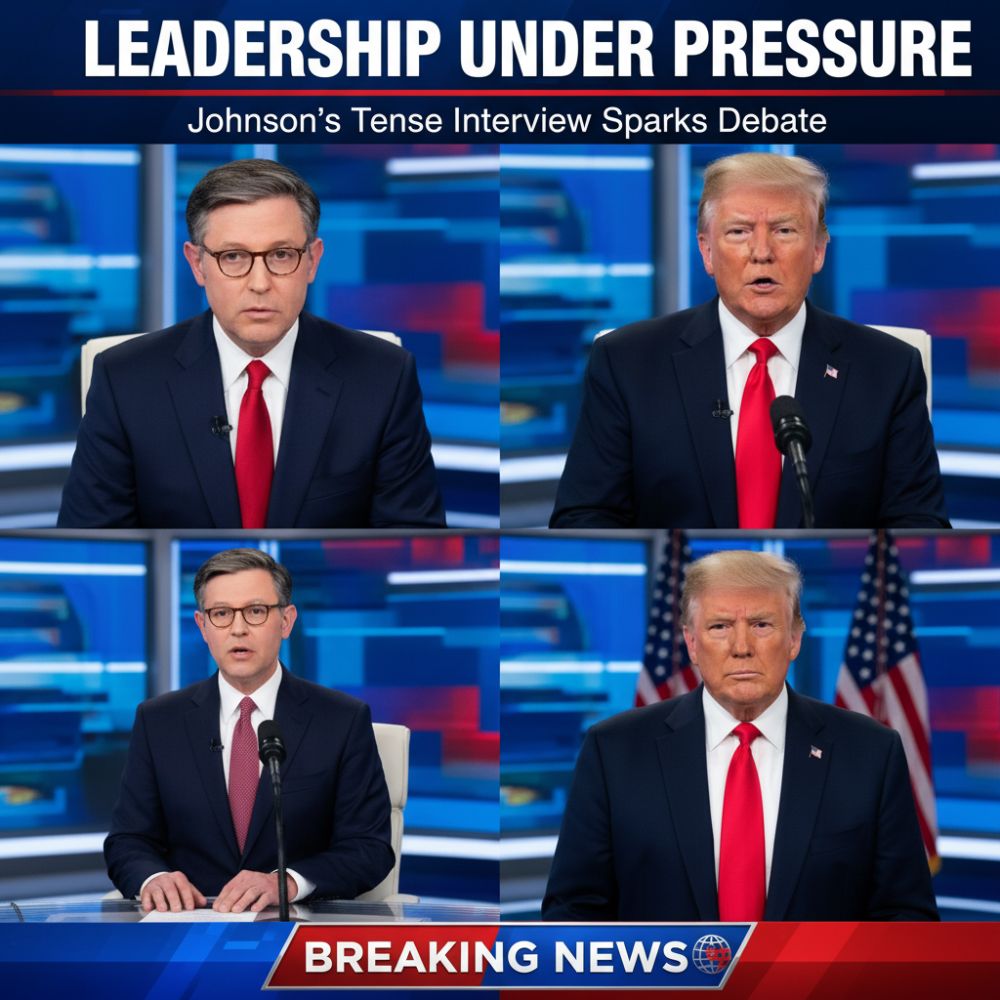
What began as a routine policy interview quickly transformed into a high-stakes moment that exposed the internal pressures shaping today’s political landscape. Viewers watching live saw a rare glimpse of strain as Johnson navigated pointed questions about his standing, party unity, and Trump’s role in ongoing decision-making at the highest levels.
A ROUTINE INTERVIEW TAKES A SHARP TURN
The segment opened with familiar ground: budget negotiations, legislative priorities, and the challenges of maintaining unity within a deeply divided House. Johnson, composed and measured, outlined his approach to governance, emphasizing stability and cooperation within his conference.
But the tone shifted when the interviewer pivoted to a more direct line of questioning—one centered not on policy, but on power.
“Mr. Speaker,” the host asked, “how secure is your position right now, given the growing influence of President Trump and the pressure from within your own ranks?”
The question landed with precision.
For a brief moment, Johnson paused—just long enough to signal that the conversation had moved into more sensitive territory.
THE MOMENT OF PRESSURE
Johnson began his response carefully.
“My focus is on doing the job the American people elected us to do,” he said. “We’re working through challenges, and that’s part of leadership.”
But the follow-up came quickly.
“Is that a yes?” the host pressed. “Do you feel secure in your role?”
This time, the pause was more noticeable.
Observers watching closely noted a subtle shift—Johnson adjusted his posture, his tone tightening slightly as he chose his words.
“Leadership positions are always about trust,” he replied. “And I believe we’re continuing to build that trust.”
The answer, while measured, did not fully deflect the underlying question. Instead, it opened the door to a broader discussion about the balance of power within the party—and the influence of one figure in particular.
TRUMP’S SHADOW OVER THE CONVERSATION
As the interview progressed, the focus increasingly turned toward Donald Trump. His role, while not formally tied to congressional leadership, has become a central factor in shaping political dynamics.
The interviewer addressed it directly.
“How much does President Trump’s support determine your future as Speaker?”
Johnson responded with caution.
“President Trump is an important voice in our party,” he said. “But my responsibility is to the entire conference and to the American people.”
The answer reflected a careful balancing act—acknowledging Trump’s influence without conceding authority.
A VISIBLE SHIFT
As the questioning intensified, viewers noted a change in Johnson’s demeanor. While he maintained composure, the rhythm of the conversation became more uneven. Responses grew shorter, more deliberate, as each question probed deeper into the realities of internal party dynamics.
Political analysts later described the moment as one of “visible pressure,” not because of any single statement, but because of the cumulative effect of the questioning.
“This is what high-stakes leadership looks like in real time,” one analyst said. “Every word matters, and every pause is interpreted.”
THE BROADER CONTEXT
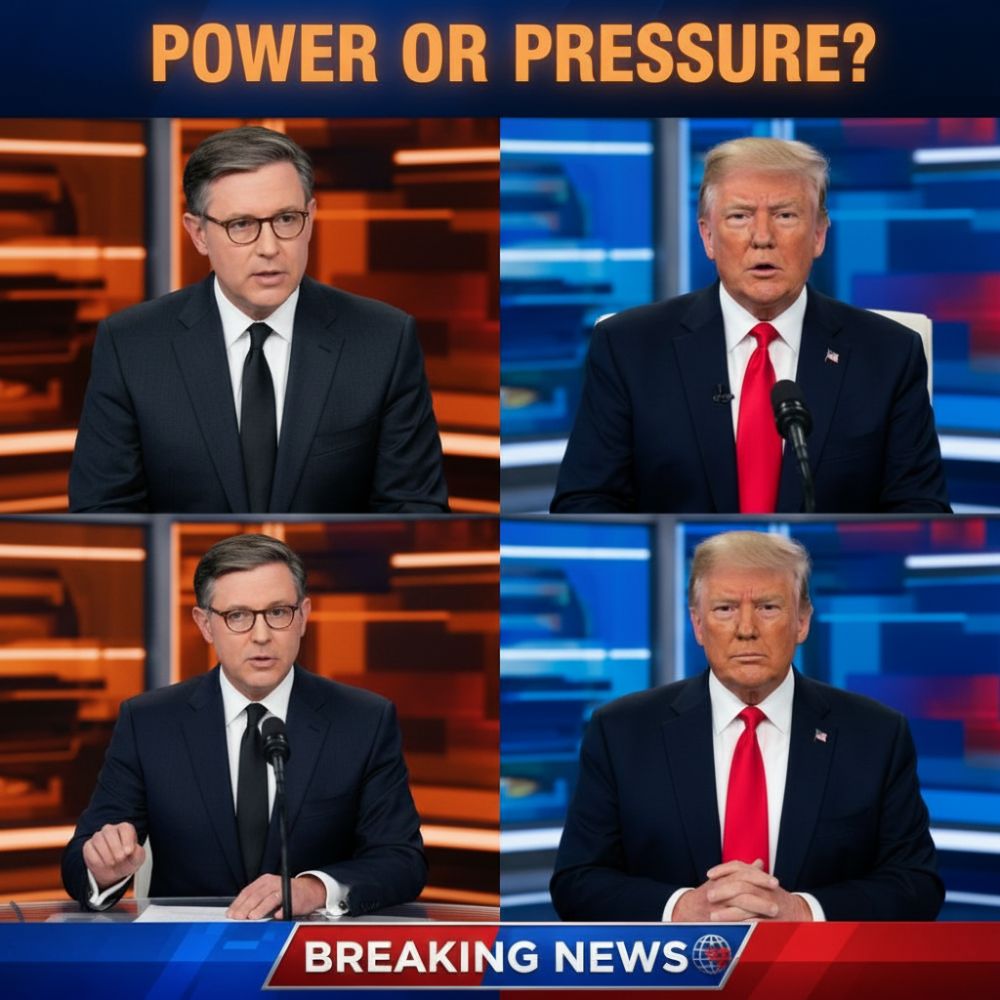
The exchange comes at a time when party unity remains a central challenge. Leadership positions in the House are shaped not only by formal votes, but by ongoing support from members with differing priorities and perspectives.
Trump’s continued influence adds another layer of complexity. His ability to mobilize support—and to shape narratives—means that his presence is felt even in settings where he is not physically present.
For Johnson, this creates a dual responsibility: maintaining cohesion within the House while navigating the expectations of a broader political movement.
MEDIA AND PUBLIC REACTION
Within hours of the broadcast, clips of the interview circulated widely across social media and news platforms. Viewers focused on specific moments—the pauses, the phrasing, the subtle shifts in tone—that suggested the weight of the situation.
Commentators offered varied interpretations:
Some viewed Johnson’s responses as steady and disciplined, reflecting the realities of leadership under scrutiny.
Others saw signs of vulnerability, interpreting the exchange as evidence of internal challenges.
Many pointed to the broader significance of Trump’s influence, noting how frequently his name surfaced throughout the discussion.
The moment quickly became part of a larger conversation about power, loyalty, and the evolving structure of political leadership.
A TEST OF COMMUNICATION
For communication experts, the interview provides a clear example of how leaders navigate high-pressure situations in real time. Johnson’s approach—measured, cautious, and focused on unity—demonstrates the importance of maintaining control over both message and tone.
At the same time, the exchange highlights the difficulty of addressing questions that have no simple answers. Leadership stability is not always defined by certainty, and attempts to project confidence must be balanced with the realities of internal dynamics.
THE AUDIENCE PERSPECTIVE
Viewers watching live experienced the tension as it unfolded. Unlike edited segments, live television captures every hesitation, every shift in tone, every moment of uncertainty.
“It felt like you were watching something unscripted,” one viewer commented. “You could see the pressure building as the questions kept coming.”
That immediacy is part of what makes such moments resonate. They offer a glimpse into the human side of leadership—the decisions, the calculations, and the effort required to maintain composure under scrutiny.
WHAT COMES NEXT
In the aftermath of the interview, attention has turned to what lies ahead for Johnson and for the broader political landscape. Leadership positions are shaped over time, influenced by both public perception and internal support.
Trump’s role, meanwhile, remains a defining factor. His influence continues to shape conversations, strategies, and expectations within the party.
For Johnson, the path forward will depend on his ability to maintain trust, navigate competing priorities, and respond effectively to the challenges highlighted during the interview.
CONCLUSION
The live television moment involving Mike Johnson and the shadow of Donald Trump serves as a powerful reminder of the complexities of modern political leadership. It illustrates how quickly a routine interview can become a defining moment, and how the interplay of questions, responses, and public perception can shape the narrative.
In an era where every word is scrutinized and every pause analyzed, leadership is not only about decisions—it is about communication, composure, and the ability to navigate uncertainty in full view of the public.
For those who watched, the moment stands as a vivid example of the pressures at the highest levels of government—and the enduring influence of figures who continue to shape the political landscape from beyond formal office.