NUUK, Greenland — In a move that has sent shockwaves through Washington and reshaped the geopolitics of the Arctic, Greenland has signed a sweeping mining and energy partnership with Canada, bypassing the United States at a moment when American interest in the island’s vast mineral wealth has never been more pronounced.
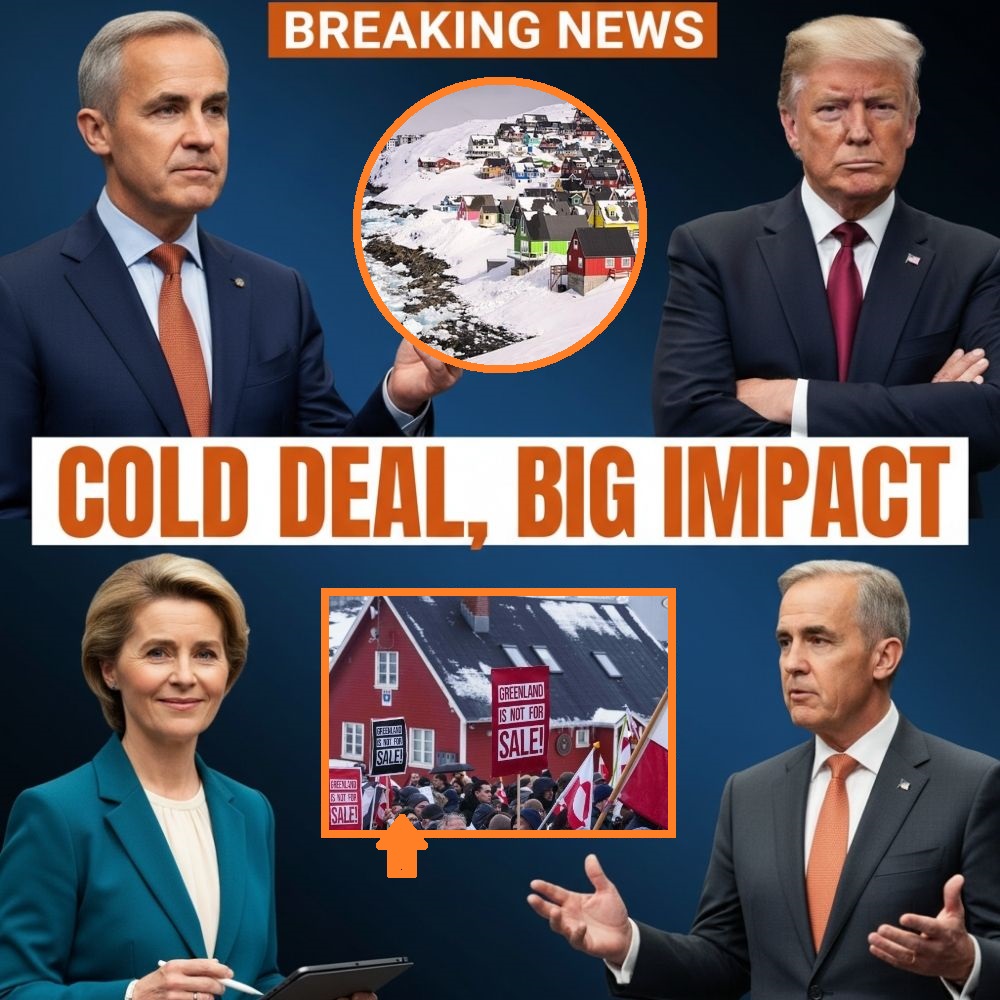
The agreement, finalized in Nuuk late Wednesday, grants Canadian mining and infrastructure firms preferential access to Greenland’s untapped reserves of rare earth elements, uranium, and other critical minerals — resources that are essential for electric vehicle batteries, advanced weaponry, and the renewable energy technologies that are driving the global economy. In exchange, Canada will provide $4.2 billion in infrastructure investment, including port facilities and energy systems designed to accelerate Greenland’s path toward economic independence from Denmark.
For the United States, the deal represents a stunning setback. President Trump, who during his first term famously floated the idea of purchasing Greenland from Denmark, has repeatedly argued that the island’s strategic location and resource wealth make it a vital national security interest. His administration has spent months courting Greenlandic officials, dangling investment packages and security guarantees in an effort to secure American dominance in the Arctic.
But those efforts appear to have backfired. Greenlandic officials, wary of being drawn into Washington’s superpower rivalries with China and Russia, have instead chosen a partner that offers resources and proximity without the political baggage.
“We are not a pawn in anyone’s geopolitical game,” said Múte Bourup Egede, Greenland’s prime minister, at a news conference alongside Prime Minister Mark Carney of Canada. “Greenland chooses its partners based on respect, shared values, and mutual benefit. Canada has demonstrated that it sees us as an equal.”
For Mr. Carney, the deal is the latest in a series of strategic moves designed to position Canada as the dominant Arctic power and to reduce the country’s economic dependence on the United States. In recent weeks, Ottawa has signed major energy and trade agreements with Qatar, Germany, and now Greenland — each one bypassing Washington and expanding Canada’s global footprint.
“The Arctic is Canadian territory, and Canadian interests must be defended and advanced,” Mr. Carney said. “This partnership with Greenland is about building a prosperous, stable, and sovereign Arctic region — one that benefits the people who live here, not distant capitals that see this land only for what it can be extracted.”
The political reaction in Washington was swift and furious. President Trump, according to multiple aides, erupted when briefed on the agreement, demanding to know how the United States had been “cut out” of negotiations that had been ongoing for months. In a series of social media posts, the president accused Canada of “undermining American security” and suggested that the deal was “illegitimate.”
Ambassador Pete Hoekstra, the U.S. envoy to Canada, was even more direct. In an interview with Fox News, he called the agreement “a dagger pointed at the heart of American economic security” and warned that the administration would consider “all options” in response.
But those options appear limited. Greenland is an autonomous territory of the Kingdom of Denmark, with full control over its natural resources. The United States maintains a military presence at the Pituffik Space Base in northern Greenland, but that facility — critical for missile defense and space surveillance — was not part of the mining negotiations.
“The United States assumed that its strategic importance to Greenland would translate into commercial dominance,” said Heather Exner-Pirot, a fellow at the Macdonald-Laurier Institute and an expert on Arctic geopolitics. “What we are seeing is that Greenland has other priorities. They want economic development, infrastructure, and a partner that will help them achieve self-sufficiency without treating them as a military outpost.”
The deal has particular significance for the global supply chain for rare earth elements. China currently dominates the market, controlling approximately 80 percent of global rare earth processing capacity. Both the United States and Europe have been racing to develop alternative supply chains, and Greenland’s Kvanefjeld deposit — one of the largest rare earth sites outside China — has been a focal point of that competition.
Under the agreement with Canada, Greenlandic rare earths will be processed in Quebec, where Canadian firms have been building out refining capacity designed to meet Western defense and technology standards. That arrangement effectively locks the United States out of a supply chain that American policymakers had hoped would reduce dependence on Chinese sources.
“This is not just about minerals,” said Rasmus Gjedssø Bertelsen, a professor of Arctic studies at UiT The Arctic University of Norway. “This is about who gets to shape the economic future of the Arctic. Canada just signaled that it intends to be the dominant player in that future, and the United States is now playing catch-up.”
For Greenland, the deal represents a historic opportunity. The island of 56,000 people has been moving slowly toward greater autonomy from Denmark, but economic dependence has remained a barrier. The Canadian investment — which includes port expansions, energy infrastructure, and training programs for Greenlandic workers — is designed to build the kind of self-sustaining economy that could make full independence feasible within a generation.
“This is our future,” said Aqqaluk Lynge, a veteran Greenlandic politician and advocate for indigenous rights. “For too long, the world has looked at Greenland and seen only resources to be taken. Canada has offered something different: partnership, respect, and a vision that puts our people first.”
As the Arctic ice continues to retreat, opening new shipping lanes and exposing previously inaccessible resources, the competition for influence in the region is intensifying. Russia has been rebuilding its Arctic military capabilities, China has declared itself a “near-Arctic state,” and now Canada has asserted itself as the preferred partner for the region’s most strategically significant territory.
Whether the United States can recover its footing remains an open question. For now, the message from Nuuk to Washington is clear: the Arctic is no longer America’s backyard. And the race for its future has already begun