What began as a sharp but familiar Senate Judiciary exchange suddenly became something far more volatile when a single photograph turned an argument about process into a public spectacle about power.
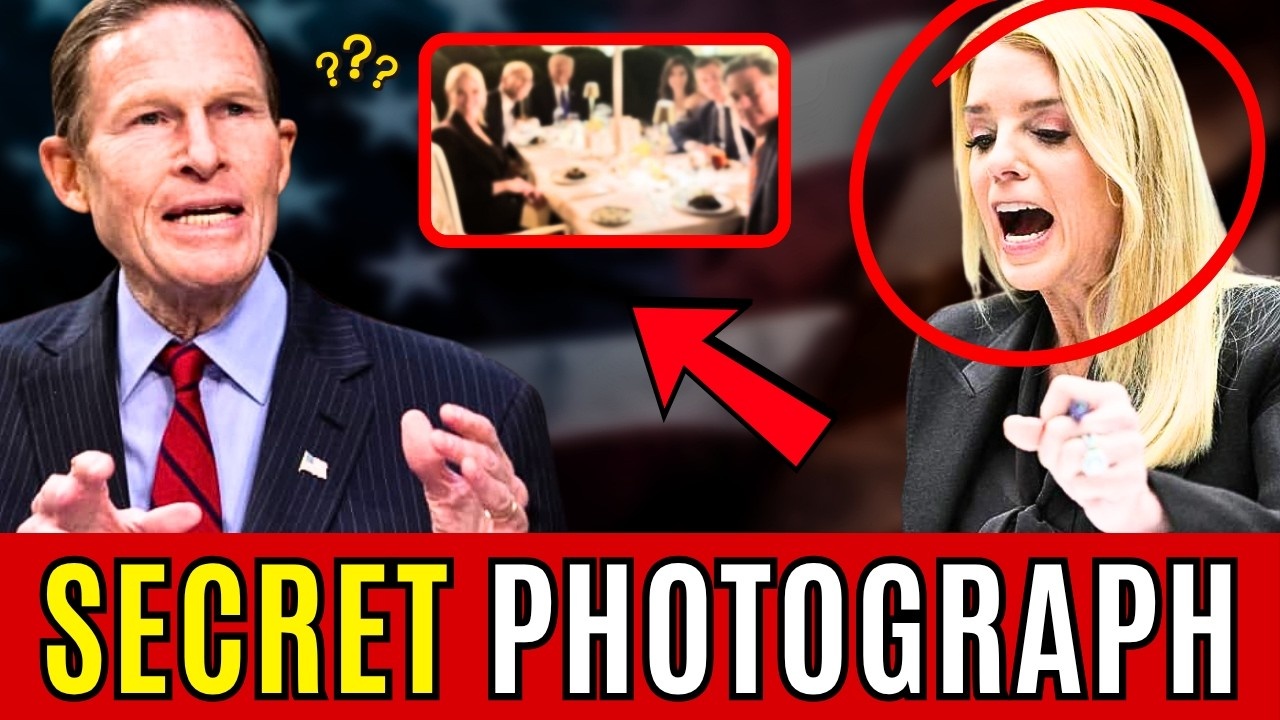
For a few tense minutes, the hearing stopped sounding like routine oversight and started sounding like a fight over whether the Justice Department can still convincingly claim independence.
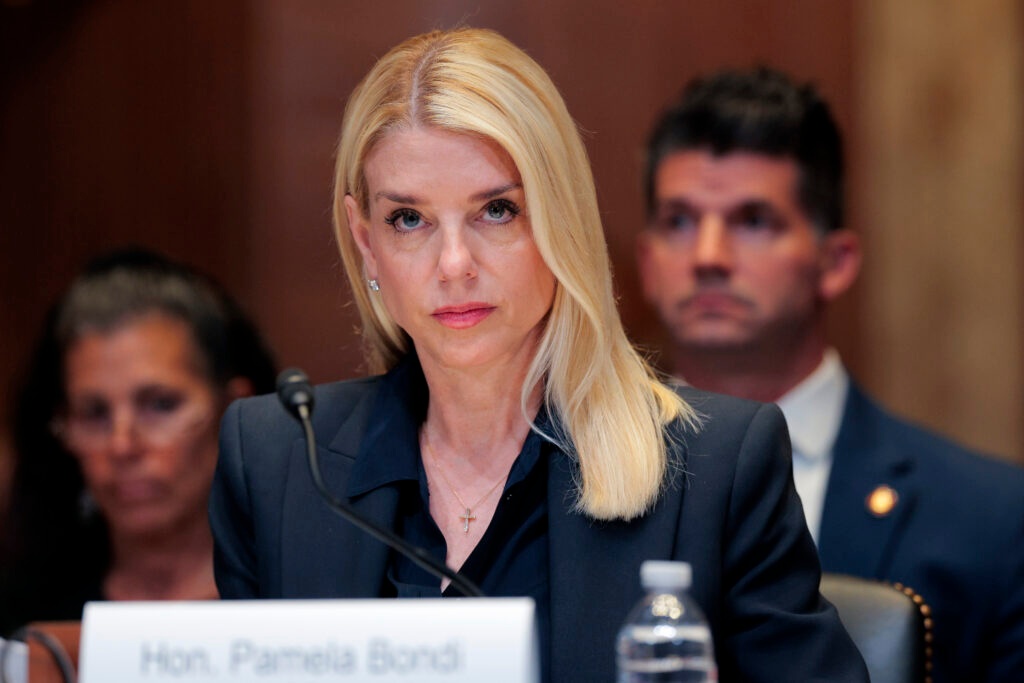
The confrontation centered on Attorney General Pam Bondi, Senator Richard Blumenthal, a White House dinner, and one question that refused to die no matter how many times it went unanswered.
Did she discuss James Comey with President Donald Trump the night before Comey was indicted.
That was the heartbeat of the exchange.
Blumenthal did not begin with the photograph, and that is exactly what made the moment more effective when he finally lifted it into view for the room.
First, he built a timeline.
He pointed to a Trump social media post from days earlier, describing it as a direct public demand for action against Comey and others, then pressed Bondi on whether she had spoken with the White House.
Bondi would not say yes.
She would not say no either, and that distinction became the entire battlefield because refusal, in a hearing like this, creates a silence that everyone rushes to interpret.
Instead of answering directly, she fell back on a line that would define her side of the exchange, saying she would not discuss conversations she had or had not had with the president.
That response was legally disciplined, politically familiar, and rhetorically frustrating all at once.
It did not resolve suspicion. It fed it.
Blumenthal understood that immediately, which is why he did not waste time arguing over the refusal as if one more question would suddenly unlock a clean admission.
He changed the frame.
That is when the photograph appeared.
A White House dinner, the night before Comey’s indictment, with Bondi visible in the image and the president sitting nearby, suddenly transformed a theoretical question into a visual scene.
That shift mattered because pictures do something raw to political arguments that transcripts alone often cannot.
A picture drags the audience into the room.
It does not prove what was said, but it makes people feel close enough to ask what might have been said, and that feeling can be more politically explosive than proof itself.
Blumenthal leaned into that effect.
He described the dinner, pointed to the president’s proximity, and asked again whether Comey had been discussed, this time with the image sitting between accusation and denial like a physical challenge.
Bondi’s first instinct was not to attack the photo.
She did something more interesting. She praised it. She called it a great picture, said she loved it, and then immediately tried to widen the scene by reminding the committee that many people were there.
That was not a random comment.
It was a deliberate effort to reduce the photo’s evidentiary power by turning what looked intimate on camera into something broad, official, and crowded in context.
In other words, Bondi’s answer was not really about the picture.
It was about shrinking the meaning Blumenthal wanted the picture to carry.
If the dinner was large, formal, and full of cabinet members, then the implied idea of a private operational conversation becomes harder to sell to the public.
That was her defensive line, even if she never spelled it out in those exact words.
Blumenthal would not let the context float.
He narrowed the focus to physical distance, saying the president had been sitting just to her left, a detail designed to make “crowded room” sound like a weak shield.
Bondi corrected him. Two seats down, she said.
That brief correction may have sounded minor, but in the logic of the hearing it was a crucial inch of ground.
One seat can sound intimate. Two seats can sound less direct.
In a confrontation built on inference, even the geography of a dinner table becomes contested political territory, because proximity is the raw material suspicion feeds on.
But after correcting the seating, Bondi still would not answer the underlying question.
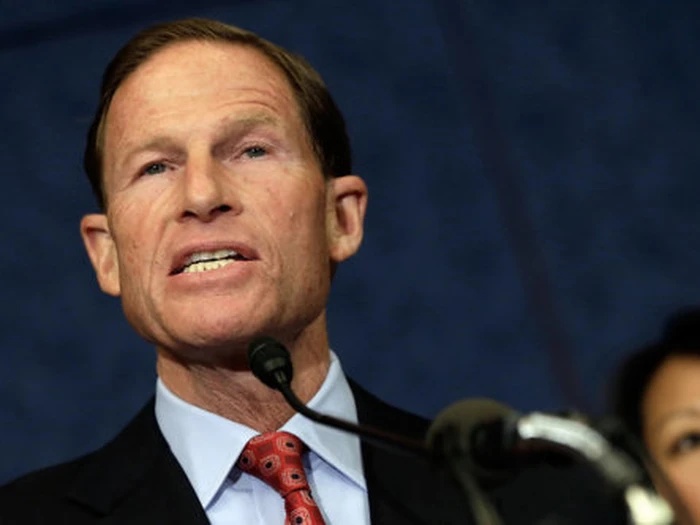
Again she refused to discuss any conversations she had or had not had with the president, and that repeated refusal became the loudest sound in the room.
Blumenthal then made the move that turned the exchange from interrogation into narrative.
He said he would take that as a yes.
That line landed hard because it was not a question, not a request, and not an accusation that needed immediate proof to become politically powerful.
It was a public conclusion drawn from a refusal, and those are the kinds of moments that spread fast because they feel decisive even when they remain unresolved.
That is why this hearing clip has the potential to trigger intense debate far beyond the committee room.
One side will see Blumenthal’s move as an aggressive but legitimate act of accountability, forcing the public to confront how often top officials hide behind non-answers when the stakes are highest.
The other side will see it as pure insinuation, turning silence into guilt and building a dramatic narrative out of a refusal that proves nothing on its own.
Both reactions are predictable, and both are politically useful to the people making them.
But the real reason the moment cuts so sharply is that it touches a nerve much deeper than one dinner or one indictment.
It taps into a larger fear that the public has about whether the machinery of justice can stay separate from the wishes, moods, and personal vendettas of presidents.
That fear is older than this hearing, older than Bondi, and older than Comey.
Americans have heard the phrase “no one is above the law” so many times that it now lands less like a principle and more like a test that institutions repeatedly struggle to pass.
Blumenthal made that tension central to the exchange by invoking Bondi’s own rhetoric back at her, pressing the contradiction between public ideals and present silence.
Bondi, to her credit or to her critics’ frustration, did not collapse under that pressure.
She countered by reaching for process rather than perception, pointing to the indictment mechanism itself and invoking the fact that a grand jury, not a presidential tweet, formally produced the charge.
That is an important distinction, and it deserves to be taken seriously.
A grand jury process and a political conversation are not the same thing, and proof of one does not automatically establish proof of the other.
But that legal distinction does not end the political question.
Blumenthal was not only asking how the indictment happened on paper. He was asking whether the White House tried to shape the climate around it, and whether Bondi would admit any direct conversation.
Those are different questions, which is why the two sides kept talking past each other without truly colliding on the same legal ground.
One was arguing about conversation. The other was arguing about procedure.
And when public trust is already shaky, that gap becomes toxic because each side sounds to its supporters like the only one telling the truth.
That is how hearing-room tension turns into viral political fuel.
You do not need a conviction, a document dump, or a smoking gun to create a social-media storm anymore. You need a visual, a refusal, a loaded timeline, and one sentence sharp enough to become a caption.
This exchange had all of it.
A White House dinner. A photo. A refusal to answer. A public declaration that the refusal would be treated as confirmation. That is not ordinary hearing content. That is algorithmic lightning.
It invites people to choose a side instantly.
Either Bondi was properly protecting executive confidentiality and refusing a political trap, or she was ducking a question the public has every right to hear answered in plain English.
That binary may oversimplify the truth, but oversimplification is exactly what makes moments like this spread.
And the spread matters because repeated public exposure changes the pressure around the underlying issue, even when the hearing itself resolves nothing in formal legal terms.
The picture now exists in public memory alongside the refusal.
The seating detail is now in the record. The timeline is now in the record. Blumenthal’s conclusion is now in the record. Bondi’s refusal is now in the record.
That is how political narratives harden.
Not always through proof, but through repetition, imagery, and the inability of institutions to offer answers that satisfy a public already primed to doubt them.
The deeper controversy is not only whether Comey was discussed at that dinner.
It is whether Americans still believe that when a president publicly attacks an opponent and the justice system moves soon after, the process can remain trusted without radical transparency.
That is the question hanging over this whole exchange, and it is why the moment feels bigger than the people in it.
Because once the public starts to suspect that silence is being used to protect power rather than preserve principle, every refusal sounds less like restraint and more like concealment.
That may or may not be fair.
But fairness is rarely what decides whether a political moment explodes online, dominates commentary, and keeps people arguing long after the hearing has ended.
What decides that is emotional clarity, and this moment had it.
One senator held up a photo. One attorney general refused to answer. One conclusion was drawn in real time, and now the country gets to fight over what that refusal really meant.
That is why this exchange will not disappear quietly.
Because in Washington, a non-answer can sometimes make more noise than an answer ever could, especially when a photograph freezes the question in place and refuses to let anyone look away.