It took one amendment, two lines, and a single close reading to turn a routine Senate markup into a confrontation that instantly felt bigger than the bill on the table.
What began as a discussion over an anti-opioid measure suddenly became a fight over transparency, trust, and the political aftershock that still follows the name Jeffrey Epstein.
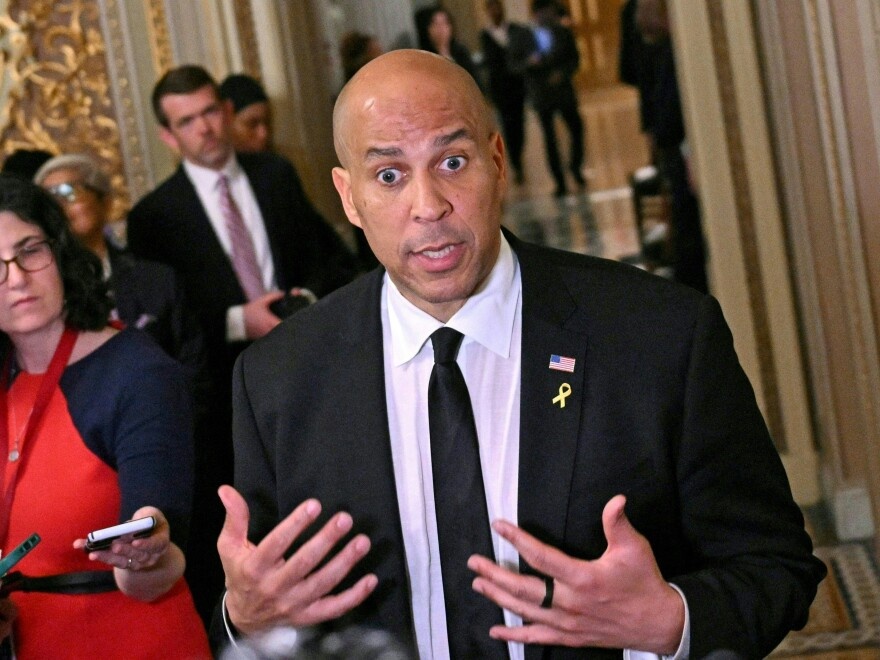
The room did not erupt all at once.
There was no dramatic entrance, no theatrical reveal, no shouting from the opening minute, which is exactly why the shift felt so powerful when it finally came.
One senator looked down at the first two lines of a fresh amendment and argued that the real purpose had been buried in plain sight.
That accusation changed everything.
Until that moment, the debate looked like a standard policy disagreement wrapped in legislative language, the kind of argument Washington produces every day and forgets by sunset.
Then those two lines were read as something else entirely, not a technical revision, not a neutral procedural edit, but a direct attempt to kill a demand for transparency.
And once that interpretation entered the room, the air got heavier.
Suddenly the argument was no longer just about an anti-opioid bill or how best to move bipartisan legislation across the finish line. It was about motive, accountability, and what lawmakers may not want the public to see.
That is why the exchange hit so hard.
The senator challenging the amendment did not frame the moment as a minor drafting disagreement. He framed it as an effort to quietly strip away a simple request for public disclosure.
In his telling, the amendment’s real target was not immigration policy, not criminal penalties, and not the broader legislative language being discussed around it.
Its target was transparency on Epstein-related records.
That is the kind of claim that instantly electrifies a room because Epstein remains one of the few subjects in American politics that still carries bipartisan suspicion, public obsession, and relentless online energy.
People may disagree on almost everything else, but once the Epstein files are mentioned, the temperature rises fast.
The senator leaned directly into that reality.
He reminded the room that Epstein is dead, but his victims are not, a line that reframed the debate away from political tactics and toward moral urgency.
He spoke about women whose lives were scarred by horrifying abuse and invoked public statements suggesting there was substantial evidence tied to crimes and potential co-conspirators.
And then came the question that hung over the entire exchange.
If there is evidence, if top law enforcement officials have publicly suggested there is a serious factual record, then why would anyone resist more transparency about what happened.
That question landed because it did not sound fringe.
It sounded like the question millions of Americans already ask whenever this case returns to the headlines, which is exactly why the moment felt designed to travel far beyond the hearing room.
The deeper force of the clash came from public distrust that has been building for years.
For many Americans, the Epstein story has never felt fully resolved, not legally, not morally, and certainly not politically, because too many names, too many rumors, and too many missing pieces still hang in the air.
That does not mean every rumor is true.
It does mean the atmosphere is combustible, and any move that appears to slow disclosure immediately looks suspicious to people already convinced that powerful interests are being protected.
That is why the words “What are you afraid of” hit with such force.
The line was not just directed at one amendment or one senator. It was aimed at the larger system of hesitation surrounding this story, the feeling that even now, years later, the truth is still being managed.
The pushback came quickly.
The senator on the other side did not accept the premise that the amendment was some secret operation against truth. Instead, he said he trusted the Senate-confirmed attorney general to decide what can legally be released.
That response matters because it reveals the central split in the debate.
One side believes transparency itself is the path to restoring trust, while the other argues that criminal files, victim protections, and legal limits cannot be dictated through political pressure attached to unrelated legislation.
That is a serious argument, and not an invented one.
There are legitimate concerns in any sensitive case about privacy, redactions, victim protection, due process, and whether lawmakers should force disclosures through procedural maneuvers instead of lawful review.
But the problem is that legal caution sounds very different in a climate where the public already suspects concealment.
In that environment, restraint can look like protection.
Procedure can look like stalling.
And silence can look like guilt, even when no formal proof has yet been shown to the public.
That is exactly why the exchange escalated so fast when the focus shifted from Epstein victims to other victims of violent crime.
The debate became personal almost instantly.
One senator asked whether the other cared about mothers who lost their children to crimes committed by people who should never have been in the country. Names were invoked. Grief was invoked.
The room changed at once.
What had been a sharp procedural dispute became a moral confrontation over who gets to claim the mantle of standing with victims and who gets accused of selective empathy.
That kind of move is politically potent because it forces the other side into a defensive posture, even if the original issue had nothing to do with denying those victims compassion.
The response came with visible anger.
The senator under attack said he would never question whether his colleague cared about victims of a heinous crime, and he made clear that he found the implication offensive and unfair.
That was the point where decorum started to crack.
Interruptions multiplied, voices sharpened, and the chairman had to intervene as the discussion drifted further away from legislative wording and deeper into motive, sincerity, and accusation.
This is where the moment stopped being a markup and started becoming content tailor-made for the modern internet.
Because the internet does not reward subtle legislative nuance. It rewards emotional collision, moral framing, and clips that can be shared with a caption strong enough to split audiences instantly.
This exchange had all of it.

It had victims, suspicion, a famous scandal, accusations of hiding the truth, outrage over sincerity, and a bipartisan bill suddenly cast as collateral damage in a larger war over public trust.
That underlying bill is crucial to understanding the scale of the blowup.
The measure being marked up was an anti-opioid bill, the kind of legislation built around a practical crisis that affects communities across the country and is supposed to attract bipartisan support.
In theory, this should have been the sort of issue both parties could move forward together without setting the room on fire.
Instead, it became the staging ground for one of the most emotionally charged debates in modern American politics.
That is part of what made the fight feel so revealing.
If even a bipartisan bill about opioids can be derailed or endangered by the unresolved fury around Epstein transparency, then this issue is not fading, not cooling, and not staying contained.
It is expanding into everything it touches.
The chairman warned that attaching Epstein-related conditions could stall the underlying legislation or prevent it from taking effect, which gave opponents of the amendment a practical argument, not merely a political one.
Pass the bill now, they argued, and keep fighting about Epstein elsewhere.
On paper, that sounds reasonable.
In practice, it failed to calm the room because the other side no longer trusted that “elsewhere” would lead to anything real. When trust collapses, delay stops sounding procedural and starts sounding strategic.
Then another layer surfaced, funding.
The senator pressing for transparency said his state had been treated unfairly in the distribution or clawback of opioid-related resources and suggested that if those concerns were seriously addressed, the standoff might be postponed.
Now the conflict had widened again.
This was no longer only about Epstein files or legislative sequencing. It was also about state-level fairness, resource allocation, and the bitter suspicion that power gets negotiated selectively behind the scenes.
That kind of expansion is what makes a hearing clip catch fire online.
People do not just see a policy disagreement. They see a whole ecosystem of distrust surfacing at once, from hidden motives to unequal treatment to public demands that never seem fully answered.
A compromise was proposed. One amendment would be withdrawn if the other disappeared too, clearing the way for the opioid bill and postponing the fight.
But the refusal to back down made the real message unmistakable.
This was not a temporary misunderstanding. This was a test of whether transparency demands would be pressed immediately or pushed off again into some later battle that might never come.
That is why this moment matters far beyond one committee session.
It exposed two radically different views of accountability in modern Washington. One side sees sunlight as the only path left to restore trust in a case that still haunts the public imagination.
The other sees politically loaded disclosure demands as a danger to process, victim privacy, legal integrity, and unrelated legislation that could save lives.
Both arguments carry force.
But only one of them matches the emotional state of the public right now, and that is the argument rooted in distrust. Americans are not calm about this subject. They are not patient.
They do not hear “trust the process” the way they once might have.
They hear distance, delay, and another attempt to keep the public one step removed from a story many already believe has never been fully told.
That is why two lines were enough to ignite such a fierce reaction.
Not because the language itself was dramatic, but because the moment tapped directly into a larger fear, that when transparency gets close, someone always finds a way to move it aside.
And until the public feels it has the full story, that suspicion will keep growing, keep spreading, and keep turning ordinary hearings into cultural flashpoints.
The vote may move on. The bill may move on. The senators will move on to the next procedural fight.
But the deeper tension will remain.
Because once people believe an amendment was written to hide the real issue, they stop seeing legislative language as technical and start seeing it as camouflage.
That is when trust breaks.
And when trust breaks around a scandal this infamous, even an opioid bill can become a battlefield, even two lines can become a weapon, and even a routine Senate markup can explode into a national argument that refuses to die.