2.8 BILLION WATCHING: Jon Stewart, Trevor Noah, Stephen Colbert & Jimmy Kimmel Abandon Late Night to Launch a ‘Truth Program’ That’s Shaking the Definition of News
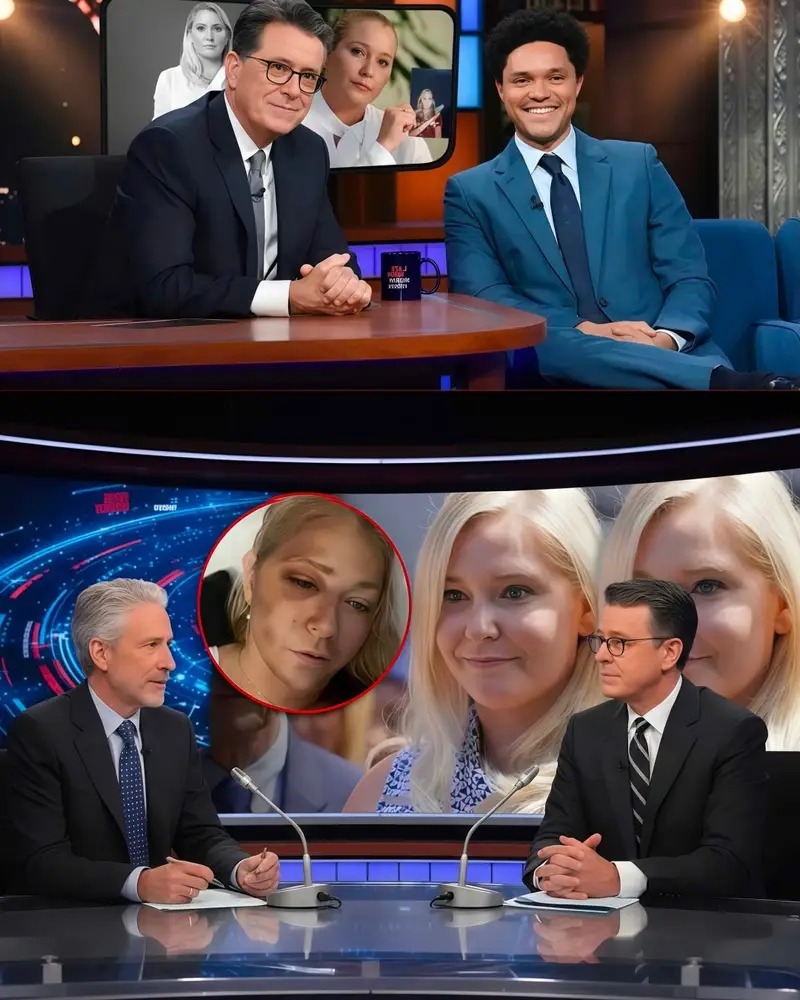
Comedy has always flirted with truth. Now, it is demanding custody of it.
In a move that stunned the entertainment industry and rattled the foundations of traditional media, four of the most recognizable satirical voices in America—Jon Stewart, Trevor Noah, Stephen Colbert, and Jimmy Kimmel—have stepped beyond the velvet rope of late-night television and into something far more volatile.
They are calling it the “Truth Program.”
There were no trailers. No press tour. No carefully staged network announcement. No corporate sponsors eager to attach their logos to the spectacle. What began as whispers about a “routine suspension” quietly escalated into a revelation that would force these titans of satire to do the unthinkable: abandon the very systems that made them powerful.
Rivalries dissolved overnight. Network loyalties evaporated. Contracts became secondary.

And within hours of its surprise debut, more than 2.8 billion viewers worldwide had tuned in across digital platforms, livestream mirrors, and independent broadcasts. In a fragmented media landscape where attention is currency and trust is scarce, that number is more than impressive—it is seismic.
When Comedy Stops Asking for Permission
For decades, Stewart, Noah, Colbert, and Kimmel operated within the boundaries of late-night tradition. Each, in his own way, blurred the line between humor and journalism.
Stewart turned satire into civic therapy.
Noah reframed American politics through a global lens.
Colbert perfected irony so sharp it cut through spin.
Kimmel weaponized vulnerability and outrage in equal measure.
But they were still, technically, entertainers.
Their monologues lived between commercial breaks. Their investigations were punctuated by applause signs. Their critiques—however biting—were filtered through corporate oversight, advertiser sensitivity, and network risk assessments.
The “Truth Program” obliterates those filters.
No applause cues. No executive notes. No safe timing. No network disclaimers.
Instead, the four hosts sit at a stark, undecorated desk—together. No studio audience. No laugh track. Just documents, clips, interviews, and questions. Hard ones.
And they are not playing characters.

The Moment That Changed Everything
At the center of this unprecedented alliance lies a departure—initially dismissed as routine. A suspension. A quiet removal. The kind of industry reshuffling that rarely makes headlines.
But something about it didn’t add up.
Sources close to the hosts suggest that as details began to surface—internal communications, editorial pressure, stories spiked without explanation—a pattern emerged. Stories that threatened powerful interests were quietly redirected. Segments that questioned institutional narratives were softened. Investigations were delayed, then buried.
Individually, each host had experienced moments of friction. Collectively, they began to see a structure.
This was not censorship in its loudest form. It was something subtler. More insidious.
Silence by design.
The “Truth Program” was born not from outrage alone, but from realization: that satire had become one of the last places where uncomfortable truths could still breathe—and even that space was narrowing.
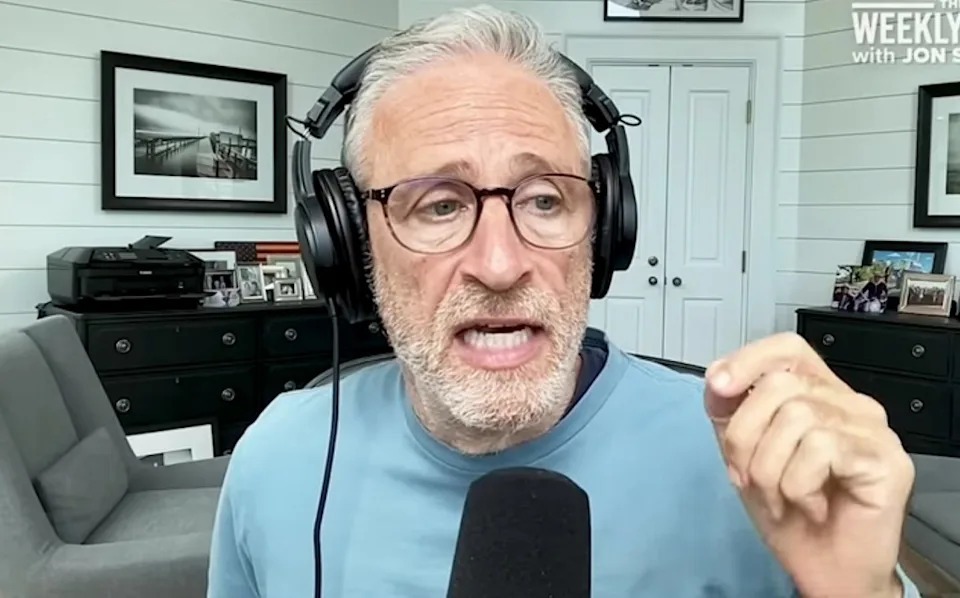
A Media Reckoning in Real Time
What makes this project extraordinary is not simply its scale or star power. It is its intent.
This is not comedy as commentary.
It is comedy as confrontation.
Each episode dissects a single topic—media ownership consolidation, political lobbying, algorithmic influence on public opinion, conflicts of interest in corporate reporting. The hosts move beyond punchlines into documentation. They connect timelines. They display receipts.
They also laugh.
But the laughter feels different. It lands heavier. Sharper.
When Stewart leans forward and asks, “Since when did asking questions become partisan?” it no longer feels like a joke. When Colbert raises an eyebrow at a contradiction between public statements and internal memos, the silence that follows is deliberate. When Noah contextualizes American narratives within global patterns of media control, the room feels smaller. When Kimmel speaks plainly—without irony—about fear inside newsrooms, it feels personal.

The result is something unfamiliar yet strangely nostalgic: journalism with teeth, delivered by men once dismissed as clowns.
Why Risk Everything?
The obvious question looms: Why would four established figures—each with wealth, security, and influence—risk reputations, relationships, and careers on a platform no network dared to endorse?
The answer may lie in credibility.
In recent years, trust in traditional news institutions has eroded dramatically. Audiences feel overwhelmed by information yet undernourished by clarity. Headlines compete with viral clips. Outrage cycles replace sustained inquiry.
Late-night satire stepped into that vacuum years ago, becoming a gateway for younger audiences to engage with politics and current events. But satire, by definition, leans on exaggeration. It comments on the news—it does not replace it.
The “Truth Program” appears to reject that boundary.

If traditional journalism has become constrained by access, advertising, and ownership structures, then perhaps those outside its formal architecture are freer to question it.
But freedom comes at a cost.
There are no legal shields provided by major networks. No public relations teams smoothing backlash. No boardrooms absorbing political pressure. Every claim must be airtight. Every document verified. Every allegation defensible.
The hosts seem acutely aware of this.
Which may be precisely why they moved together.
An Unlikely Newsroom
The chemistry between Stewart, Noah, Colbert, and Kimmel is unexpectedly restrained. Gone are the competitive monologues and ratings battles. In their place: something closer to a roundtable.
They disagree at times. They challenge each other. They clarify. They concede.
It resembles not a performance, but a newsroom.

Could this unlikely alliance evolve into the kind of journalistic institution the public has been searching for—one unafraid to question power, expose silence, and redefine accountability?
That possibility is what terrifies critics and excites supporters.
Because if comedians can command billions of viewers to watch long-form investigative discussions, what does that say about the state of traditional news?
Redefining “News”
The most radical aspect of the “Truth Program” is not its content—it is its challenge to definition.
For generations, “news” has been framed as objective reporting delivered by accredited institutions. Comedy was ancillary. Commentary was supplemental. Analysis followed reporting.
But in an era where corporate ownership shapes coverage priorities and algorithms determine visibility, audiences are increasingly skeptical of institutional neutrality.
The four hosts are not claiming objectivity.
They are claiming transparency.

They openly state their perspectives. They show their sourcing process. They acknowledge uncertainty where it exists. They correct themselves publicly.
In doing so, they are experimenting with a hybrid model: investigative rigor fused with conversational candor.
It feels less like being told what happened and more like being invited into the process of understanding it.
Backlash and Applause
Unsurprisingly, reactions have been polarized.
Supporters hail the project as a necessary disruption—a reminder that journalism’s core mission is accountability, not comfort.
Critics argue that entertainers stepping into investigative territory blurs lines dangerously. They warn of spectacle masquerading as substance, of personality overshadowing precision.
But perhaps the most telling response is the viewership itself.
2.8 billion people do not gather out of idle curiosity.
They gather when something feels urgent.
The End of Late Night?
It would be premature to declare the death of traditional late-night television. The format has survived wars, scandals, technological shifts, and cultural revolutions.
Yet something fundamental has shifted.

Late night once provided catharsis at the end of the day—a space to laugh at chaos before sleep. The “Truth Program” denies that comfort. It lingers. It unsettles. It demands follow-up.
This is no longer entertainment designed to close the evening.
It is programming designed to open questions.
A Defiant Experiment
Whether the “Truth Program” becomes a lasting institution or a brief, explosive chapter in media history remains uncertain. Sustaining independence at that scale will test legal, financial, and personal limits.
But its mere existence signals a broader reckoning.
In a world saturated with information yet starved for trust, audiences are not merely consuming content—they are searching for courage.
Stewart, Noah, Colbert, and Kimmel have wagered their legacies on the belief that truth, delivered without corporate insulation, still matters.
They are no longer just defending free speech.
They are interrogating the architecture that defines it.
And as billions watch, one uncomfortable question echoes across studios, boardrooms, and newsrooms alike:
If the sharpest truth-tellers in comedy felt compelled to step outside the system to speak freely—what does that reveal about the system itself?
This is not late-night television.
It is not satire.
It is not safe.
It is a reckoning—and the audience is wide awake.